
The month my salary went up by forty percent, I was certain this was the year I would finally get ahead. Twelve months later I sat down to see what I had actually saved, and the number was almost exactly what I had saved the year before. That is lifestyle inflation, and it is the most expensive habit most of us never notice we have.
Nothing had gone wrong. There was no emergency, no crash, no bad investment. I could not even point to a single decision I regretted.
A better apartment, because the commute was killing me. A car I had spent two years telling myself I would buy “when I could afford it.” Dinners out on weekdays instead of only on Saturdays. Each one, on the day I decided it, felt completely reasonable. Each one was permanent.
That is the part that took me years to understand. The raise was temporary news. The spending was a standing order.
What Lifestyle Inflation Actually Is
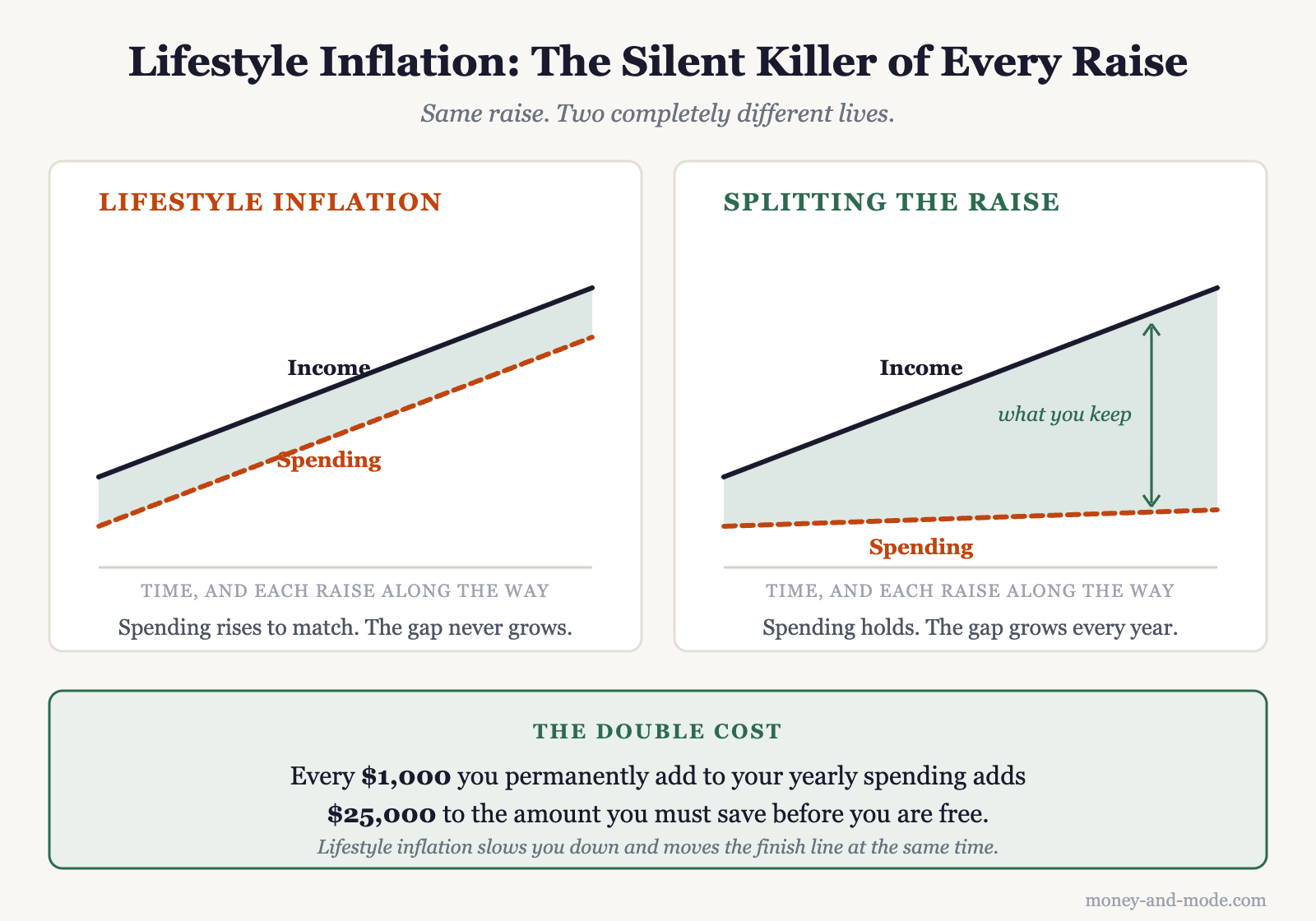
Lifestyle inflation — sometimes called lifestyle creep — is the habit of raising your spending every time you raise your income, so that the gap between the two never grows.
You earn more. You spend more. You feel roughly the same.
It is not stupidity and it is not weakness. It is the most natural response in the world. You worked hard, the money arrived, and there is a genuinely long list of small frictions in your life that money can remove. Removing them feels like the whole point of earning more.
The trouble is arithmetic. Wealth is not built by what you earn. It is built by the gap between what you earn and what you spend. Lifestyle inflation is the thing that quietly closes that gap every time it opens.
The Arithmetic That Should Be Taught in Schools
Take someone earning $70,000 who saves $10,000 a year. Their savings rate is about 14%.
They get a raise to $90,000 — a genuinely good raise, the kind you celebrate. If they keep their spending exactly where it was, they now save $30,000 a year. Their savings rate triples to 33%, and the date they become financially independent moves closer by more than a decade.
If instead they let their spending rise to match — new apartment, upgraded car, a slightly better version of everything — they still save $10,000. Their savings rate has actually fallen to 11%. They earn twenty thousand dollars a year more and are, in the only sense that matters, further from freedom than they were before.
Same raise. Two completely different lives. The difference isn’t income. It’s what happened in the ninety days after the money arrived.
This is exactly why I argued in The Only Number That Determines Your Financial Freedom that your savings rate — not your salary — is the number to watch. Lifestyle inflation is the mechanism by which a rising salary produces a falling savings rate. It is the specific way that number gets destroyed.
The Double Damage Nobody Warns You About
Here is the part that genuinely shocked me when I first worked it out.
Lifestyle inflation does not just slow you down. It moves the finish line away from you at the same time.
The amount you need to stop working is a multiple of what you spend, not what you earn. Under the rule I explained in The 4% Rule Explained, you need roughly 25 times your annual spending saved before your money can support you.
So every $1,000 you permanently add to your yearly spending adds $25,000 to the amount you must accumulate.
Think about that with a real number. A $500-a-month upgrade — a nicer car, a bigger place, a rung up on any ladder — is $6,000 a year.
That single decision adds $150,000 to your target. Not to your spending. To the pile you need before you are free.
You are running toward a line, and each upgrade takes the line and moves it further away, permanently, while you are still running.
Why Lifestyle Inflation Is So Hard to See
Three things make this almost invisible while it is happening.
It arrives one reasonable decision at a time. Nobody wakes up and decides to inflate their lifestyle. They decide to fix one specific annoyance. The pattern only exists in aggregate, and you never see the aggregate.
Every upgrade stops feeling like an upgrade. Psychologists call this hedonic adaptation, and the everyday name for it is the treadmill.
The better apartment is thrilling for about six weeks. Then it is simply where you live, and the next thing that would make you happy is one more step up. You paid a permanent price for a temporary feeling — and I have paid it more than once.
Spending ratchets. This is the cruellest part. Spending goes up smoothly and comes down only with real pain.
Nobody notices when you move to a better place. Everybody notices when you move back. Going up costs money; coming down costs money and pride. That is why the upgrade you make at 35 is usually still with you at 50.
I watched this happen to people around me for twenty-five years in the software business. I saw engineers whose salaries tripled across a decade — genuinely, three times the money — and whose net worth barely moved. Not one of them was foolish. Their spending had simply kept perfect pace, the whole way up.
As I wrote in The Psychology of Money, being smart offers almost no protection here. If anything, a good income buys you a longer runway on which to make this mistake.
How to Stop Lifestyle Inflation: Decide Before the Money Arrives
The only method I have ever seen work is embarrassingly simple, and its power is entirely in the timing.
Split the raise before you ever see it.
When more money is coming — a raise, a bonus, a client, a loan finally paid off — decide the split in advance. Something like half to savings and investments, half to your life. Then make the savings half automatic on the day the money starts arriving, so it never touches your current account and never becomes visible.
The timing is not a detail. It is the whole trick. You are not fighting temptation; you are arranging never to meet it.
Money you never see is astonishingly easy not to spend. Money that sits in your account for three weeks has already been mentally spent on something.
And you still get the raise. You get to feel it. You are simply keeping half of it instead of none.
Two more things that make this hold:
Separate one-time from recurring. A holiday is one-time. A bigger apartment is a decision you re-make every month for years, without ever being asked again.
Be generous with the first kind and slow with the second. Most of the damage lives in the recurring column.
Upgrade one thing at a time. When a raise comes, pick a single thing to improve. Then wait a year. The waiting does something odd and useful: about half the things on the list stop mattering while you wait, and you find out which half.
Whatever you do keep, put it somewhere boring and automatic — for most people that means a low-cost index fund — and then stop thinking about it.
The Spending Worth Inflating
I want to be careful here, because there is a version of this advice that turns into a joyless life, and I do not believe in it.
The goal is not to spend nothing. Money is genuinely useful. Some of the best purchases of my life were things I paid real money for: time with family, health that I stopped postponing, a shorter commute during the years my sons were small, a doctor’s opinion I did not delay because of cost.
The distinction that matters is not cheap versus expensive. It is chosen versus drifted into.
Lifestyle inflation is what happens by default when you do not choose. It fills the space money makes, automatically, with whatever is nearest — usually a slightly better version of something you already had and had stopped noticing.
Deliberate spending is different. You picked it. You know what it cost you in years of working. You would pick it again.
So the question is never “am I spending too much?” It is: If this had to be the one thing I upgraded this year, would it still be this?
Most of the time, the honest answer is no. And that answer, asked before the money arrives rather than after, is worth more than any raise you will ever be given.
Frequently Asked Questions
What is lifestyle inflation?
Lifestyle inflation — sometimes called lifestyle creep — is the habit of raising your spending every time you raise your income, so the gap between the two never grows. You earn more, you spend more, and you feel roughly the same. It is not weakness. It is the most natural response in the world, and it is why a bigger salary so often produces the same bank balance.
Why does a raise never make me feel richer?
Because wealth is built by the gap between what you earn and what you spend, not by the earning alone. Someone on $70,000 saving $10,000 has a 14% savings rate. Raised to $90,000 with spending held flat, they save $30,000 — a 33% rate. Let spending rise to match and the rate falls to 11%, despite earning $20,000 more.
How much does lifestyle inflation actually cost?
It costs you twice. It slows your saving and it moves your finish line at the same time. Because financial independence needs roughly 25 times your annual spending, every $1,000 you permanently add to your yearly spending adds $25,000 to what you must accumulate. A $500-a-month upgrade adds $150,000 to your target.
How do I stop lifestyle inflation?
Split the raise before you ever see it. When more money is coming, decide the split in advance — say half to savings, half to your life — and make the savings half automatic from the first day, so it never touches your current account. You are not fighting temptation; you are arranging never to meet it.
Is it wrong to ever upgrade your lifestyle?
No — the goal is not to spend nothing. The distinction that matters is not cheap versus expensive, it is chosen versus drifted into. Lifestyle inflation is what fills the space money makes when you do not choose. Ask whether, if this had to be the one thing you upgraded this year, it would still be this.
What was the last upgrade you made that you’d genuinely choose again — and what was the one that quietly became permanent before you noticed? I’d love to hear both in the comments.