
I’ve known brilliant people who can’t manage money to save their lives.
One of my earliest employees had a PhD in computer science. He was sharper than me on almost every technical problem we faced. He also lived paycheck to paycheck well into his forties, despite a six-figure salary, because he couldn’t stop upgrading his lifestyle faster than his income grew — the fastest way to destroy a healthy savings rate.
Intelligence and financial success are only weakly correlated. This confused me for years. It shouldn’t have.
The brain has built-in bugs when it comes to money. Knowing they exist is the first step to overriding them.
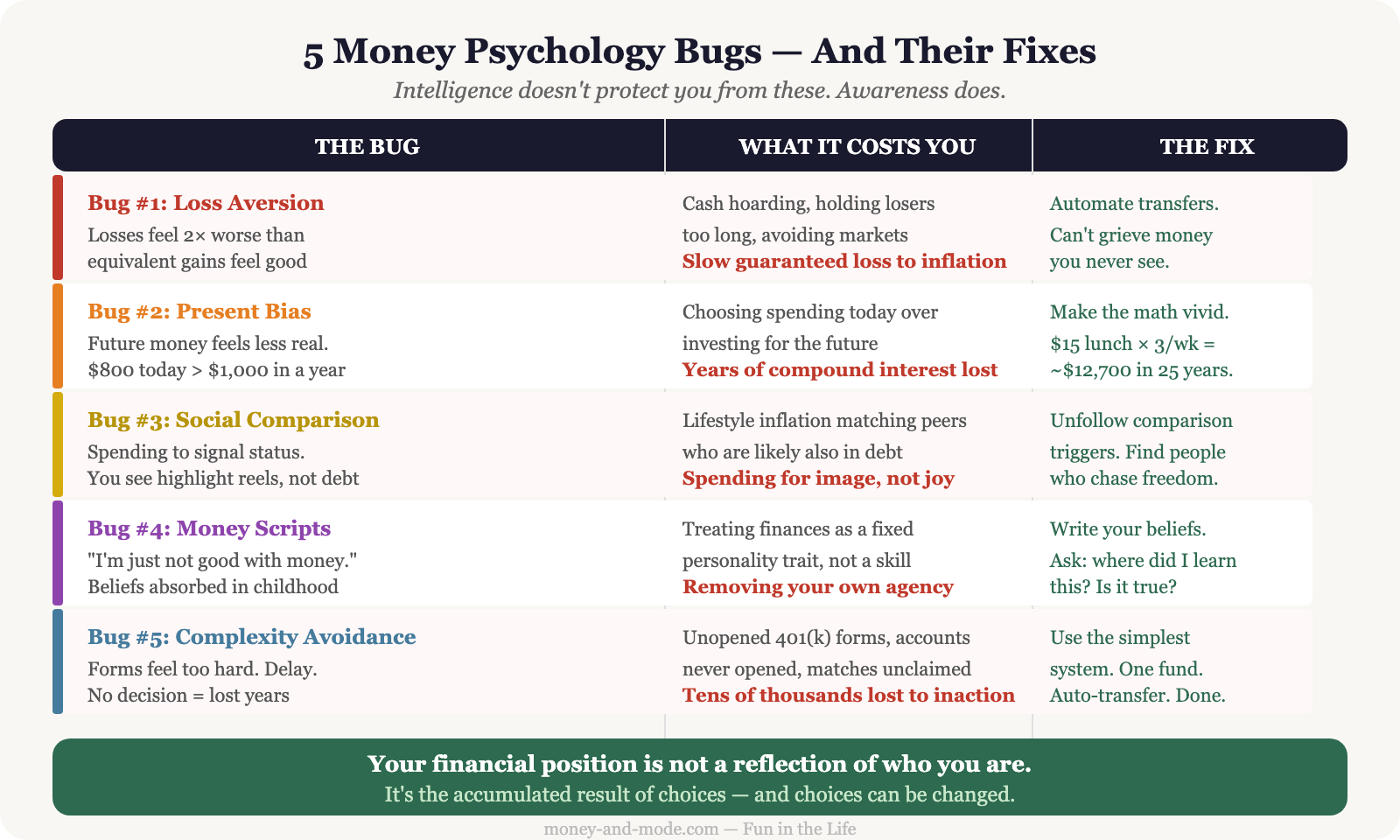
Bug #1: Loss Aversion
Decades of behavioral research — most famously by psychologists Daniel Kahneman and Amos Tversky — established something uncomfortable about how humans experience money: we feel losses roughly twice as intensely as equivalent gains.
Losing $1,000 hurts about twice as much as gaining $1,000 feels good. Mathematically, those are the same amount. Emotionally, they are not even close.
This bug causes two classic financial mistakes.
The first: we avoid investment risk by keeping money in cash or savings accounts “to be safe.” The money is guaranteed. It won’t drop 20% in a bad market year. But it also won’t grow fast enough to outpace inflation, and it will never build real wealth. The avoidance of a painful loss leads to the slow certainty of falling behind.
The second: we hold losing investments too long. Selling a stock that’s down 30% means realizing the loss — making it feel real and permanent. So we hold on, hoping it comes back. Meanwhile, the money is trapped in a bad investment when it could be working elsewhere. The brain prefers painful hope to painful certainty.
The fix: automate your investments through payroll contributions or auto-transfers. When you never see the money in your checking account, the transfer doesn’t feel like a loss. Your brain can’t grieve what it never held.
Bug #2: Present Bias
Here’s a question. Would you rather have $800 today, or $1,000 in exactly one year?
Most people take the $800. Mathematically, waiting for $1,000 represents a 25% annualized return — better than almost any investment available. But the brain heavily discounts future money. Today’s $800 feels more real, more certain, more now.
Psychologists call this present bias or hyperbolic discounting. We value the present far more than the future, even when the math clearly favors waiting.
This is why saving feels like deprivation. You’re trading something you could have today — a dinner out, a better phone, a nicer car — for an abstract future benefit that your brain can barely imagine. Your future self feels like a stranger. And most people don’t sacrifice much for strangers.
The fix: make the future vivid and the math tangible. Run the compound interest calculation on your daily or weekly spending habits. If you spend $15 on lunch out three times a week, that’s $2,340 per year. Invested at 7% real returns over 25 years, that $2,340 is roughly $12,700. Not per year — that’s what just one year’s lunch spending would grow to. Over 25 years of lunch habits, the number becomes staggering.
I’m not saying don’t buy lunch. I’m saying making the math concrete changes how the present and future feel in comparison. Your brain responds to vivid numbers.
Bug #3: Social Comparison
We are a deeply social species, and our spending is partly a social signal.
The car you buy, the house you choose, the vacation you post about — these are not purely functional decisions. They are, at least in part, communications to your peer group about your status, your success, your taste. This was adaptive in small communities where social status translated to survival advantages. It is expensive and largely meaningless in modern suburban America.
The problem is that your peer group is always spending more than you. Or at least it looks that way. Social media has turbocharged this by making everyone’s best moments — the vacation, the new kitchen, the event — perpetually visible. You see the highlight reel, not the credit card bill that funded it.
I went through a version of this in my early thirties, shortly after my first exit. I had more money than I’d ever had, and I found myself looking at what other successful people appeared to own and wondering if I was keeping up. It took a few years to genuinely stop caring. The freedom that came from exiting that competition was worth more than any of the things the competition was about.
The fix: deliberately reduce your exposure to peer spending signals. Unfollow accounts that trigger comparison. Redefine your reference group — find people who optimize for financial independence rather than visible consumption. They exist. They’re usually quieter, less on Instagram, and measurably less stressed.
Bug #4: Money Scripts
Financial therapist Brad Klontz developed the concept of money scripts — unconscious beliefs about money that we absorb in childhood and carry into adulthood without examining them.
Common ones: – “Money is the root of all evil.” – “Rich people are greedy and selfish.” – “I’m just not good with money.” (This one is particularly insidious because it removes agency — it makes your financial situation feel like a fixed trait rather than a pattern of choices.) – “Talking about money is rude or shameful.” – “There’s never enough.” – “More money will finally make me happy.” (The opposite of “money doesn’t buy happiness” — both are oversimplifications.)
These beliefs were often formed watching your parents’ relationship with money. If money was always a source of conflict and stress in your home, you may have absorbed the belief that money itself causes suffering — and unconsciously avoid accumulating it. If you watched a parent get rich and become someone your family didn’t like, you may have a deep resistance to wealth that you’ve never consciously examined.
The fix: name your money scripts explicitly. Write down the things you believe about money — all of them, even the ones that seem obvious or embarrassing. Then ask: where did I learn this? Is it actually true? Does it serve me?
This isn’t therapy (though therapy helps). It’s just the discipline of examining your inherited assumptions rather than running on autopilot.
Bug #5: Complexity Avoidance
This one is underrated and extremely common.
Financial decisions feel complicated. The 401(k) enrollment form has twelve investment options and no clear guidance. The tax implications of a Roth IRA vs. a traditional IRA take real thinking. The brokerage account application asks questions you don’t know how to answer.
So people delay. The form sits on the desk. The account never gets opened. The decision feels too important to make incorrectly, so it never gets made at all.
And in the meantime, years pass. Years of compound interest that were never earned. Years of employer 401(k) matches that were left on the table. Real money — tens of thousands of dollars in some cases — lost not to bad decisions, but to no decision.
The fix: use the simplest possible financial system. One brokerage account. One or two index funds. One automatic transfer on payday. Complexity is the enemy of action. You do not need an optimized portfolio. You need a working portfolio. A simple portfolio you stick with for thirty years beats a perfect portfolio you never build.
The Deepest Money Belief
Here’s the most dangerous money belief I’ve encountered — in myself and in others.
The belief that your current financial position is somehow fixed. That it reflects who you are, rather than the decisions you’ve made.
It doesn’t.
Every financial position is the result of accumulated choices — including whether you chased shortcuts that were never really passive: what you earned, what you spent, what you saved, how you invested or didn’t. Those choices compound over time, and they can be changed. Not overnight. Not without real effort. But they are choices, not fate.
The moment you stop seeing your finances as a reflection of your worth or your destiny — and start seeing them as a system you can learn to manage — is the moment real change becomes possible.
That shift happened for me not when I made my first million, but years before, when I started understanding money as a skill rather than a personality trait.
Frequently Asked Questions
Why do smart people stay broke?
Because intelligence and financial success are only weakly correlated. The brain has built-in bugs when it comes to money, and being sharp does not disable them. One of my earliest employees had a PhD in computer science and still lived paycheck to paycheck into his forties on a six-figure salary, because he upgraded his lifestyle faster than his income grew.
What is loss aversion and how does it hurt investors?
We feel losses about twice as intensely as equivalent gains — research established by Daniel Kahneman and Amos Tversky. That causes two mistakes: hoarding cash to feel safe, which never outpaces inflation, and holding losing investments too long because selling makes the loss feel permanent. The fix is to automate investing, so your brain cannot grieve money it never held.
Why does saving feel like deprivation?
Present bias. The brain heavily discounts future money, so today’s dinner out feels more real than an abstract future benefit — your future self feels like a stranger, and people do not sacrifice much for strangers. The fix is making the math vivid: $15 lunches three times a week is $2,340 a year, which at 7% real returns becomes roughly $12,700 over 25 years.
What are money scripts?
Unconscious beliefs about money absorbed in childhood and carried into adulthood unexamined — a concept developed by financial therapist Brad Klontz. Common ones include “money is the root of all evil” and “I’m just not good with money,” which is especially damaging because it turns a pattern of choices into a fixed trait. The fix is to write yours down and ask where you learned them.
Why do people never get around to opening an investment account?
Complexity avoidance. The 401(k) form has twelve options and no guidance, so the decision feels too important to make incorrectly and never gets made at all. Meanwhile years of compound interest and employer matches are lost to no decision. The fix is the simplest possible system: one brokerage account, one or two index funds, one automatic transfer on payday.
Which of these money psychology bugs do you recognize most in yourself — and has naming it ever helped you change the behavior?