
In 1994, a financial researcher named William Bengen published a paper that quietly became the mathematical foundation of financial freedom for millions of people.
Most people who cite it have never read it.
The paper answered a question that seems simple but had never been rigorously studied: how much of your portfolio can you withdraw each year, adjusted for inflation, without running out of money over a 30-year retirement?
Bengen’s answer, based on historical US market data going back to 1926, was 4.15%. He rounded it down to 4% as a margin of safety. The term “safe withdrawal rate” was born.
Four years later, three professors at Trinity University confirmed Bengen’s work. Their conclusion: a 4% withdrawal rate on a portfolio of 50% stocks and 50% bonds had a historical success rate of approximately 95% over any 30-year period from 1926 to 1995.
That is the Trinity Study. That is the 4% rule. That is what “95% of the time, you will not run out of money” actually means.
Your Financial Independence Number
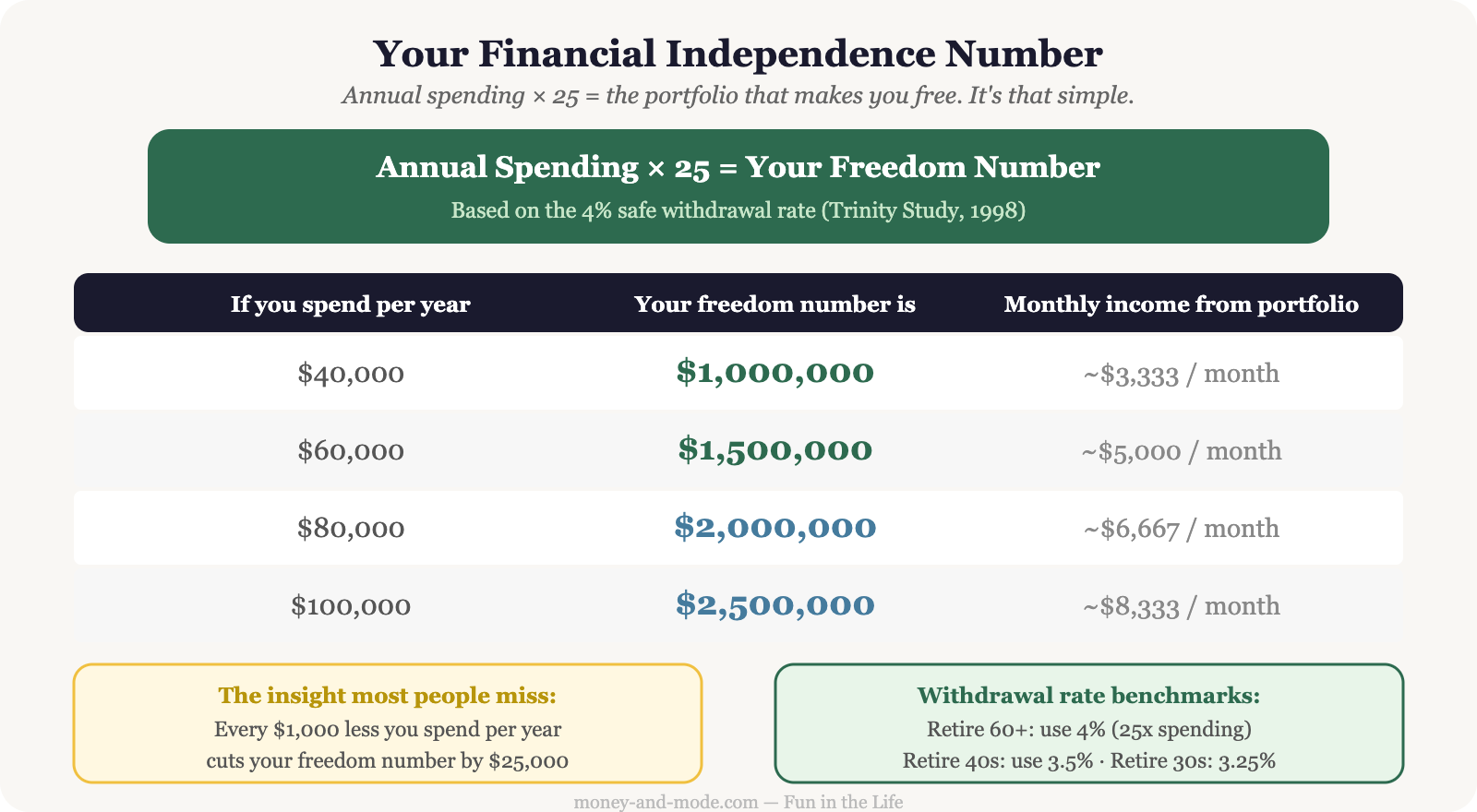
The 4% rule produces one of the most useful calculations in personal finance: your financial independence number. Take your annual expenses. Multiply by 25. The result is the portfolio you need to be financially free.
At your number, invested in a diversified portfolio of low-cost index funds — funded by a high savings rate — historical data suggests you can withdraw your annual expenses every year — adjusted for inflation — for 30 years, with a 95% chance of never running out.
What People Get Wrong About the 4% Rule
Mistake one: treating 95% as a guarantee. It is not. It is a historical probability. Past markets are not a binding contract about future markets.
Mistake two: applying a 30-year rule to a 50-year retirement. If you retire at 40 rather than 65, you might need your money to last 50 years or more. The historical success rate of 4% over 50 years drops meaningfully — to around 80 to 85%. For longer retirement horizons, most researchers now recommend 3.5% or even 3.25%.
Mistake three: ignoring spending flexibility. The 4% rule models rigid annual withdrawals. Real people spend less in bad market years and more in good ones. This flexibility dramatically improves real-world outcomes.
Mistake four: forgetting the other side. The 4% rule is about withdrawal. People who retire with $2 million and spend $100,000 per year are using a 5% withdrawal rate — meaningfully above the safe zone. People who retire with $2 million and spend $60,000 are at 3% — comfortably conservative.
The Number Is Not Fixed
I want to tell you something about your financial independence number that took me years to fully understand.
The number is not fixed. It is determined by your spending. And your spending is largely a choice.
Every $1,000 you permanently reduce from your annual expenses does two things simultaneously. It raises your monthly savings — and the fastest way to widen that gap is to build leverage instead of selling your time. And it reduces your financial independence number by $25,000. A household that reduces annual spending from $80,000 to $60,000 does not just save $20,000 this year — it reduces its financial independence target by $500,000 and accelerates its timeline by years.
This is why I keep coming back to the same question: what do you actually need to spend to live a life that is genuinely good? Not the life you perform for others. Not the lifestyle that keeps pace with your social circle. The life that actually makes you happy when you are sitting quietly and thinking about it honestly.
That number, for most people, is considerably lower than what they are currently spending.
Frequently Asked Questions
What is the 4% rule?
A safe withdrawal rate — how much of your portfolio you can withdraw each year, adjusted for inflation, without running out over a 30-year retirement. William Bengen calculated 4.15% in 1994 using US market data back to 1926, then rounded down to 4% as a margin of safety.
What did the Trinity Study actually say?
Four years after Bengen, three professors at Trinity University confirmed his work. Their conclusion: a 4% withdrawal rate on a portfolio of 50% stocks and 50% bonds had a historical success rate of approximately 95% over any 30-year period from 1926 to 1995.
How do I calculate my financial independence number?
Take your annual expenses and multiply by 25. That is the portfolio you need to be financially free. Invested in diversified low-cost index funds, historical data suggests you can withdraw your annual expenses every year — adjusted for inflation — for 30 years, with roughly a 95% chance of never running out.
What do people get wrong about the 4% rule?
Four things. Treating 95% as a guarantee rather than a historical probability. Applying a 30-year rule to a 50-year early retirement, where success drops to around 80–85% and researchers suggest 3.25–3.5% instead. Ignoring spending flexibility. And forgetting that your actual withdrawal rate depends on what you spend, not what you saved.
What is your financial independence number, based on your current spending? Have you calculated it? Share it in the comments — or share what surprised you about the calculation.