
There are three ways to make money. Most people use only the first one, for their entire lives, and never understand why financial freedom feels so far away.
The first way: You sell your time. You go to a job, you do work, you get paid. The moment you stop showing up, the income stops. Your earning capacity is capped by the number of hours in a day and the rate someone will pay per hour. This is employment. It is also, for most people, a ceiling they never break through.
The second way: You sell your time at a higher rate. You become a consultant, a freelancer, a specialist. You earn more per hour. But the fundamental equation has not changed — you are still trading hours for money. You get sick, the income stops. You take a vacation, the income stops. This is freelancing. It is better than employment in many ways, but it is not leverage.
The third way: You build something that makes money while you are not working. A business with a team. A software product. An investment portfolio. Something that generates income independent of your active hours. This is leverage. And it is the only path to genuine financial freedom.
What Leverage Actually Means
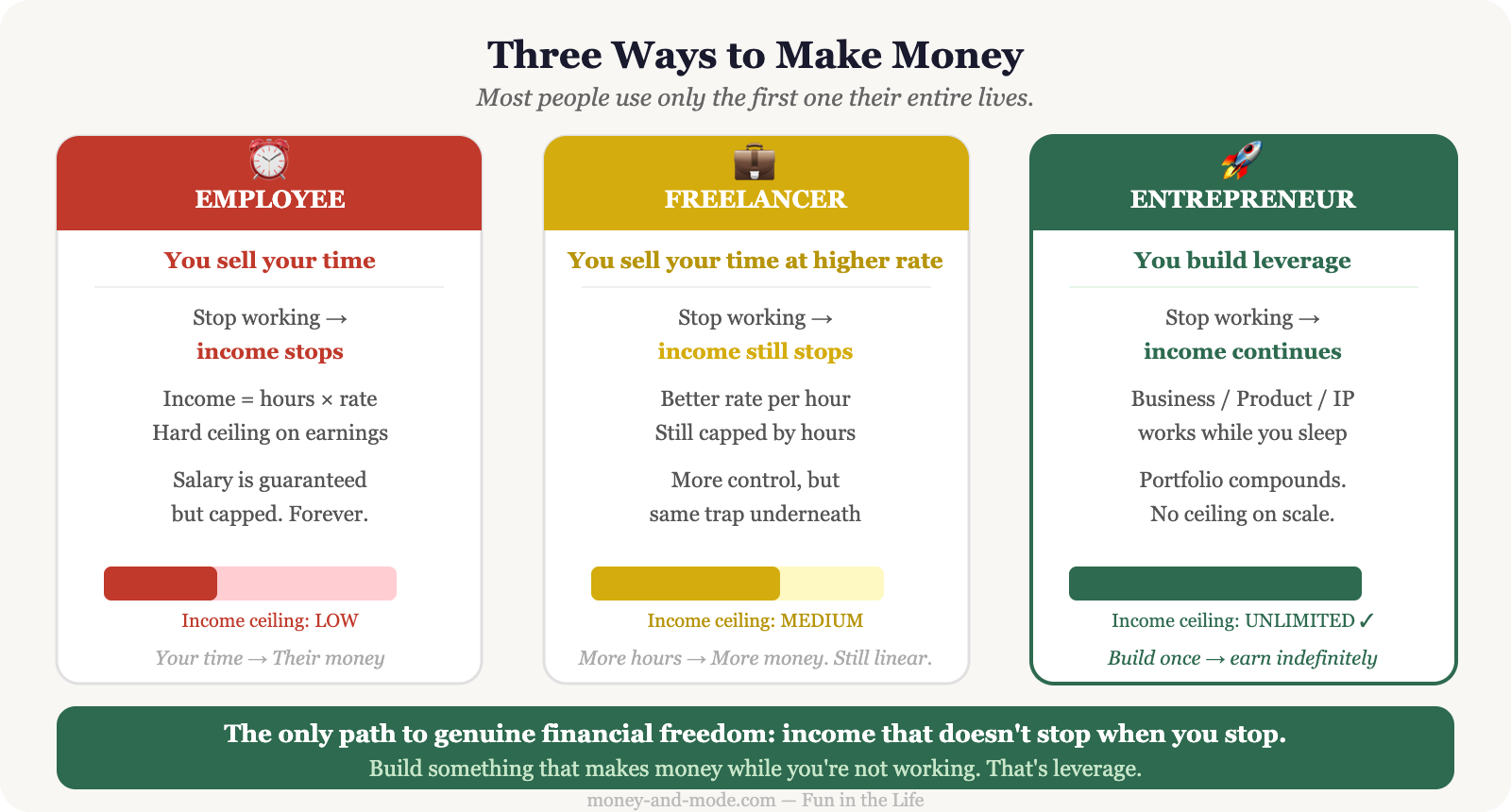
Financial leverage means applying your skill, your capital, your time — once, at the right point — and having the output be disproportionate to the input. You build a system that continues producing value beyond the moment of your effort.
A software product: you build it once, sell it to a thousand customers without doing a thousand times the work. Each additional customer costs you almost nothing. The software works at 2am when you are asleep.
A portfolio of investments: the money works. You do not have to. A well-invested portfolio of $1 million generates — conservatively — $30,000 to $40,000 per year in returns, every year, whether you are paying attention or not.
Intellectual property: a book written once, read by thousands. A course recorded once, watched by students across the country. A brand built over years, attracting opportunities that would cost competitors enormous effort to create.
You Do Not Need to Build a Unicorn
Entrepreneurship, in the popular imagination, means startups, venture capital, billion-dollar exits, and sleeping in the office. This is not what entrepreneurship has to mean. And this limited definition is costing a lot of people their financial futures.
Consider what a modest, unglamorous small business actually produces:
A software consulting business with four good people and a handful of long-term clients. Annual revenue of $800,000. Margins of 30% after salaries and costs. Owner’s income: $240,000 per year.
A content business — a newsletter, a YouTube channel, a community built around genuine expertise — generating $100,000 to $200,000 per year from advertising, memberships, and partnerships.
None of these are unicorns. None require VC funding or the willingness to bet everything. All of them produce something employment cannot: income that does not stop when you stop.
Start Before You Are Ready
The most common reason people do not start is that they are waiting to be ready. Waiting to have enough money, enough knowledge, enough confidence, enough time.
These things do not arrive before you start. They arrive because you started.
My advice — and I give it from experience, not theory — is to begin building the second income before you need it. While you still have the salary. While the financial pressure is lower. Build the side business, the product, the service, the content. Let it be small and imperfect. Let it generate its first $1,000 of revenue, which will teach you more than any book about entrepreneurship.
The first $1,000 of business revenue is not important because of the money. It is important because of what it proves: that people will pay for what you have built. That the market exists. That you are capable of this.
Frequently Asked Questions
What are the three ways to make money?
Sell your time, which is employment. Sell your time at a higher rate, which is freelancing or consulting. Or build something that earns while you are not working — that is leverage. The first two are capped by the hours in a day. Only the third leads to genuine financial freedom.
What does leverage actually mean?
Applying your skill, capital or time once, at the right point, and having the output be disproportionate to the input. Software built once and sold to a thousand customers. A portfolio where the money works instead of you. A book written once and read by thousands. It keeps producing beyond the moment of effort.
Do I need to build a startup or raise venture capital?
No — and that assumption is costing people their financial futures. A software consulting business with four good people at $800,000 revenue and 30% margins pays its owner $240,000 a year. A newsletter or channel built on genuine expertise can produce $100,000 to $200,000. None of these are unicorns.
When should I start building leverage?
Before you need it — while you still have the salary and the financial pressure is lower. People wait until they have enough money, knowledge, confidence and time, but those things arrive because you started, not before. The first $1,000 of revenue matters because it proves people will pay for what you built.
What would you build, if you were going to start something? Write it in the comments — I would genuinely like to know.