
I have kept a journal for eleven years. Somewhere in those pages is almost everything useful I have learned about business, family, health and my own mind. And for most of those eleven years, I could not find a single word of it when I actually needed it. Using AI as a second brain is what finally changed that, and the system is much simpler than the phrase makes it sound.
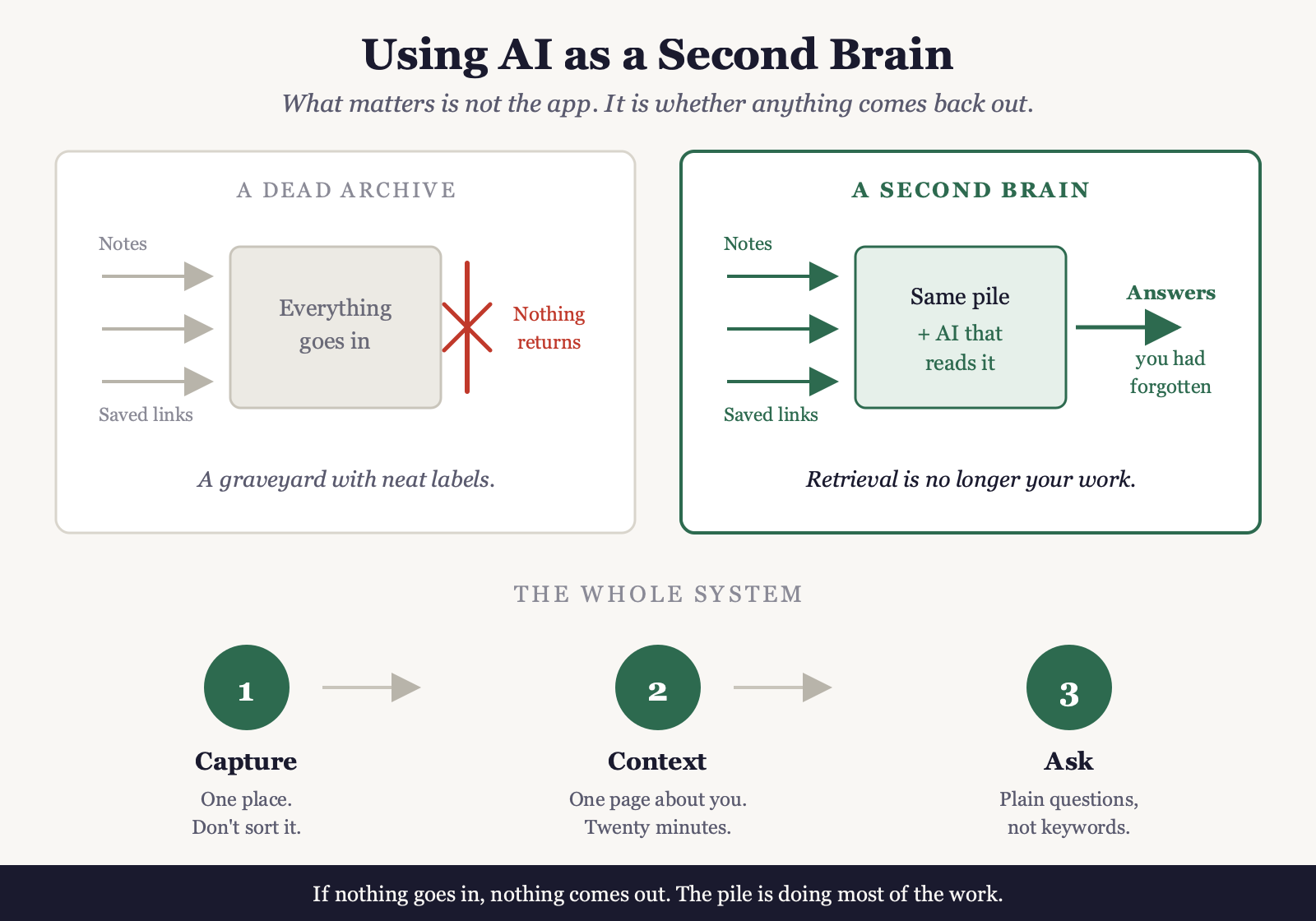
A second brain is just a place outside your head where you keep what you do not want to lose. Notes, ideas, articles you saved, things people told you that turned out to be true.
People have been building these for centuries, in notebooks and card boxes. The idea is not new. What is new is that the pile can now answer you.
Why My First Ten Years of Notes Were Useless
Here is the uncomfortable truth I had to admit at 49. I did not have a second brain. I had a graveyard with good folders.
Everything went in. Nothing ever came back out.
I saved articles I never reopened. I wrote journal entries I never reread. I built a folder structure I was quietly proud of and then stopped opening the app entirely, because nothing useful ever came back the other way.
That is the whole failure, and I think it is almost universal. A note you cannot retrieve at the moment you need it is not a note. It is a feeling that you were once organised.
The difference between a second brain and a dead archive is not the app, the tags, or the folder names. It is whether anything ever comes back out.
What Changed When I Started Using AI as a Second Brain
The change was not that I started writing more. I had eleven years of material already. The change was that I could finally ask it questions.
Now I can say: “Look through my journal entries from the last two years and tell me what I keep worrying about that never actually happened.”
And I get an answer. A slightly humbling one, usually.
That is the entire shift. Retrieval stopped being my job. For years the bottleneck was not storing things, it was remembering that I had stored them and then finding them. A machine that reads faster than me removed that bottleneck completely.
I no longer need a filing system good enough for my future self to navigate. I only need the material to exist somewhere, in plain language.
The Three Parts of My System
I want to be honest about how ordinary this is. There is no clever software here. There are three parts, and only one of them takes any real effort.
One: capture, without organising. When something is worth keeping I put it in one place.
An article goes to a read-later app. A thought goes into a plain text file. A conversation worth remembering becomes four lines the same evening.
I have completely stopped sorting things as they come in. That was the part that used to exhaust me, and it turns out it was the least valuable part.
Two: one file that explains me. This is the piece that made the biggest difference, and I will come back to it in a moment.
Three: ask, out loud, in normal words. Not keywords. Actual questions, the way you would ask a colleague who had read everything you wrote.
That is it. Capture, context, ask. Everything else people build on top of this is optional. If the asking part feels awkward at first, How to Talk to AI covers it properly — it is a skill, and it takes about a week to get comfortable.
The One File That Made the Biggest Difference
If you do only one thing from this article, do this one.
I keep a single page that explains who I am. Not a resume. Context.
It says what I do, what I am working on this year, who my family is, how I like things explained to me, and what I find annoying in an answer. It is about a page long and it took me twenty minutes to write.
Then I start from it. Every serious conversation begins with the AI already knowing the background instead of me typing it again.
The difference is hard to overstate. Before, every conversation started at zero and the answers were generic, because the input had no memory of me. After, the answers sound like they came from someone who knows my situation.
Most people who tell me AI gives them bland, obvious advice are simply starting from zero every time. The tool is not the problem. It has never been told anything.
What It Actually Looks Like on an Ordinary Tuesday
Three real examples, so this does not stay abstract.
I had a difficult conversation coming up with someone I have worked with for years. I asked what I had written about our previous disagreements. It found two entries I had genuinely forgotten and pointed out that both times the real problem was schedule pressure, not the thing we argued about. It was right.
My son Mihir sent me a long thread about how his startup was thinking about hiring. I saved it. Two weeks later, thinking about my own team at Cymetrix, I asked what I had saved recently about small teams. It brought that thread back when it mattered, which is a thing my own memory reliably fails to do.
And every few months I ask the least comfortable question available: “What advice do I keep giving other people that I am not following?” I recommend it. I also recommend sitting down first.
None of these are impressive technically. They are ordinary. That is exactly why the system survives — nothing in it requires me to be disciplined on a bad week.
What a Second Brain Cannot Do
I need to be careful here, because there is a version of this idea that gets oversold badly.
It does not think for you. It brings things back and finds patterns; the judgment about what any of it means is still yours, and it always will be.
It is not perfectly reliable. It occasionally states something with great confidence that is simply wrong.
On anything that matters, check what it tells you against the original. This is the same caution I raised in What Is an AI Agent?, and it has not gone away.
And it will not fix an empty pile. If nothing goes in, nothing comes out. The eleven years of journals are doing most of the work here, not the software.
One more thing worth saying plainly: be careful what you put in. Anything genuinely private — health details, other people’s confidences, financial specifics — deserves a pause before it goes into any tool you do not control.
How to Start This Week
You do not need a weekend and a new app. Two steps.
Today: write the page about yourself. Who you are, what you are working on, what matters to you right now, how you want things explained. Twenty minutes. Keep it where you can paste it.
This week: pick one place for everything you want to keep, and put things there without sorting them. One place is the only rule.
Then, in a month, ask it something you would normally have to remember on your own. That first moment when something you had forgotten comes back at exactly the right time is when this stops being a productivity idea and starts being genuinely useful.
This is the same quiet leverage behind the one-person business and behind saving two hours a day with AI. It is not that the work gets done for you. It is that you stop losing what you already know.
At 50, I have accepted that my memory is not improving. But for the first time in my life, the record of what I have thought and learned is not disappearing behind me. Everything I have written down is still reachable. That feels less like a productivity trick and more like a small kind of peace.
Frequently Asked Questions
What is a second brain?
A second brain is simply a place outside your head where you keep what you do not want to lose — notes, ideas, saved articles, things people told you that turned out to be true. People have built these for centuries in notebooks and card boxes. The idea is not new. What is new is that the pile can now answer you.
Why do most note-taking systems fail?
Because everything goes in and nothing ever comes back out. Most people build a beautiful folder structure, add to it for two weeks, then stop opening the app because nothing useful ever returns the other way. That is a graveyard with neat labels, not a second brain. A note you cannot retrieve when you need it is not really a note.
What is the one file that makes the biggest difference?
A single page that explains who you are. Not a resume — context. What you do, what you are working on this year, who your family is, how you like things explained, and what you find annoying in an answer. It takes about twenty minutes to write, and every conversation afterwards starts with the background already known instead of at zero.
Can AI as a second brain think for you?
No, and it is oversold when people suggest otherwise. It brings things back and finds patterns you missed, but the judgment about what any of it means stays yours. It is also not perfectly reliable — it will occasionally state something confidently that is simply wrong, so on anything that matters, check it against the original.
How do I start using AI as a second brain this week?
Two steps, no new app and no lost weekend. Today, write the one-page description of yourself and keep it somewhere you can paste from. This week, pick one place for everything you want to keep and put things there without sorting them. One place is the only rule. Then in a month, ask it something you would normally have to remember yourself.
What have you written down over the years that you have completely lost track of — journals, notes, saved articles? And what would you ask it first if you could? I’d love to hear in the comments.