
Last Tuesday I handed an AI agent a mess I had been avoiding for three weeks.
Eleven months of bank statements, sitting in a folder, needing to be turned into one summary my accountant could actually use. Boring work. The kind you keep pushing to next weekend.
I described what I wanted. Then I went and made tea.
When I came back, it had opened each file, pulled out the numbers, noticed that two months were in a different format and handled them differently, built the summary, and left me a note saying one statement seemed to be missing a page.
That last part is what matters. It didn’t just answer me. It noticed something and told me.
That is what people mean when they say “AI agent” rather than “chatbot” — and it is the whole point of this article.
What Is an AI Agent? The Simplest Definition
An AI agent is an AI that can take actions to finish a task, not just produce words.
That’s it. That’s the definition.
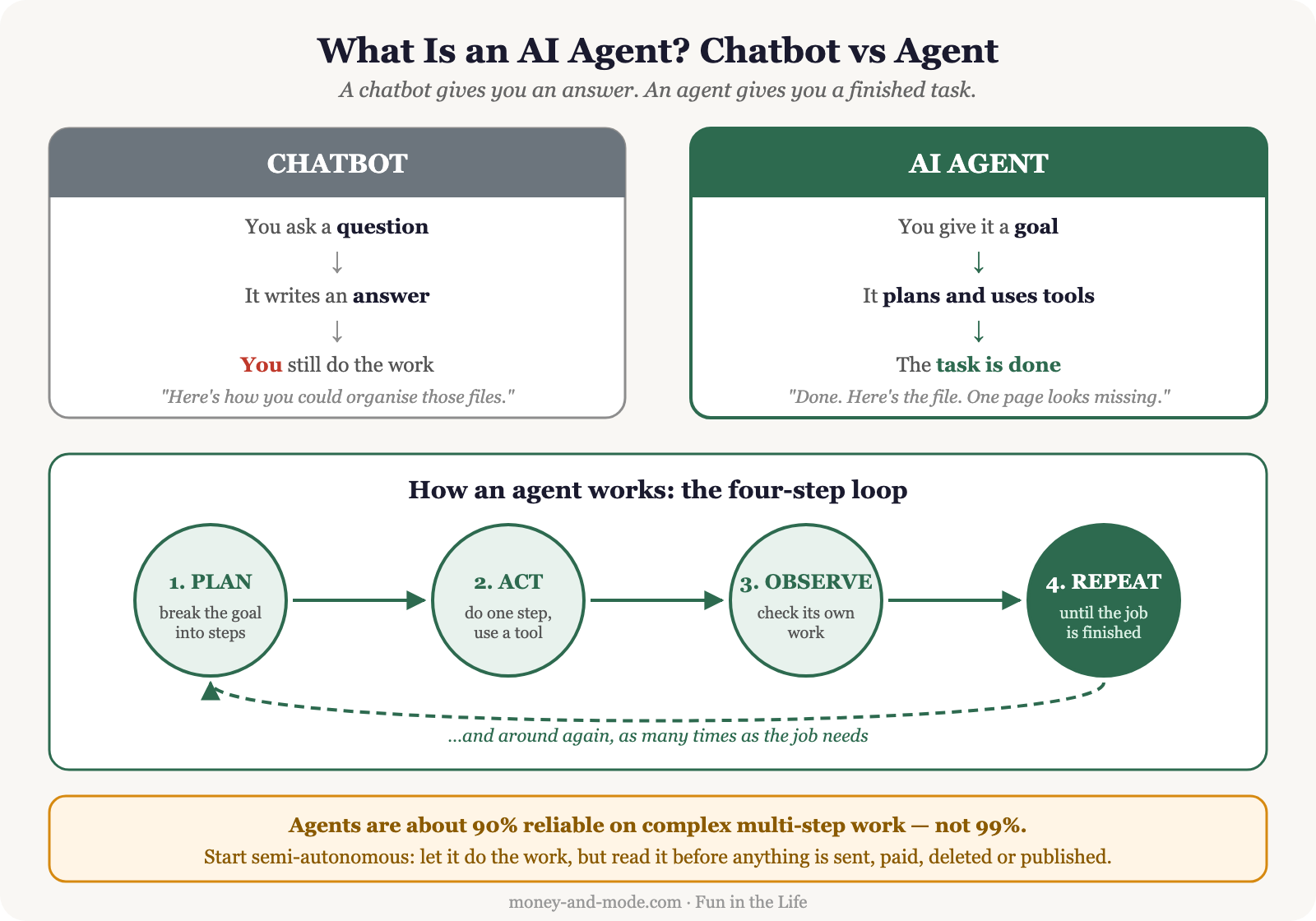
A chatbot like the one in What Is ChatGPT? is a brilliant conversationalist. You ask, it answers, and then you go do the work. It’s advice. Excellent advice, often — but advice.
An agent is given a goal instead of a question. It then works out the steps itself, uses whatever tools it needs — opening files, searching the web, filling in a spreadsheet, sending a draft — checks whether the step worked, and keeps going until the job is done or it gets stuck.
Chatbot: “Here’s how you could organise those statements.”
Agent: “I’ve organised them. Here’s the file. One page looks missing.”
The Difference, in One Sentence You’ll Remember
A chatbot gives you an answer. An agent gives you a finished task.
Think of the difference between asking a knowledgeable friend how to file your taxes, and hiring someone who actually files them.
Both are valuable. They are not the same thing.
I have been in the software business for twenty-five years, and I’ve watched a lot of technology arrive wearing a bigger hat than it deserved. This one is genuinely different — not because the AI got smarter, but because it was finally allowed to press the buttons instead of only describing which buttons to press.
How AI Agents Actually Work: Plan, Act, Observe, Repeat
Under all the excitement, an AI agent runs a loop with four steps. No jargon needed.
1. Plan. It breaks your goal into smaller steps. “Summarise these statements” becomes: open each file, find the transactions, standardise the formats, add them up, write the summary.
2. Act. It does one step. Opens a file. Runs a calculation. Searches for something.
3. Observe. It looks at what happened. Did the file open? Do the numbers look sane? Is something missing?
4. Repeat. Based on what it saw, it decides the next step — and goes around again.
That loop is the entire magic trick. A chatbot answers once and stops. An agent goes around this circle twenty times if the job needs twenty times.
And that “observe” step is why my agent caught the missing page. It wasn’t following a fixed script. It was checking its own work as it went.
What Could You Actually Hand to an AI Agent?
Forget the futuristic stuff for a minute. Here are ordinary things people are already handing over:
- Research that takes twenty tabs. “Compare these four health insurance plans for a family of four and tell me which one covers what, in a table.” It reads all four and builds the table.
- The pile of documents. Receipts, statements, bills, school forms — anything where the work is opening thirty files and pulling out four things from each.
- The follow-up you keep forgetting. Drafting the replies, organising the thread, making the list of who hasn’t responded.
- Learning something properly. Not “explain compound interest” but “build me a week-by-week plan to understand my own investments, and check my understanding at the end of each week.”
If a task is mostly tedious rather than difficult, it is probably agent-shaped. If it needs judgment about people you know, or a decision only you can live with, it isn’t.
The Part Nobody Tells You: Agents Get Things Wrong
Here is the honest bit, and I would rather you hear it from me than find out the hard way.
Agents are roughly ninety percent reliable on complex multi-step work. Not ninety-nine. Ninety.
That number is fine when it’s drafting your emails. It is not fine when it’s moving your money.
The people who build these systems professionally have a rule about this: start semi-autonomous, not fully autonomous. Let the agent do the work, but have it stop and show you before anything final happens. Sending. Paying. Deleting. Publishing.
They call it a human-in-the-loop checkpoint. I call it the same thing I’d do with a talented new hire — let them do the whole job, but read it before it goes out. Not because you don’t trust them. Because that’s how anyone earns trust.
I still read every summary before it reaches my accountant. It has been right every time so far. I’ll still read the next one.
Everyone Becomes a Manager Now
This is the part that surprised me most.
The skill that matters with agents isn’t technical. It’s the ability to describe a job clearly — the same skill that separates a good manager from a frustrating one.
If you hand a person a vague instruction, you get vague work. Agents are exactly the same, and they don’t push back or read your face. Everything I wrote in How to Talk to AI matters twice as much here, because now the AI isn’t just writing an answer you can skim — it’s doing something.
Say what “done” looks like. Say what it shouldn’t touch. Say what to do if something looks wrong. That’s it. That’s the skill.
Which, if you’ve been wondering about the questions in Will AI Take My Job?, is worth sitting with. The work that’s moving isn’t the thinking. It’s the middle part — the execution. What stays yours is deciding what’s worth doing, and judging whether what came back is good enough.
How to Start Using AI Agents This Week, Without Breaking Anything
Three steps. Genuinely small.
One: Pick a task you’ve been putting off that’s tedious rather than sensitive. Not your taxes. The recipe folder. The comparison spreadsheet. Something where the worst outcome is a wasted twenty minutes.
Two: Describe it the way you’d brief a capable new assistant on their first day. What you want, what “finished” means, and what to do if something looks off.
Three: Read what comes back before you act on it. Every time, for the first several weeks. You are building a sense of where this thing is reliable and where it isn’t — and that instinct is worth more than any tool.
The tea, by the way, was excellent. That’s roughly what this technology gives you: not a different life, just a few reclaimed pieces of one.
Two and a half decades of watching technology arrive taught me something the excitement usually misses — the goal was never to do more. It was to have to do less of what never mattered.
Frequently Asked Questions
What is an AI agent in simple terms?
An AI agent is an AI that can take actions to finish a task, not just produce words. A chatbot answers your question and then you go do the work. An agent is given a goal instead, works out the steps itself, uses tools like files and searches, and keeps going until the job is done.
What is the difference between a chatbot and an AI agent?
A chatbot gives you an answer. An agent gives you a finished task. It is the difference between asking a knowledgeable friend how to file your taxes and hiring someone who actually files them. Both are valuable, but only one of them leaves you with the work still to do.
How do AI agents actually work?
They run a four-step loop. Plan: break your goal into smaller steps. Act: do one step, using a tool. Observe: check whether it actually worked. Repeat: decide the next step based on what it saw. A chatbot answers once and stops; an agent goes around that circle as many times as the job needs.
Are AI agents reliable enough to trust?
Roughly ninety percent reliable on complex multi-step work — not ninety-nine. That is fine for drafting emails and not fine for moving money. The rule the people who build these systems follow is to start semi-autonomous: let the agent do the work, but read it before anything is sent, paid, deleted or published.
What tasks should I give an AI agent first?
Something tedious rather than sensitive. Research that would take twenty tabs, a pile of documents where you need four things from each, follow-ups you keep forgetting. If a task is mostly boring rather than difficult, it is probably agent-shaped. If it needs judgment about people you know, it is not.
What’s the one tedious task in your week you’d hand over first, if you trusted it completely? Tell me in the comments — I’m genuinely curious what people would let go of.