
You have probably heard the name ChatGPT by now. Your colleague mentioned it. Your kids brought it up at dinner. You saw it trending on the news. And maybe — just maybe — you quietly wondered: what exactly IS this thing?
If that is you, welcome. You are in the right place. Today I am going to explain what is ChatGPT explained simply — no technical words, no confusing diagrams, just plain English over a cup of chai.
What Is ChatGPT, Really? A Simple Explanation for Beginners
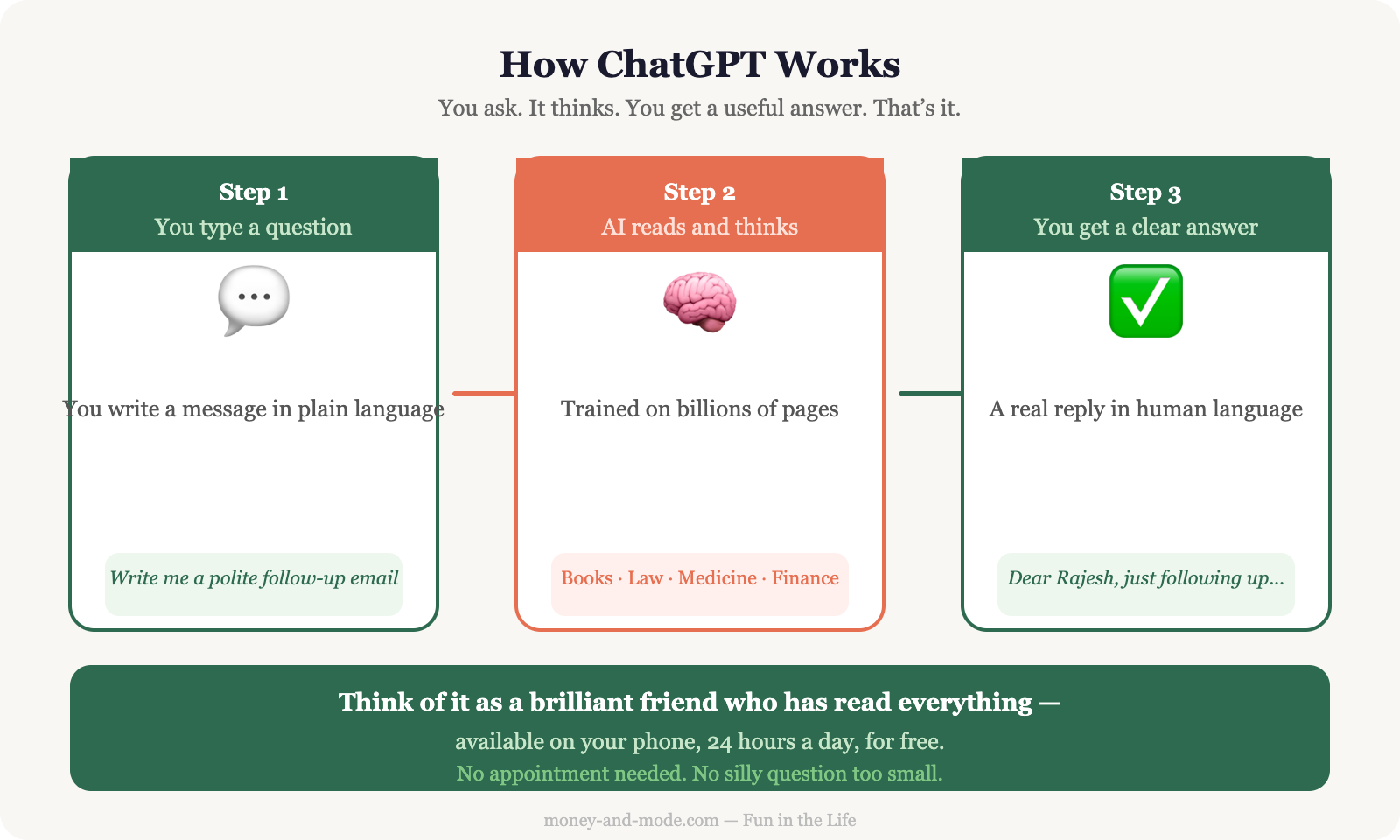
Here is the simplest way I can describe it: ChatGPT is a computer program you can have a conversation with. You type a question or a request, and it types back a helpful, thoughtful answer — in normal human language.
Think about that brilliant friend you wish you had. The one who has read thousands of books, knows about medicine, law, cooking, finances, travel, and history — and has infinite patience to answer your questions without making you feel silly. ChatGPT is a bit like that friend. Available any time, on your phone or computer, for free.
It was created by a company called OpenAI, based in San Francisco. I personally use a similar tool called Claude, made by a company called Anthropic. Different brand, same idea. These tools are all part of a new family of AI assistants that have changed how millions of people work and live. I covered this bigger shift in my article on How AI Is Changing Everyday Life — worth a read if you want the full picture.
How Does ChatGPT Work? (In Plain English, I Promise)
You do not need to understand the engineering to use it — just like you do not need to understand how a car engine works to drive one. But a little context helps.
ChatGPT learned by reading an enormous amount of text: books, websites, articles, conversations — billions and billions of words. Through this reading, it learned patterns. It learned how language works, how ideas connect, how questions are answered. Think of it like a student who studied for twenty years without sleeping.
When you ask it something, it does not “look up” the answer like a search engine. Instead, it generates a response word by word, based on what it has learned. It predicts what a helpful, accurate answer would sound like.
That is why it feels like talking to a person — because it has learned from the way people write and communicate.
One thing to know: ChatGPT’s knowledge has a cutoff date. It does not browse the internet in real time (though some versions now can). So for breaking news or very recent events, always double-check with a news source.
What Can You Actually Use ChatGPT For?
This is where it gets exciting. Here are real things people use it for every day:
Writing help. You can ask it to write an email, a birthday message, a complaint letter, or a job application. Tell it the situation, and it gives you a draft. You edit it to match your voice.
Answering questions. Ask it anything — “what causes high blood pressure?”, “what is the difference between a mutual fund and a fixed deposit?”, “how do I make paneer at home?” It gives clear, detailed answers.
Explaining complicated things. Got a legal document you do not understand? A medical report with terms that confuse you? Paste the text and ask it to explain in simple language. This alone has saved me hoursof confusion.
Learning something new. Want to learn basic Excel? Need to understand how a loan EMI is calculated? Ask it to teach you, step by step, like a patient tutor.
Planning and brainstorming. “Help me plan a 5-day trip to Rajasthan for a family with elderly parents.” It gives you a thoughtful starting point.
I have personally used AI assistants like this to save significant time every single day. If you want to see how, read my article How to Use AI to Save 2 Hours Every Day — there are practical tips you can start using immediately.
Is It Safe to Use? Common Worries Addressed
I hear this question often, especially from people my age. And it is a fair concern.
The short answer: yes, it is generally safe to use for everyday tasks. Millions of people use it daily without any problem. But there are a few things to keep in mind.
Do not share sensitive personal information. Do not type your Aadhaar number, bank account details, passwords, or anything deeply private into any AI tool. Treat it like a public space — helpful, but not private.
Verify important information. ChatGPT can make mistakes. It is confident even when wrong sometimes. For medical decisions, legal matters, or financial choices, use it as a starting point — then confirm with a real professional.
It is not a person. It has no feelings, no agenda, no memory of past conversations (in the basic version). It is a tool. A very powerful tool — but still a tool.
I also know many people worry: if AI can do all this, does that mean it will replace human jobs? That is a completely separate and important question. I wrote about it in detail here: Will AI Take My Job? — my honest, experienced take on a topic that worries a lot of people.
How Do You Get Started?
Getting started with ChatGPT is easier than you might think. Here is what to do:
- Go to chat.openai.com on your phone or computer.
- Create a free account with your email address.
- Type anything in the chat box — a question, a request, a problem you need help with.
- Read the response. Ask a follow-up if you need more.
That is it. No installation, no technical setup. Just you and a very knowledgeable conversation partner.
My advice: start with something low-stakes. Ask it to write a birthday message for a friend. Ask it to explain something you read in the newspaper. Get comfortable. Then slowly discover what else it can do for you.
One Last Thought
When I first started using AI tools like this — and I use Claude, Anthropic’s version, almost every day now — I felt a bit like I had found a superpower I did not know existed. Not because it does everything perfectly. But because it meets me where I am, explains things patiently, and helps me think more clearly.
You do not have to be young, or tech-savvy, or working in technology to benefit from this. You just have to be willing to try.
The hardest part is typing that first question.
Frequently Asked Questions
What is ChatGPT in simple terms?
ChatGPT is a computer program you can have a conversation with. You type a question or a request, and it types back a helpful, thoughtful answer in normal human language. Think of a brilliant friend who has read thousands of books and has infinite patience — available any time, free to start.
How does ChatGPT actually work?
It learned by reading an enormous amount of text — books, websites, articles, conversations — and picked up patterns in how language works and how ideas connect. When you ask it something, it does not look up the answer like a search engine. It generates a response word by word, based on what it learned.
Is ChatGPT safe to use?
Generally yes, for everyday tasks. But do not type sensitive personal information — bank details, ID numbers, passwords — into any AI tool. Verify anything important, because it can sound confident even when it is wrong. For medical, legal or financial decisions, use it as a starting point and confirm with a real professional.
How do I get started with ChatGPT?
Go to chat.openai.com on your phone or computer, create a free account with your email, and type anything into the chat box. No installation, no technical setup. Start with something low-stakes — a birthday message, or explaining a newspaper article — and build from there.
Now I am curious about you: Have you tried ChatGPT or any AI tool yet? What stopped you — or what surprised you when you did? Share in the comments below — I read every single one.