
A few years ago, my son called me from San Francisco and said, “Dad, I just had an AI write my entire pitch deck in 20 minutes.”
I didn’t fully understand what he meant at the time. I’d heard the word AI a hundred times. But pitch deck in 20 minutes? That felt unreal.
Today, I use AI every single day. It helps me think through problems, draft emails, plan my week, and even make sense of complex news. And I’m a 50-something businessman who grew up without even a computer at home.
So if you’re wondering what all this “AI” noise is about — this article is for you. No jargon. No hype. Just the honest truth about how AI is already in your life, whether you know it or not.
## You’re Already Using AI — You Just Don’t Call It That
Let’s start with the simplest truth: AI is not some futuristic robot. It’s already in your pocket.
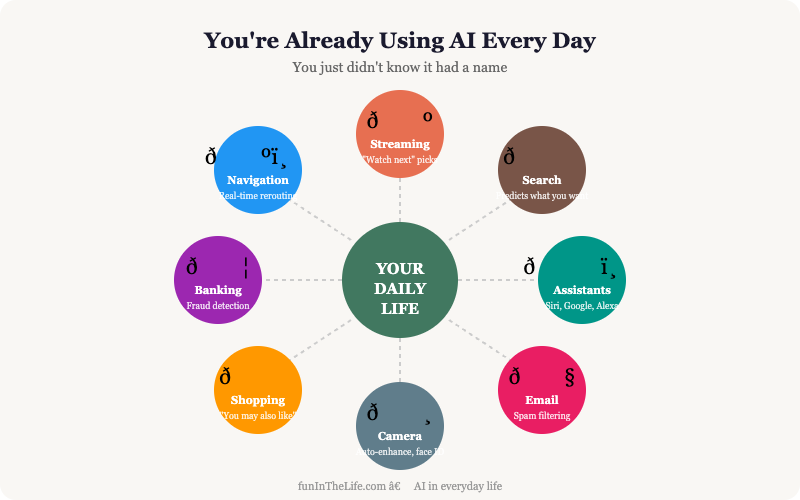
When Netflix recommends a show you actually want to watch — that’s AI. When Google Maps reroutes you around traffic in real time — that’s AI. When your bank sends you an alert because a suspicious transaction just happened — that’s AI. When you ask Siri or Google “what’s the weather today” — that’s AI.
Most of us have been living with AI for years. We just called it “the algorithm” or “smart features.”
The change happening right now is that AI has gotten dramatically smarter — and dramatically more useful — for ordinary people doing ordinary things.
## What’s Actually New in the Last Two Years
Until recently, AI was mostly invisible. It worked behind the scenes — sorting your spam, ranking search results, suggesting the next word on your phone keyboard.
What changed is that AI can now talk to you. It can listen to a question — in plain English — and give you a thoughtful, useful answer. Not a list of links. An actual answer.
This is what tools like ChatGPT, Google Gemini, and Claude are. You type a question the way you’d ask a smart friend. And it responds the way a smart friend would — except it’s available at 2am, never judges you, and never gets tired.
Here’s what regular people are doing with this today:
Writing help. People use AI to write emails, job applications, complaint letters, even wedding speeches. You give it a rough idea, it gives you a polished draft. You edit it to sound like yourself. Done.
Learning new things. Want to understand how a mutual fund works? How to read a blood test? Why your electricity bill is so high? You can ask AI in plain language and get a clear explanation — not a 40-page PDF.
Health questions. AI can’t replace your doctor, but it can help you understand what the doctor said, prepare better questions before an appointment, or understand a diagnosis in simple terms.
Decision making. Should you buy or rent? Take this job or stay? Travel now or wait? AI can help you think through the pros and cons, consider angles you hadn’t thought of, and organise your thinking — even if the final decision is always yours.
## The Part Nobody Talks About: AI Saves You Time
Here’s something I’ve learned personally: the most powerful thing AI does is give you time back.
I used to spend 45 minutes writing a detailed email. Now it takes 10. I used to spend an hour researching something. Now I get a summary in 5 minutes and spend the rest of the time actually thinking about it.
One hour a day saved is 365 hours a year. That’s more than two full weeks of your life — every single year. Given back to you.
Think about what you’d do with two extra weeks. More time with your children. More rest. More of the things that actually make life feel worth living.
## What AI Cannot Do (And Will Never Do)
AI cannot love your family. It cannot experience your life. It cannot feel the warmth of a good friendship or the satisfaction of a hard day’s work. It cannot replace your intuition about the people you know — or your wisdom built from decades of experience.
I’ve spent years reflecting on what actually matters in life. The conclusion I keep coming back to is simple: health, family, peace of mind. No AI can deliver those. No technology can.
What AI can do is handle the repetitive, draining, time-consuming tasks — so you have more space for what actually matters.
Think of it like electricity. Electricity didn’t replace human skill or human connection. It just made the mechanical parts of life faster and easier — so we could focus on the human parts.
AI is the new electricity.
## Three Simple Ways to Start Using AI Today
You don’t need to be technical. You don’t need to buy anything special. Here’s how to start:
1. Ask it a question you’ve been curious about. Go to chat.openai.com or claude.ai (both free to start). Type a question you’ve been meaning to Google but never got a satisfying answer to. See what happens.
2. Use it to write something you’ve been putting off. That email to your landlord. That message to an old friend. That complaint to the bank. Describe what you want to say, let AI draft it, then edit it to sound like you.
3. Use it to understand something confusing. Your insurance policy. Your child’s school report. A news article you couldn’t fully make sense of. Paste it in and ask: “Explain this to me simply.”
## The Honest Bottom Line
AI is not magic. It makes mistakes. It gets things wrong. It needs you to check its work.
But it is genuinely useful — probably more useful than any technology that’s come along in the last 20 years for ordinary people doing ordinary things.
The people who learn to use it well will have a real advantage. Not because AI is replacing humans — but because AI-assisted humans are getting more done, making better decisions, and reclaiming time they didn’t know they’d lost.
You don’t have to become a tech expert. You just have to start.
Frequently Asked Questions
Am I already using AI without knowing it?
Almost certainly. Netflix recommending a show, Google Maps rerouting you around traffic, your bank flagging a suspicious transaction, Siri answering a weather question — all of that is AI. Most of us have lived with it for years. We just called it “the algorithm” or “smart features.”
What actually changed about AI in the last two years?
AI learned to talk. It used to work invisibly — sorting spam, ranking search results, suggesting the next word on your keyboard. Now you can ask a question in plain English and get a thoughtful answer instead of a list of links. That is what ChatGPT, Google Gemini and Claude are.
What can AI not do?
It cannot love your family, live your life, or replace the wisdom you built over decades. It cannot feel a good friendship or your intuition about people you know. What it can do is handle the repetitive, draining, time-consuming tasks so you have more space for what actually matters.
How do I start using AI today with no technical skill?
Three ways. Ask it a question you have been curious about. Let it draft something you have been putting off — an email, a complaint letter. Or paste in something confusing, like an insurance policy or a school report, and ask it to explain simply. Start free at chat.openai.com or claude.ai.
Have you tried AI yet? What question would you most want to ask it? Share in the comments below.