
For twenty-five years I have run a company with people in it.
Hiring them. Training them. Worrying about their salaries on the first of every month. Learning, slowly and expensively, that a business is mostly not about the work — it is about the coordination around the work.
So when I say that a one-person business can now do what used to need a team of ten, I am not saying it from a conference stage. I am saying it as someone who spent two and a half decades building the ten-person version, and who now watches one person quietly out-produce it.
That deserves a careful explanation. Not a hype one.
What a One-Person Business Actually Means Now
A one-person business is exactly what it sounds like: one human being, no employees, running something real that earns money.
That is not new. Freelancers, consultants, shopkeepers, tailors — India has always been full of one-person businesses. My father knew a dozen of them.
What is new is the ceiling.
Historically, a one-person business had a hard limit built into it. You could only serve as many clients as you could personally handle. Every hour spent on invoices was an hour not spent on the work people actually paid you for. Growth meant hiring. Hiring meant management. Management meant you stopped doing the thing you were good at.
That ceiling is what has moved. Not the talent. The ceiling.
The Real Reason a Team of Ten Existed
Here is something that took me fifteen years to see clearly.
Most of the people in a small company are not there to do the core work. They are there to do the work around the work.
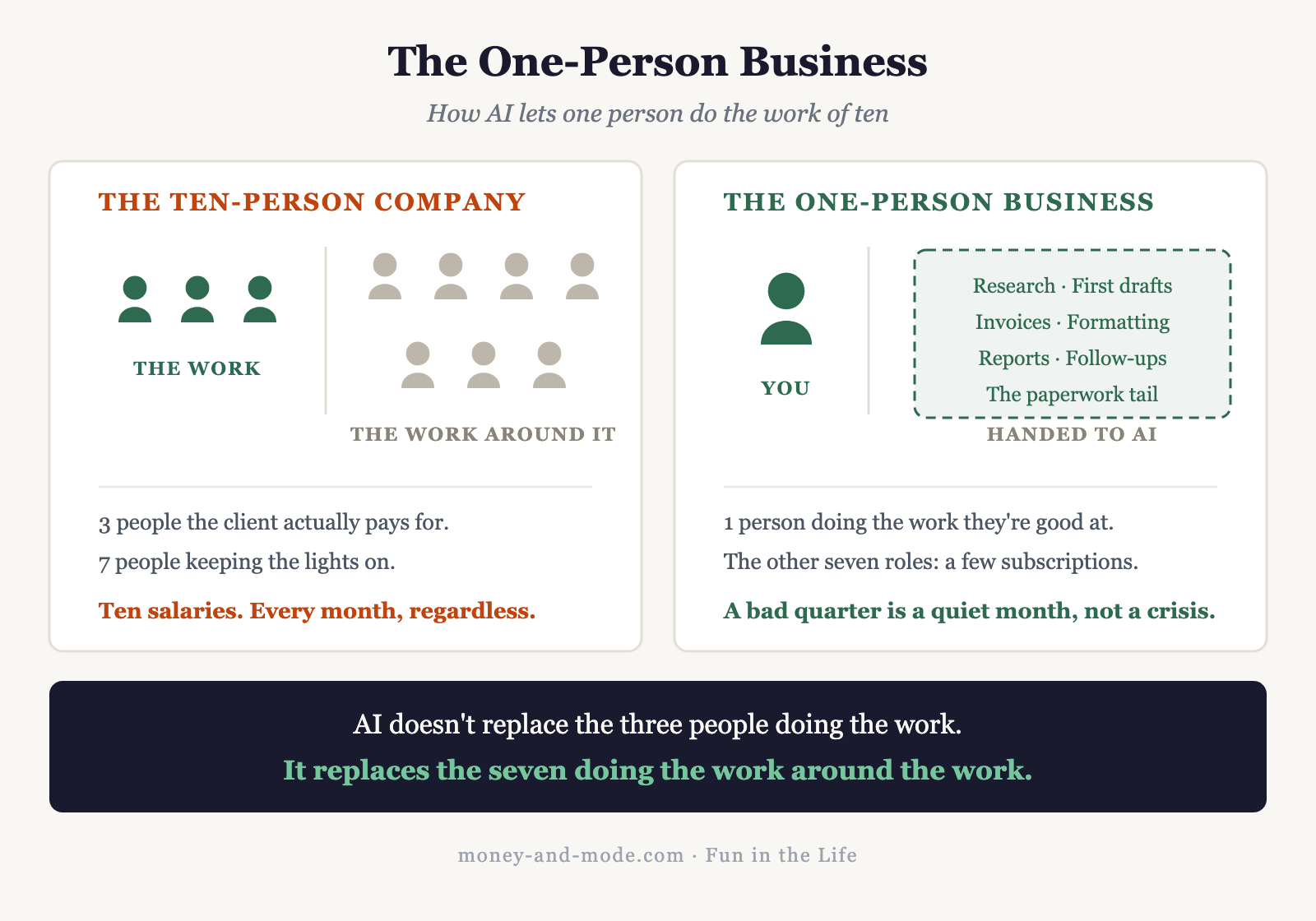
Think about a ten-person consulting firm. Maybe three people do the actual consulting. The rest: someone chasing invoices, someone writing proposals, someone doing research, someone managing the website, someone answering emails, someone formatting reports, someone keeping the books.
None of that is unimportant. All of it is necessary. But almost none of it is the thing the client is paying for.
A one-person business with AI does not replace the three consultants. It replaces the seven.
That distinction matters enormously, and most of the excited talk online gets it backwards.
What AI Actually Takes Off Your Plate
If you have read What Is an AI Agent?, you already know the key shift: a chatbot gives you an answer, an agent gives you a finished task. For a solo business owner, the second one is what changes the maths.
Here is what genuinely moves off one person’s plate today. Not someday. Today.
Research. What used to be an afternoon of reading before a client call is now twenty minutes. I ask for a briefing on a company, get it, then spend my time thinking about it instead of assembling it.
First drafts of everything. Proposals, reports, emails, contracts, that page on your website you have been avoiding for eight months. The first draft is the expensive part psychologically. Having one appear changes whether the task happens at all.
Formatting and cleanup. Turning a mess into a document. Turning a document into a presentation. This is pure drudgery and it consumes shocking amounts of a small business owner’s week.
The paperwork tail. Summarising statements, reconciling numbers, drafting the follow-up nobody wants to write. I gave an agent eleven months of bank statements recently and went to make tea. That story is in the agent article, and it is the honest version of what this looks like.
Being a second pair of eyes. Not always right — but it catches the thing you missed at 11 pm when there is nobody else to ask.
Add it up honestly across a week and it is not a small saving. For me it is somewhere between a day and a day and a half. That is the work of several people, recovered.
What AI Does Not Do (Be Very Clear About This)
I would be a poor guide if I stopped at the good news.
It does not bring you clients. Trust is still built by a human being who shows up, remembers your name, and does not disappear when things go wrong. No tool has solved this and I do not believe one is about to.
It does not have judgement about your specific situation. It knows what is generally true. It does not know that this particular client always goes quiet in August, or that this deal smells wrong.
It does not care. When something goes badly, the person who fixes it at midnight is you. That was true at ten people and it is true at one.
It does not remove the loneliness. This is the part almost nobody writes about. A team is not only labour — it is company. Running a one-person business means the wins are quieter and the bad days have no one in the room. Plan for that honestly.
And there is a trap worth naming: doing the work of ten people does not mean you should take on the work of ten people. That is just a more efficient way to burn out. The point of the leverage is to buy back your life, not to fill the space with more work — which is the same trap I wrote about in Stop Selling Your Time. Build Leverage Instead.
The Financial Case Nobody Mentions
A ten-person company in India costs you, conservatively, a serious monthly number before you have earned a rupee. Salaries, office, software, compliance, the accountant who handles the compliance.
A one-person business with good AI tools costs a few thousand rupees a month in subscriptions.
The difference is not just profit. It is risk. A bad quarter at ten people is a crisis with other people’s families attached to it. A bad quarter at one person is a quiet month.
I have lived through the first kind. I would not wish it on anyone.
Lower fixed costs also mean a far higher savings rate, and a higher savings rate is the entire game — as boring and true as index funds are. A one-person business is not only a way to work. It is one of the fastest routes to actually owning your time.
Where to Start If This Is You
Do not start by buying tools. Start by watching yourself for one week.
Write down every task you did that you did not want to do, and that did not require you specifically. Just the list. No judgement.
At the end of the week, look at it. That list is your hiring plan — except you are not hiring anyone. Take the single most repeated, most soul-draining item and hand only that one to AI for a month. Learn it properly.
Then take the next one.
That is genuinely it. The people I see doing this well are not using thirty tools. They are using two or three, deeply, on the specific parts of their week that were quietly killing them.
The Honest Summary
A one-person business used to mean accepting a smaller life. Fewer clients, less reach, a hard ceiling.
That is no longer true, and I say that as someone who built the alternative and paid for it in years.
But the goal was never to do the work of ten people. The goal was always to do the work you are good at, keep more of what you earn, and go home at a reasonable hour. AI just removed most of the reasons you could not.
What is the one task in your week that drains you most — the one that isn’t really your work at all? Tell me in the comments. I read every one.