
Something quietly strange has happened in modern life.
We are more desperate for deep connection than any previous generation. Therapy is booming. Loneliness is called an epidemic. Apps exist to help adults make friends. Entire industries are built around the human hunger to feel truly known.
And at the same time, we’ve quietly accepted an idea that would have seemed bizarre to almost every civilization before us: that when children grow up, family relationships naturally fade — and that this is healthy, even desirable.
I’ve been thinking about this tension for a long time. I don’t think it’s a coincidence.
The Independence Trap
Modern culture — particularly in the West, but spreading fast everywhere — has elevated independence as the highest personal virtue.
Move out at eighteen. Build your own life. Don’t lean on your parents. Don’t burden your children. Autonomy is maturity. Needing people is weakness.
There’s something real in that. Children do need to grow into their own people. Adults shouldn’t live as permanent dependents. Independence has genuine value.
But somewhere along the way, independence became a reason to stop investing in the very relationships where we first learned to be human.
We don’t call it abandonment. We call it respecting each other’s space. We call it healthy boundaries. We tell ourselves that occasional calls and holiday visits are enough — because isn’t that what adults do?
And then we wonder why we feel so alone.
You Cannot Learn Connection Anywhere Except Home
Here is something I believe with some certainty: connection is not an instinct. It’s a skill.
It has to be learned. Like all skills, it’s learned through practice — daily, repeated, unglamorous practice. And the first place that practice happens is in the family.
A child who grows up in a home where people talk honestly about what they feel, where parents and children actually know each other’s inner lives, where difficult conversations don’t end relationships — that child learns how to connect. They carry it with them. They know what real closeness feels like, so they can build it elsewhere.
A child who grows up in a home where everyone is physically present but emotionally absent — where conversations stay safe and surface-level, where vulnerability is treated as weakness — that child grows up not quite knowing how to be known. They want connection desperately. But they don’t know how to let it happen.
This is not a moral judgment. Most parents did the best they knew how. But the pattern matters: societies built on strong family connection produce people who know how to connect. That stability ripples outward — into marriages, friendships, communities, workplaces.
When the family fractures, the fractures travel.
What We’ve Traded and What It Cost
I think of the pace that many people now accept as normal — the long hours, the constant availability for work, the sense that productivity is the measure of a life well lived.
Some of this drive is admirable. Ambition and hard work are not wrong.
But when the work never stops, something pays the price. And what usually pays first is the relationship that requires the most of us: family.
A father who is too busy to know his son’s actual thoughts. (I wrote more about what that closeness actually looks like in the family that feels like heaven.) A mother who feels she knows her daughter’s schedule but not her fears. Adult children who call dutifully on birthdays but share nothing real.
This is not a failure of love. It is a failure of attention. And it is very common.
The cost shows up later, and it shows up everywhere. In the loneliness of the person who has achieved everything and feels nothing. In the marriages that collapse because neither person ever learned to be truly open. In the communities that are physically close but socially hollow.
Connection Does Not Require Proximity
One thing I want to say clearly: you don’t have to live next door to stay connected.
A father who works long hours in a demanding career can still know his son. Not through quantity of time — but through intentionality. A message sent that goes beyond logistics. A letter that shares what he actually believes about life. An email that says: here is what I’m thinking about this week, what are you thinking about?
It takes ten minutes. It builds something that lasts decades.
The same is true across any distance — geographic, generational, cultural. Connection is not about proximity. It’s about the decision to let someone see you, and to genuinely look at them in return.
Families that maintain this — even imperfectly, even inconsistently — hold together in ways that others don’t. They have a reference point. A sense of being known somewhere, by someone, in a way that doesn’t depend on performance or status.
That is not a small thing to give a child. Or to give yourself.
The Foundation Beneath Everything Else
Every major philosophical tradition and every serious religion, across cultures and centuries, arrives at roughly the same conclusion about what makes a human life good.
Not wealth. Not status. Not achievement.
Meaning. Relationship. The sense of belonging to something larger than yourself.
We are different from animals in one important way: we can reflect on our own lives. We can ask whether the way we’re living is actually working. We can choose differently.
The purely material life — optimised for income, status, and consumption — delivers some of what it promises. But it tends to hollow out over time. The people I’ve seen who are genuinely content in their later years are almost never the ones who optimised hardest for wealth. They are the ones who tended their relationships while they had the chance.
That’s not sentiment. That’s what the evidence of lived experience keeps returning.
The Circle Expands
Here’s how I think about it:
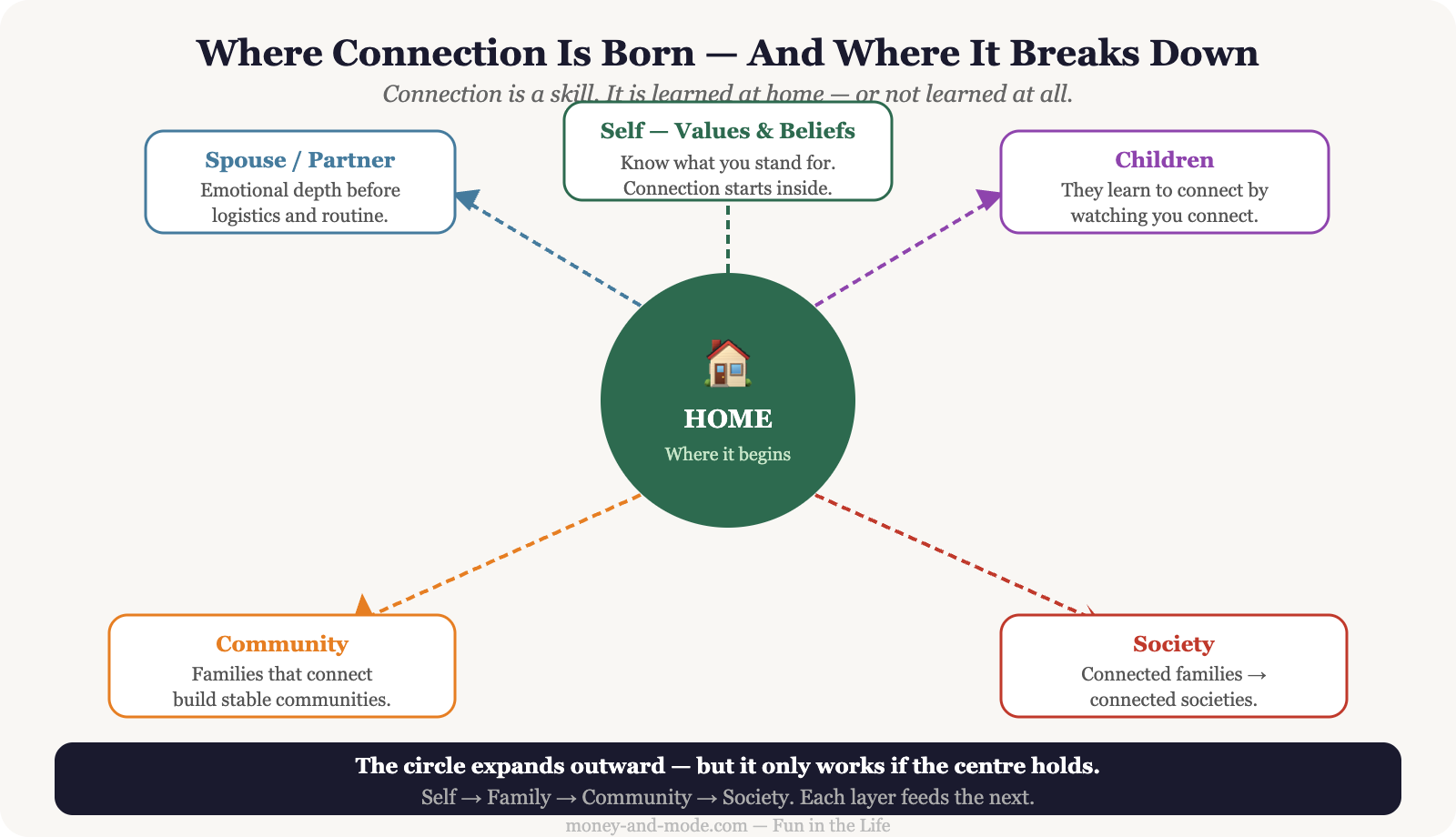
Start with yourself. Are you emotionally honest? Do you know what you actually value and believe? A person without a clear value system cannot be a reliable partner to anyone — not to a spouse, not to a child, not to a community.
Then the family. Are the people in your home actually known to each other? Not just their schedules — their fears, their hopes, their sense of what life is for?
Then the community. A family that has learned to connect becomes a resource for its community. The values don’t stay inside the walls.
This is how societies stay healthy — not through policy or prosperity alone, but through the transmission of something harder to measure: the capacity for genuine human connection, passed from generation to generation, beginning at the kitchen table.
Nobody is saying don’t build a career. Don’t make money. Don’t be ambitious. Build all the leverage you can.
Do all of that. But do it alongside the other thing — the harder, quieter, more important thing.
Stay connected. Start at home. Let it grow outward from there.
Frequently Asked Questions
Is connection a skill or an instinct?
A skill. Like all skills it is learned through daily, repeated, unglamorous practice — and the first place that practice happens is the family. A child raised in a home where people talk honestly about what they feel learns how to connect, and carries that everywhere else.
Why are we lonelier than ever?
Because we have made independence the highest personal virtue and quietly accepted that family relationships should fade once children grow up. We call it respecting each other’s space, or healthy boundaries. Meanwhile therapy is booming, loneliness is called an epidemic, and apps exist to help adults make friends.
Can you stay connected to family from a distance?
Yes. Connection is not about proximity — it is the decision to let someone see you, and to genuinely look at them in return. A message that goes beyond logistics. An email that says what you actually think about life. It takes ten minutes and builds something that lasts decades.
Does focusing on family mean giving up ambition?
No. Nobody is saying do not build a career, do not make money, do not be ambitious. Do all of that. The point is to do it alongside the harder, quieter thing — rather than letting the relationship that asks the most of you be the one that quietly pays the price.
In your own experience — is connection something you learned at home, or something you’ve had to figure out on your own? What do you wish had been different?