
Let me say something that most financial writers will not say plainly.
For the majority of people — the ones who do not love their work, who go every morning not because they are called to go but because the rent is due — a modern job is a form of financial slavery.
I do not say this to be dramatic. I say it because I believe it is the honest description, and honest descriptions matter when you are trying to change something.
You wake at a time not of your choosing. You go to a place not of your choosing. You spend the majority of your waking hours doing tasks largely chosen by someone else. You do this in exchange for a salary — which covers your expenses, which keep you needing the salary next month. The cycle continues until you are 60, or until the company decides it does not need you anymore, whichever comes first.
If you love your work — truly, genuinely love it — then this is not slavery. It is purpose. There are people like this. They are fortunate, and they are rarer than they appear.
The Two Calendars
I have kept a personal journal for over a decade. One question appears in it again and again, in different forms: am I building something, or am I just surviving?
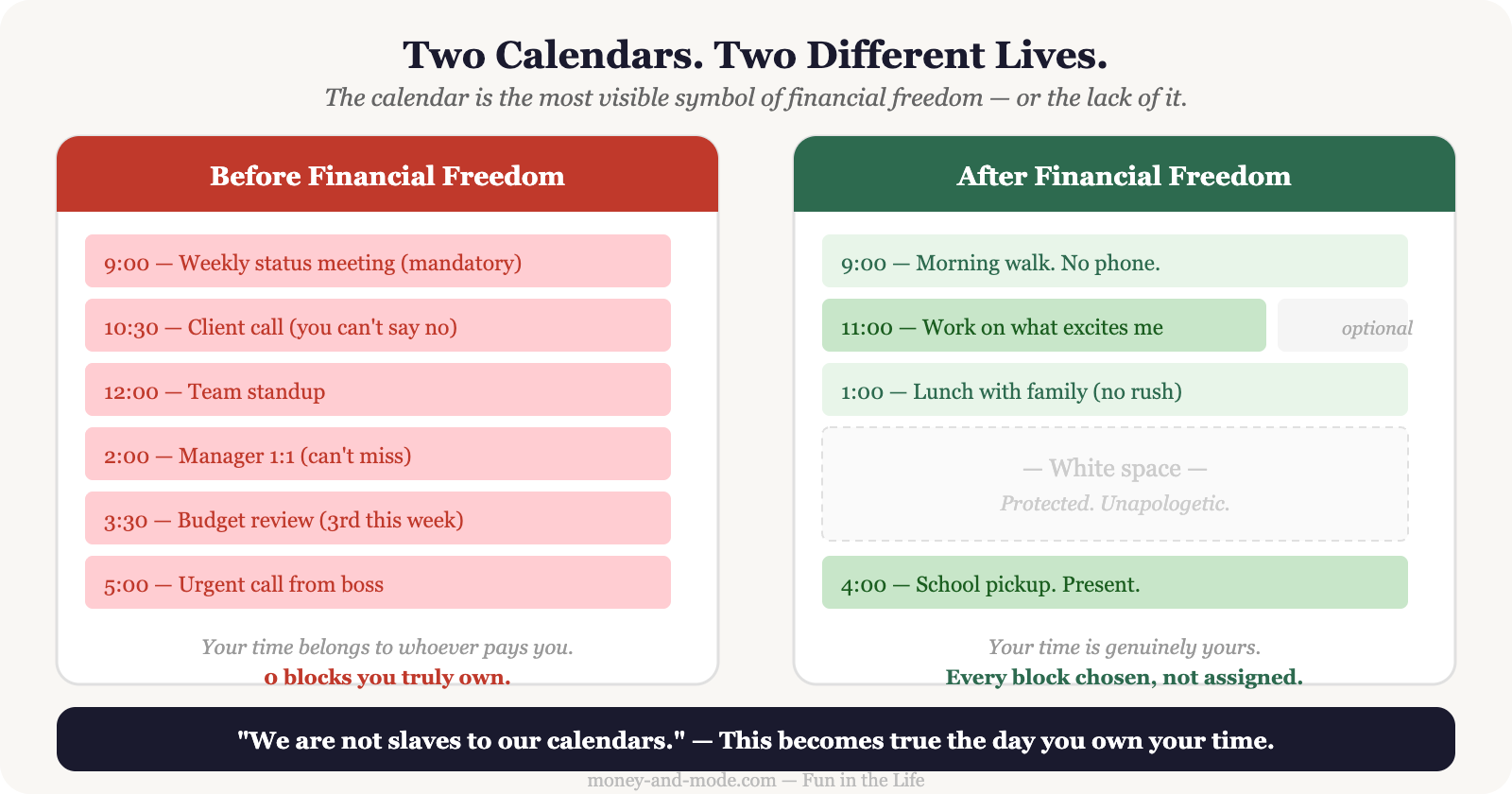
The calendar tells you the answer. A calendar packed with obligations — meetings at times you did not pick, about things that drain rather than feed you, with people whose priorities are not yours — is not a sign of importance. It is a sign of dependency. Your time belongs to whoever is funding it.
The financially free person’s calendar has white space. Real, protected, unapologetic white space — because white space is where thinking happens. Where family happens. Where the long thoughts that actually matter get thought.
The Trap Has a Name
The trap is comparison. We live inside a social circle — family, colleagues, neighbors, school friends — and we measure ourselves against them. Without quite noticing it, we make financial decisions not based on what we genuinely want, but based on what signals the right things to the people around us.
The car. The house in the right neighborhood. The school with the right name. These things are not inherently wrong. Some of them are genuinely enjoyable. But neuroscience has established quite clearly: the enjoyment fades faster than we expect.
This is called hedonic adaptation — the brain’s tendency to return to a baseline emotional state regardless of what happens to us. We upgrade our car and feel genuinely happy for a few months. Then it becomes the car. The pleasure is real but it is temporary. The expense is permanent. We are working, in many cases, to finance pleasures we will not remember.
Making Your Life Antifragile
The writer Nassim Taleb introduced a word I have thought about for years: antifragile. Fragile things break under stress. Resilient things survive stress. Antifragile things actually get stronger from stress.
Most people’s financial lives are fragile. One job loss, one medical emergency — and everything is at risk. Because the entire structure depends on a single salary arriving on time, every month, forever.
Financial freedom is the project of making your life antifragile. Not just resilient — but genuinely stronger under pressure. When markets fall, your investments buy more units at lower prices. When a recession hits, your diversified income streams mean no single source can cripple you. Problems become interesting challenges rather than existential threats.
What Owning Your Time Actually Looks Like
Let me describe, concretely, what owning your time actually looks like. Not the fantasy version — the real one.
It is not lying on a beach, which becomes boring within days. It is not endless travel, which becomes its own form of exhausting work.
Here is what it looked like in my own life, after I had built financial independence and moved back to India:
I worked in bursts. When a project genuinely interested me, I gave it everything. When it didn’t, I didn’t. Some mornings I woke up, looked at my calendar full of scheduled meetings, and cancelled all of them. No elaborate explanation. No guilt.
You wake when your body is ready. You have your coffee without looking at your phone, because nothing is urgent and nothing is demanding. You are present with your family in a way that is simply not possible when you are mentally carrying someone else’s quarterly targets. You read what you want to read. You have conversations that go where they want to go.
When something goes wrong — in business, in investments, in the wider world — you respond from a position of clarity and strength. You have time to think, financial cushion to absorb, and the mental spaciousness that comes from not being desperate. Problems become interesting challenges rather than existential threats.
What to Build
There is no single answer. But the building blocks are consistent across every person who has genuinely achieved financial freedom.
Investment income. A portfolio — of index funds, of carefully chosen equities — that grows through compounding and eventually generates income without requiring your attention.
A business that works without you. Not freelancing. A business with systems, with a team, with processes that continue when you step back.
The decision to stop comparing. This is not a financial asset, but it is the most important decision on this list. Exiting the comparison game is, financially, one of the most valuable moves you can make.
Here is the question I would leave you with — the one I have returned to in my journal more times than I can count:
If you did not need money from your work, would you still be doing what you are doing?
If the answer is yes — you are fortunate. If the answer is no — that is important information. Not about whether to quit tomorrow, but about what you are building toward.
Frequently Asked Questions
Why is selling your time a trap?
Because the cycle sustains itself. You wake at a time not of your choosing, go somewhere not of your choosing, and do tasks largely chosen by someone else — in exchange for a salary that covers expenses, which keep you needing the salary next month. It continues until 60, or until the company decides otherwise.
What does your calendar reveal about financial freedom?
A calendar packed with obligations you did not pick is not a sign of importance — it is a sign of dependency. Your time belongs to whoever is funding it. The financially free person’s calendar has real, protected white space, because that is where thinking, family and the long thoughts happen.
What is hedonic adaptation and why does it matter for money?
It is the brain’s tendency to return to a baseline emotional state regardless of what happens to us. You upgrade the car and feel genuinely happy for a few months. Then it becomes the car. The pleasure is real but temporary; the expense is permanent. Much of our spending finances pleasures we will not remember.
What does an antifragile financial life mean?
Fragile things break under stress, resilient things survive it, and antifragile things get stronger from it. Most financial lives are fragile — one job loss or medical emergency puts everything at risk, because everything depends on a single salary arriving on time. Diversified income turns problems into interesting challenges rather than existential threats.
What would you do differently if your income were fully covered by your investments? Tell me in the comments — I am genuinely curious.