
Two months ago, a friend of mine in Pune got a call that sounded exactly like his son’s voice — panicked, saying he’d been in an accident and needed money transferred immediately to a UPI ID for the hospital. The voice had the right accent, the right nervous laugh his son always did mid-sentence, even a phrase his son actually uses. My friend nearly sent the money.
He stopped only because something felt a half-second off, and he called his son’s number directly instead of the number that had called him. His son picked up from his hostel room, completely fine.
That voice on the phone was not his son. It was an AI scam — and this is exactly why every family needs to understand how to protect themselves from AI scams today, not someday.
I’m not telling you this to scare you. I’m telling you because I’ve spent 25 years around technology, and even I found this one unsettling enough to sit my own parents down and walk them through it, phrase by phrase, the way I’ll walk you through it now.
What Changed: Why AI Scams Feel So Different Now
Phone scams are old. What’s new is the voice.
Until recently, a scam call sounded like a stranger reading a script — wrong accent, wrong details, easy to catch. Today, a scammer needs as little as three to ten seconds of someone’s voice, often lifted from a YouTube video, an Instagram reel, or even a voicemail greeting, to generate a convincing clone. The AI doesn’t need to understand what it’s saying. It just needs to sound like someone you already trust.
That’s the whole trick. These scams don’t try to convince you of something implausible. They borrow the trust you already have for a real person and use it against you, at the worst possible moment — when you’re panicked and moving fast instead of thinking slowly.
In India specifically, this usually shows up in two forms: a fake distress call from a “family member,” or a fake bank/KYC-update call asking you to share an OTP or complete a UPI request to “verify” your account. Both work the same way. They manufacture urgency so you act before you check.
The Three AI Scams Hitting Indian Families Right Now
1. The Voice-Clone Distress Call. A cloned voice of your child, spouse, or parent calls (or messages via a voice note) claiming an emergency — accident, arrest, stranded somewhere — and asks for money to be sent immediately via UPI, usually to an unfamiliar ID.
2. The Fake KYC or Bank Verification Call. An AI-generated voice, sometimes paired with caller ID spoofing so it shows your actual bank’s number, tells you your account will be frozen unless you share an OTP or complete a “verification” UPI request right now.
3. The Deepfake Video Call. Less common but rising — a short video call where the face and voice both look and sound like someone you know, usually kept deliberately short and blurry (“bad network”) so you don’t notice anything off before the emotional ask comes.
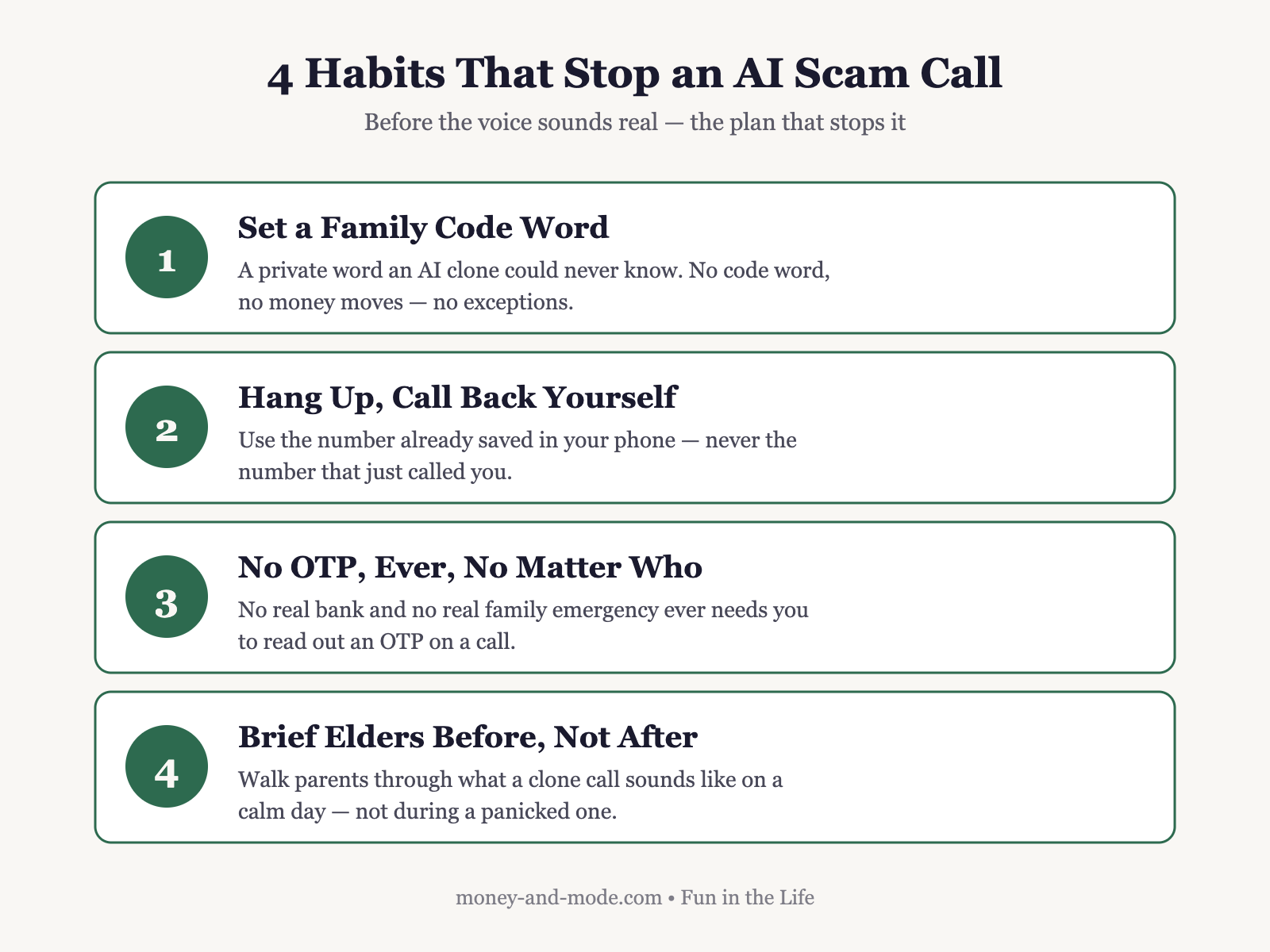
How to Protect Your Family From AI Scams: 4 Habits That Actually Work
1. Set a Family Code Word
This is the single most effective thing you can do, and it costs nothing. Agree on a private word or question with your immediate family — something an AI clone would have no way to know. If anyone calls in “distress” asking for money, the code word gets asked before anything else moves. No code word, no transfer, no exceptions, even if the voice sounds perfect.
2. Hang Up and Call Back on a Known Number
If a call demands urgent money or an OTP, hang up. Then call the person back yourself, on the number you already have saved for them — never the number that called you, and never a number given to you during the call. This single habit defeats almost every version of this scam, because the scammer’s whole plan depends on you staying on their line.
3. No OTP, Ever, No Matter Who’s Asking
No real bank, no real family member in a genuine emergency, and no real government office will ever need you to read out an OTP over the phone. This one is worth repeating to parents specifically, since OTP-sharing scams target older adults far more than voice-clone scams do. If anyone asks for an OTP on a call, the call is fraudulent — full stop.
4. Sit Down With Older Family Members Before It Happens, Not After
This is the part most families skip, and it’s the one I’d push hardest. Don’t wait for a scare to explain this. Sit with your parents or older relatives this week, calmly, and walk through exactly what a voice-clone or fake-KYC call sounds like, using this article if it helps.
My own parents’ reaction, when I first explained AI voice cloning to them, was disbelief — “how can a machine sound exactly like him?” That disbelief is precisely the gap scammers are counting on. Close it in a calm conversation now, not in a panicked phone call later.
A Personal Note
I think about my friend’s near-miss often, mostly because of how close it actually was — not because the scam was clever, but because the emotion was real. He wasn’t foolish. He was a father who heard his son’s voice in distress and reacted the way any of us would. That’s the part technology can’t fully protect against; only a habit built in advance can.
This connects to something I’ve written about before: real connection across generations in a family isn’t built during a crisis, it’s built in the ordinary conversations before one. The code word, the “call back on a known number” rule — these work precisely because you agreed on them on a quiet Sunday, not because you figured them out mid-emergency.
If you’re newer to how AI actually works day to day, it helps to first understand what an AI agent actually is and how these systems generate convincing output from very little input — it demystifies why a “three-second voice clip” is enough, and makes the whole thing far less mysterious and far less frightening.
And if you want the same AI that scammers misuse working for you instead, I’ve shared how I personally use it every week in 5 AI habits that save me 10 hours — the technology itself isn’t the villain here. Being unprepared for how it can be misused is.
The One Conversation to Have This Week
You don’t need to become a cybersecurity expert. You need one 15-minute conversation with the people you love most: agree on a code word, agree to always call back on a known number, agree that no one ever shares an OTP over the phone. That’s it. That’s the whole defense, and it works against nearly every version of this scam making the rounds right now.
Frequently Asked Questions
How does an AI voice-clone scam call actually work?
A scammer feeds just three to ten seconds of someone’s real voice — often lifted from a YouTube video, Instagram reel, or voicemail greeting — into an AI tool that generates a convincing clone. The clone doesn’t need to understand what it’s saying; it only needs to sound familiar enough that you react on trust instead of checking first.
What is the single best way to stop a voice-clone scam?
Agree on a private family code word that only real family members would know, and never move money or share an OTP until it’s given. It costs nothing, takes five minutes to set up once, and defeats the scam regardless of how convincing the cloned voice sounds.
Should I ever share an OTP over the phone?
No, never — not with a bank, not with a government office, and not with a family member in a genuine emergency. No legitimate caller needs you to read out an OTP. If anyone asks for one on a call, treat the call as fraudulent and hang up.
How do I explain this to my parents without scaring them?
Have the conversation on a calm day, not after a close call. Explain plainly that a machine can now copy a familiar voice from a few seconds of audio, then agree together on the code-word and call-back-on-a-known-number habits — the explanation matters less than the two habits actually sticking.
Has your family already had a close call with a scam like this — or have you set up a code word of your own? I’d genuinely like to hear how you’re handling it. Drop a comment below.