
I did the math on a bad Sunday night in August, mostly out of guilt. I run Cymetrix, a 37-person company, and for years my honest answer to “how do you have time for all this?” was that I didn’t, not really. I just moved the tiredness around.
Then I actually timed a week. Five habits, all built around AI, were quietly giving me back close to 10 hours I used to lose to email, research, meeting notes and first drafts. None of them are clever. None needed a new app. Here is exactly what they are.
Why I Stopped Counting “Using AI” as One Thing
For a long time I thought of AI as one big vague habit — “I use Claude a lot.” That framing was useless. It told me nothing about where the time actually went, so I could never tell what was working and what was just noise.
What changed things was breaking it into five specific, repeatable moments in my day. Each one is small on its own. Together they add up to a real second job’s worth of hours, handed back every single week.
Habit 1: A Five-Minute Morning Triage (Saves ~90 Minutes a Week)
Every morning, before I open email, I ask AI to sit between me and my inbox for five minutes. Not to answer anything — just to sort it. What actually needs me today, what can wait, what is noise.
This only works because of something I wrote about before: keeping AI as a second brain, a single file that already knows what I’m working on this year, who my team is, and what I consider urgent versus what I consider a distraction dressed up as urgent.
Without that context, the triage is generic and I ignore it. With it, five minutes most mornings replaces the 20 minutes I used to spend scrolling my inbox top to bottom, deciding priority as I went, one email at a time.
Habit 2: Meeting Notes That Turn Into Action Items on Their Own (Saves ~2 Hours a Week)
I sit in a lot of client and team calls. For years, “notes” meant a half-page of my own handwriting that I’d try to decode two days later, usually failing.
Now every serious call gets recorded and summarized, with a short prompt: what did we actually decide, who owns what, and what changes if nothing happens by Friday. That last question is the one that matters — it forces a real answer instead of a vague summary.
This alone gives back close to two hours a week that used to go into re-listening to bits of calls or, worse, into meetings we didn’t need because nobody remembered what the last one had already settled.
Habit 3: First Drafts of Everything, Never Blank Pages
I no longer start anything from zero — not a client email, not a proposal, not a LinkedIn post, not a difficult message to someone on my team. AI writes the first version. I edit it into something that sounds like me.
This is a skill, not a trick, and it took me longer to get comfortable with than I expected. How to Talk to AI is the piece I wish I’d read a year earlier — the difference between a useless draft and a genuinely useful one is almost entirely in how you ask.
The honest math here: writing something from a blank page used to take me 25 to 40 minutes, depending on how much I was avoiding it. Editing a first draft into shape takes 8 to 10. Across a normal week of five or six of these, that’s about 2.5 hours back — and, just as important, five fewer things I was quietly dreading on my to-do list.
Habit 4: A Quick Gut-Check Before Any Real Decision (Saves ~90 Minutes a Week)
Before I say yes to a vendor, a hire, or a new tool for the business, I ask AI to do a fast first pass — what’s the standard price range, what do people usually get wrong here, what question am I forgetting to ask.
It is not the final word. It is a way to walk into the real conversation already informed instead of finding out afterward that I missed something obvious. That habit alone has saved me from at least two bad decisions this year that I would have made purely on a good sales pitch.
This is close in spirit to what I wrote about running a lean team in The One-Person Business — the leverage isn’t that AI decides for you. It’s that the research that used to take an hour of scattered tabs now takes ten minutes, so you actually do it instead of skipping it under deadline pressure.
Habit 5: A Ten-Minute Friday Number Check (Saves ~2.5 Hours a Week)
Every Friday, I ask AI to pull together what actually happened this week against what I expected — revenue, pipeline, anything that’s drifting off track at Cymetrix. Not a full report. Just: what changed, and what should I actually worry about going into next week.
This replaced a much longer ritual of pulling numbers from three different places myself, comparing them by eye, and usually missing the one thing that mattered because I was tired by the time I got to it on a Friday afternoon. Ten focused minutes, with the pulling-together already done, beats an exhausted hour of me doing it manually every time.
What This Actually Adds Up To
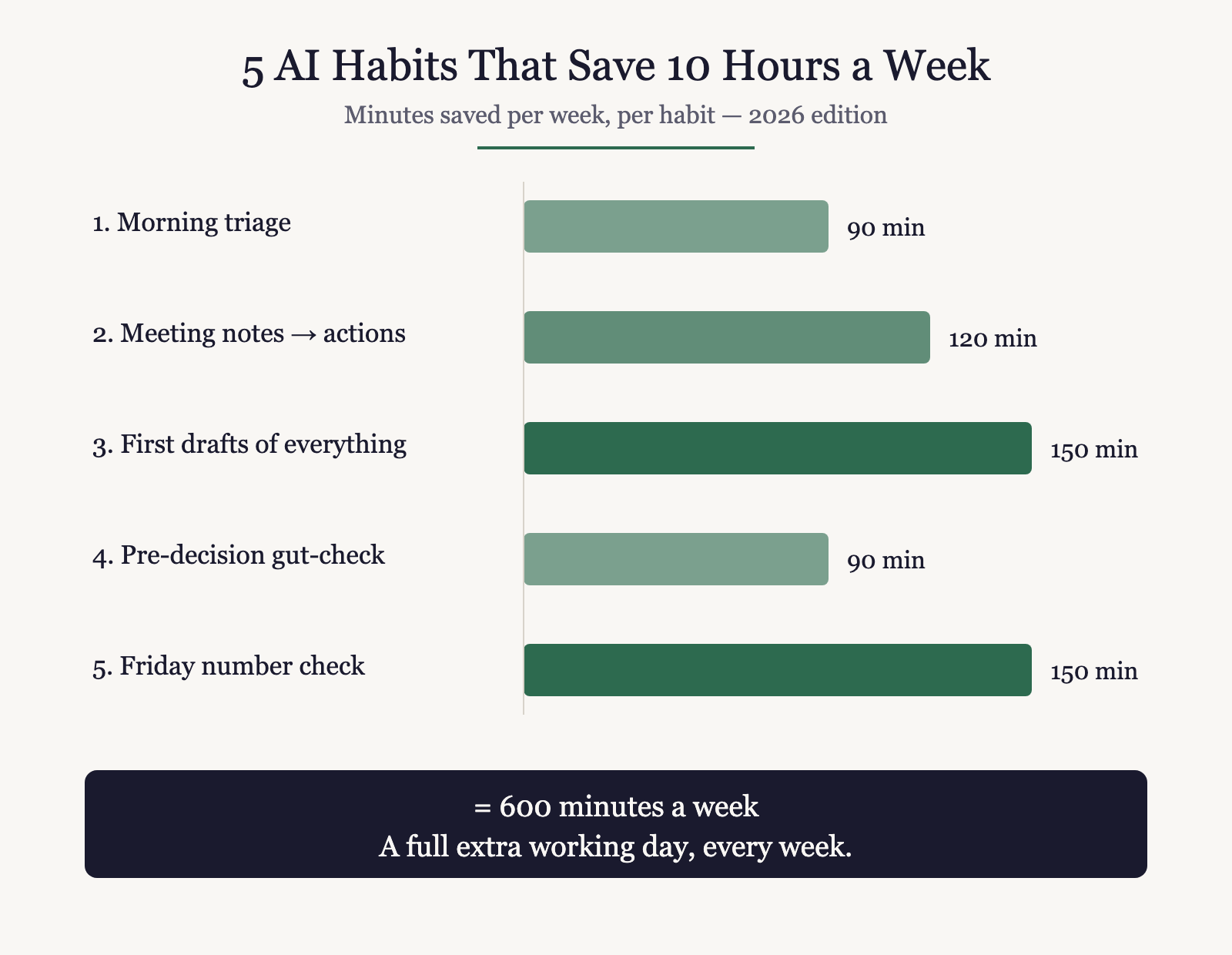
| Habit | Time Saved Per Week |
|---|---|
| Morning triage | ~90 minutes |
| Meeting notes → action items | ~2 hours |
| First drafts of everything | ~2.5 hours |
| Pre-decision gut-check | ~90 minutes |
| Friday number check | ~2.5 hours |
| Total | ~10 hours |
Ten hours a week is a full extra working day, every single week, for the rest of the year. I did not get it by working faster. I got it by not starting five different things from zero, over and over, all week long.
What I’m Still Careful About
None of these five habits involve me handing over a decision that actually matters. AI drafts, summarizes, and does the first pass. I still read every email before it sends, still make the actual call on the hire or the vendor, still own what the Friday numbers mean for the business.
That caution isn’t optional, and it isn’t paranoia either — it’s just where the judgment still has to live. The time comes back from skipping the blank page and the scattered tabs, not from skipping the thinking.
Start With Just One of These
You do not need all five habits at once, and you definitely do not need a new app to start. Pick the one that matches your worst Monday morning — probably the inbox triage or the first-draft habit — and run it for two weeks before you touch anything else.
The time doesn’t show up all at once. It shows up quietly, most noticeably on the Friday you realize you actually finished the week instead of dragging the last of it into the weekend.
Frequently Asked Questions
What are good daily AI habits for saving time?
Five that work in practice: a five-minute morning inbox triage, turning meeting recordings into notes and action items automatically, using AI for the first draft of every email or document, running a quick research gut-check before big decisions, and a short Friday review of what actually happened that week. Together they can save roughly 10 hours a week.
How much time can AI habits actually save each week?
In one real week of tracking: about 90 minutes from morning inbox triage, 2 hours from meeting notes turning into action items, 2.5 hours from AI-drafted first drafts, 90 minutes from pre-decision research, and 2.5 hours from a Friday number review — close to 10 hours total, roughly a full extra working day.
Do I need a new app to build AI habits like these?
No. None of these five habits require new software — they are prompts and routines built around a general AI assistant you likely already use. The habit is the five-minute or ten-minute ritual itself, not a specific tool.
Is it safe to let AI make decisions for you?
No, and none of these habits do that. AI drafts, summarizes, and does the first pass of research — a person still reads every email before it sends, still makes the actual call on a hire or vendor, and still owns what the numbers mean. The time saved comes from skipping the blank page, not from skipping the judgment.
Which of these five would save you the most time right now — and what’s stopping you from starting it this week? I’d genuinely like to know in the comments.