
The most useless financial advice I ever received was also the most repeated: keep three to six months in an emergency fund. Nobody ever told me three to six months of what, or what would happen on the day I actually needed it.
I found out the hard way, in my late twenties, when a client who owed my young company two months of billing simply stopped replying. Payroll was in nine days. I had a good business, a good year behind me, and almost nothing liquid — every bit of money I had was busy being productive somewhere else.
I made it through by borrowing at a rate I am still slightly embarrassed about. The business was never in danger. My judgment was, though: for nine days I was ready to accept almost any deal from anyone, because I needed cash more than I needed good terms.
That is the thing nobody tells you about an emergency fund. It is not really about surviving. It is about not having to make bad decisions quickly.
Three to Six Months of What, Exactly?
The standard advice fails at the first word after the number.
Three to six months of your salary is far too much. You do not need to replace your gross income during a crisis — you need to keep the lights on.
Three to six months of your current spending is closer, but still wrong, because your current spending includes things that would obviously stop in a real emergency: the holiday, the restaurants, the subscriptions, the extra investing.
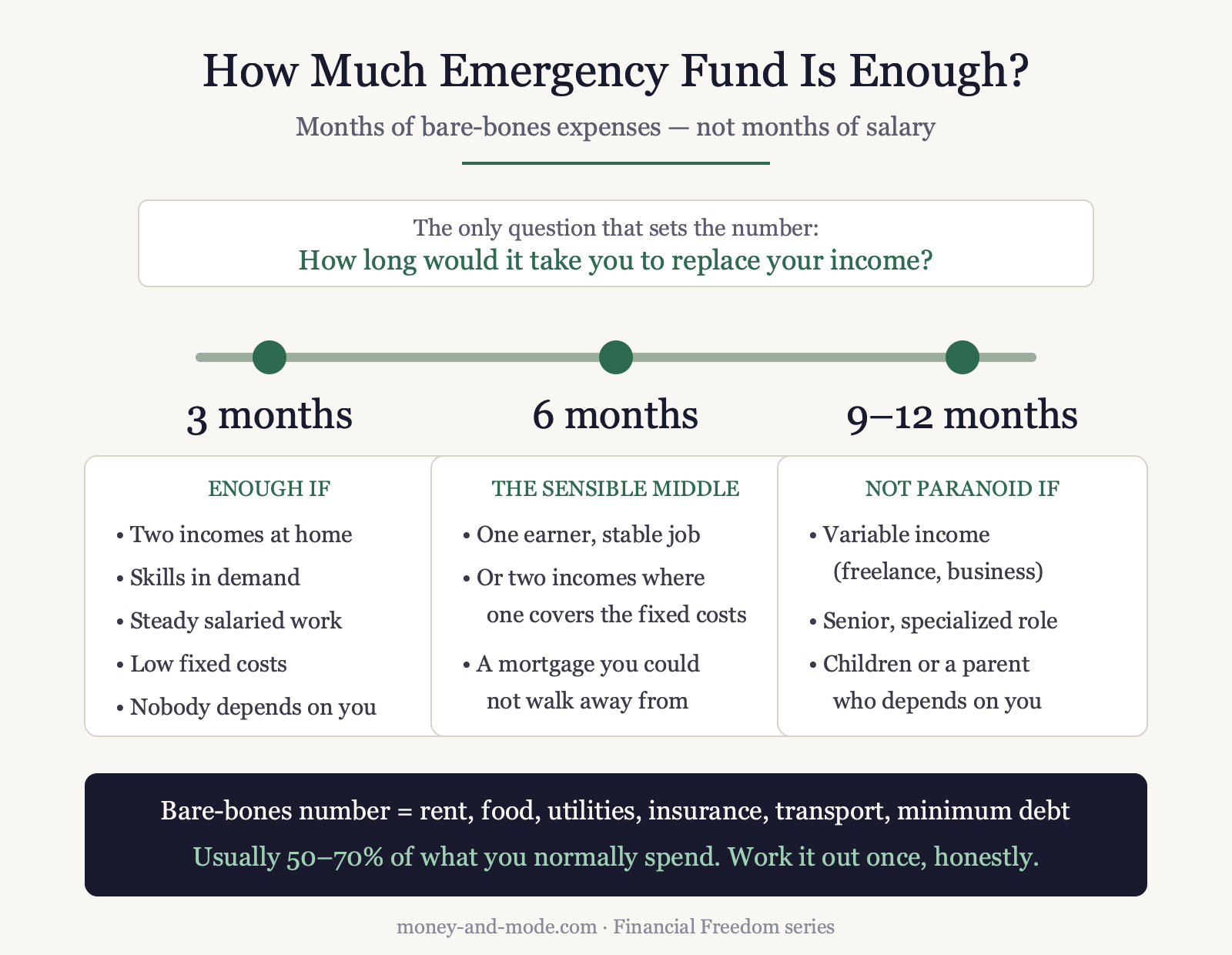
What you actually need is months of your bare-bones number — rent or mortgage, food, utilities, insurance, transport to work, minimum debt payments, childcare. The version of your life with the fun removed but the roof intact.
For most people that is somewhere between 50% and 70% of what they normally spend. So work it out, once, honestly. It is a smaller and much less frightening number than the one in your head, and everything else in this article depends on it.
How Much Emergency Fund Do You Actually Need?
Once you have the bare-bones number, the question stops being “three or six?” and becomes a much better one:
How long would it realistically take me to replace my income?
That is the whole calculation. Everything else is detail.
A software engineer in a hot market with two months of severance and a working spouse is in a completely different position from a single-income freelancer in a small town. Handing both of them the same “six months” is lazy advice.
Here is how I would actually place someone on the scale.
Three months is enough if you have two incomes in the household, your skills are in demand, your work is salaried and steady, your fixed costs are low, and nobody else depends on you financially.
Six months is the sensible middle for a single earner in a stable job, or a two-income household where one income covers most of the fixed costs.
Nine to twelve months is not paranoid if your income is variable — freelance, commission, consulting, business owner — or your role is senior and specialized enough that finding the next one takes a long time.
Senior people are not more employable. They are less. There are fewer chairs at that level and it takes months to find an empty one.
Add a month or two to whatever you land on if you have children, an older parent you help, a mortgage you could not walk away from, or a health situation in the family.
I have run a consulting business for most of my adult life, which means my income has never once been the same two years running. I keep closer to twelve months than to three. Not because I am nervous, but because I know exactly what nine days of desperation feels like and I do not want a repeat with more at stake.
What Counts as an Emergency
A fund that gets raided is not a fund. But being too strict is its own kind of failure. People who refuse to touch their savings end up putting the car repair on a credit card at 24%, which is a much more expensive way to have an emergency.
The test I use has three parts. It has to be unexpected, necessary and urgent. All three.
The car breaks down and you need it for work: all three. The roof leaks: all three. A medical bill: yes, obviously.
A wedding you were invited to eight months ago is necessary and perhaps urgent, but it is not unexpected. That is a savings goal, not an emergency. And a very good deal on something you have always wanted is none of the three, however good the deal is.
Job loss is the big one, and it is the reason the fund exists at all. Everything else is a rehearsal.
Where to Keep an Emergency Fund
Boring, liquid, and slightly annoying to reach. In that order.
Boring means a high-yield savings account or a money market fund. Not the stock market. This is the one pot of money where the goal is not growth — it is certainty.
Money you might need in a bad month cannot be invested in something that falls 30% precisely because the month is bad. That is the whole problem: emergencies and market crashes are correlated. The month you are laid off is often the month your portfolio is down.
This is the one place where the advice I gave about boring index funds does not apply. Index funds are for money you will not touch for a decade. An emergency fund is for money you might need on Tuesday.
Liquid means you can have it in two days, without penalty, without selling anything, without asking anyone.
Slightly annoying to reach means a different bank from your everyday account, with no debit card attached. You want a small amount of friction — enough that spending it takes a decision, not a tap.
And whatever you do, automate the filling of it. As I wrote about lifestyle inflation, money you never see is remarkably easy not to spend. The same trick that builds wealth builds the safety net.
Emergency Fund or Pay Off Debt First?
This is the question I get most, and there is a clean answer.
If you have credit card debt at 20% or more, a full six-month fund is not your first move. Paying that down is a guaranteed 20% return, which is roughly double what the stock market has historically managed, and it is not even risky.
But do not go to zero cash either. The sequence that works:
- Save a starter fund of about $1,000 to $2,000. Enough to absorb a car repair or a medical bill without new debt.
- Kill the high-interest debt. All of it.
- Then build the real fund to your number over the following year.
The starter fund exists so that step 2 does not get undone by an ordinary bad week. Without it, every small emergency goes straight back onto the card and you never actually finish.
Once the debt is gone, the money that was servicing it is the single easiest boost your savings rate will ever get. Point it at the fund first, then at your investments, and do it automatically before you have a chance to notice it.
The Return Nobody Puts on a Spreadsheet
The common objection to holding a lot of cash is that it is lazy money. Twelve months of expenses sitting in a savings account, earning less than inflation in a bad year — you can calculate exactly what that costs you over a decade, and it is not nothing.
I have run that calculation on my own money. It cost me real returns. I would do it again.
Because the actual return on an emergency fund is not interest. It is the list of things you never have to do.
You do not sell your investments at the bottom of a crash to cover rent. That single avoided mistake can outweigh a decade of the interest you gave up.
You do not take the first job you are offered. You take the third, which pays more and does not make you miserable, because you can afford to wait six weeks.
You do not borrow at 24%. You do not ask family. You do not lie awake. And in my case, you do not spend nine days negotiating from a position where the other side can smell it.
Financial freedom is usually described as a big number — the 25× target I wrote about in The 4% Rule Explained. But it does not arrive all at once on the day you hit it. It arrives in installments, and the emergency fund is the first one.
The first time you face a genuinely bad month and your reaction is mild irritation rather than fear, something permanent has changed. You are not free yet. But you have stopped being fragile, and that is the part of freedom that arrives earliest.
Frequently Asked Questions
How much emergency fund do I actually need?
It depends on one thing: how long it would realistically take you to replace your income. Three months is enough with two household incomes, in-demand skills and low fixed costs. Six months is the sensible middle for a single earner in a steady job. Nine to twelve months is not paranoid if your income is variable or your role is senior and specialized.
Is an emergency fund three to six months of salary or expenses?
Neither, exactly. You do not need to replace your gross salary during a crisis, and your current spending includes holidays, restaurants and subscriptions that would stop anyway. What you need is months of your bare-bones number — rent, food, utilities, insurance, transport, minimum debt payments and childcare. For most people that is 50–70% of normal spending.
Where should I keep my emergency fund?
Boring, liquid and slightly annoying to reach. A high-yield savings account or money market fund, never the stock market — emergencies and market crashes are correlated, so the month you are laid off is often the month your portfolio is down. Keep it at a different bank from your everyday account with no debit card attached.
Should I build an emergency fund or pay off debt first?
Both, in sequence. Save a starter fund of about $1,000 to $2,000 first, then kill any debt above 20% — paying that down is a guaranteed 20% return — then build the full fund over the following year. The starter fund exists so an ordinary bad week does not put the debt straight back on the card.
What actually counts as an emergency?
A three-part test: it must be unexpected, necessary and urgent, all three. A car you need for work breaking down qualifies. A wedding you were invited to eight months ago is necessary but not unexpected — that is a savings goal. A very good deal on something you have always wanted is none of the three.
What is the emergency that taught you your number — and had you worked it out before it happened, or after? I’d love to hear it in the comments.