
Open your Instagram feed or YouTube shorts for five minutes. You’ll find someone selling you the dream: make money while you sleep. Earn without working. Build passive income and escape the rat race — just buy their $997 course to learn how.
I’ve been building businesses since my late twenties. I sold my first software company at 31. I know what income from assets actually looks and feels like.
And I’m here to tell you: almost none of what’s being sold as passive income is actually passive.
Let me explain what’s really going on — and what genuinely works.
What Passive Income Actually Means
The phrase “passive income” gets used so loosely it’s nearly meaningless now.
Here’s a cleaner definition: passive income is income that requires minimal ongoing active work, after significant upfront work or capital investment.
Notice what that definition includes: significant upfront work or capital investment.
This is the part the Instagram gurus leave out.
ALL income is earned. Every single dollar. The question is only when you do the earning. You either front-load the work — building a product, a rental property, a portfolio — or you front-load the capital by investing a large sum that generates returns. There is no income that requires neither work nor capital. Anyone promising you that is lying, or genuinely confused.
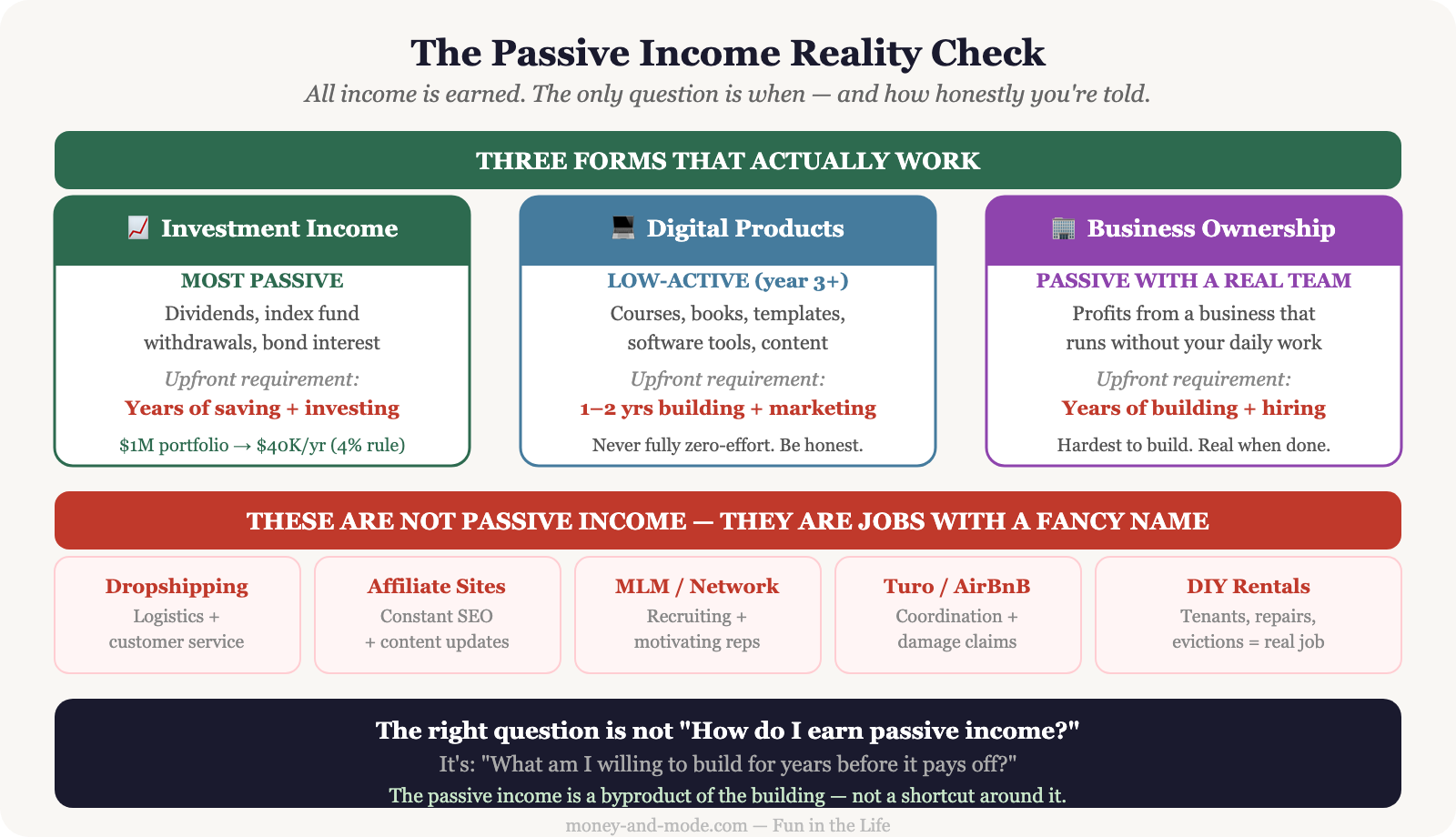
Three Forms That Actually Work
1. Investment Income
This is the most genuinely passive form of income that exists. Dividends from stocks, interest from bonds, and systematic withdrawals from an index fund portfolio.
You put money in. The market compounds it. You draw a percentage out each year.
At a 4% withdrawal rate — the well-researched safe withdrawal rate from the Trinity Study — a $1 million portfolio generates $40,000 per year without touching the principal. You do not manage tenants. You do not create content. You do not take calls. You literally own small pieces of hundreds of companies and collect your share of their earnings.
The catch is obvious: you need the portfolio first. Building $1 million takes years of earning, saving, and investing at a high savings rate. But here’s what people miss — you don’t need to wait until you hit $1 million to start. Even $200,000 in a portfolio generates $8,000 per year. That’s a meaningful supplement to other income. And it grows.
This is where I’d tell almost everyone to start. Open a brokerage account. Put money in a total market index fund. Repeat monthly. The passive income will come. It just comes after the patient accumulation, not instead of it.
2. Digital Products and Content
A book, an online course, a Notion template, a software tool. These can genuinely earn while you sleep — I’ve seen it happen.
But here’s the passive income truth they don’t tell you: year one of building a digital product is not passive at all. It is extremely active. You are creating, revising, marketing, building an audience, troubleshooting, answering questions, and doing it all without certainty that anyone will pay for it.
Year three, if the product is good and you’ve built an audience, starts to look more passive. The product is already built. Reviews and word-of-mouth drive some sales. If you’ve done good SEO work, search traffic finds you.
Even then — maintaining a course, updating content, handling customer service — it never fully goes to zero effort. The more accurate framing is low-active income, not passive income. That’s still worth building. Just go in with honest expectations.
3. Business Ownership with a Real Team
This is what I actually did. And it is real — but it is also the hardest to build.
When I ran my first SaaS company, I was working 60-hour weeks for years. The “passive” phase came later, once we had a team with clear ownership, systems that ran without my daily involvement, and leaders who could make decisions I used to make. By the time I exited, the business ran largely without me.
That is genuine passive income — the profits of a business that doesn’t need you to show up. But it is not quick, and it is not cheap. It requires years of building, hiring, training, and letting go of control. Most entrepreneurs find that last part hardest.
What Is NOT Passive Income
Let me save you some time and money.
Dropshipping — You are running a logistics and customer service operation. Suppliers change, products get discontinued, ads need management, refunds happen. It’s a job.
Most affiliate websites — Require constant SEO maintenance, content updates, and link-building to stay ranked. Google algorithm changes can wipe out years of work overnight. Not passive.
MLM / network marketing — It’s sales work. Full stop. The “passive income” from your “downline” requires you to recruit and motivate other salespeople continuously.
Renting your car on Turo — You are coordinating pickups, handling damage claims, cleaning the vehicle, and managing availability. It’s operations work.
Rental properties without a property manager — Tenants call at midnight. Pipes burst. You interview applicants and handle evictions. Property management is a real job. With a property manager, it becomes more passive — but the manager costs 8–12% of rent, and you still own the decisions.
None of these are bad ways to make money. Some of them are genuinely profitable. But calling them passive income is dishonest.
The Question Nobody Asks
When people ask me how to earn passive income, I always say the same thing: that’s the wrong question.
I never set out to earn passive income. I set out to build something useful — a software product that solved a real problem, a team that could serve customers better than I could alone — real leverage instead of selling my time, a portfolio that compounded without my attention.
The passive income was a byproduct of the building.
When you start by asking “how do I earn passive income?”, you’re already looking for shortcuts that don’t exist. You end up buying courses, trying dropshipping, joining MLMs — chasing the dream of income without effort, and finding only effort without reliable income.
The better question is: What am I willing to build for years before it pays off?
Investment portfolio? Digital product? A business? Pick one. Do the work. The income eventually becomes passive — because you front-loaded the effort while others were looking for shortcuts.
Where to Start Today
If you’re starting from scratch, here’s my honest recommendation: begin with investment income, because the path is clearest.
Open a brokerage account at Fidelity, Vanguard, or Schwab — today, not next week. Set up an automatic monthly transfer to a total market index fund. Make it an amount that is slightly uncomfortable but survivable. Then forget about it.
In 15 years, you will have genuinely passive income from a portfolio that earns dividends and grows through market returns. That’s not exciting. It’s not an Instagram story. But it is real, and it works.
Everything else — the course, the rental, the business — those can come alongside. But start with the boring foundation.
Frequently Asked Questions
Is passive income real?
Partly. A cleaner definition is income that requires minimal ongoing active work after significant upfront work or capital investment. All income is earned — the only question is when you do the earning. You either front-load the work or front-load the capital. Anyone promising neither is lying, or genuinely confused.
Which forms of passive income actually work?
Three. Investment income is the most genuinely passive — a $1 million portfolio at a 4% withdrawal rate generates $40,000 a year. Digital products and content, which are honestly low-active rather than passive. And business ownership with a real team and systems that run without you.
What is not passive income?
Dropshipping, which is a logistics and customer service operation. Most affiliate websites, which need constant SEO maintenance. MLM and network marketing, which is sales work. Renting your car on Turo, which is operations. And rental properties without a manager. Some are profitable — but calling them passive is dishonest.
Where should a beginner start with passive income?
With investment income, because the path is clearest. Open a brokerage account at Fidelity, Vanguard or Schwab, set up an automatic monthly transfer into a total market index fund, make it slightly uncomfortable but survivable, then forget about it. Even $200,000 invested generates about $8,000 a year.
What’s the biggest misconception about passive income you’ve encountered — and have you ever tried to build one of these income streams yourself?