
Eleven years ago I started writing a few lines every night, mostly because I couldn’t sleep and my head was too loud to just lie there. I had no plan for it. I wasn’t trying to become a “journaling person.” I just needed somewhere to put the noise.
Eleven years and thousands of entries later, I can tell you exactly what that habit gave me. It didn’t make me more productive. It didn’t organize my life. What it did was much bigger and much quieter than that: it taught me how peace actually works.
Peace Is Not the Absence of Problems
For most of my life I assumed peace was a destination — a place you arrive at once enough things go right. Enough money in the bank. Enough success. Enough of the big problems solved. Then, finally, peace.
Eleven years of writing down what was actually happening in my head, night after night, killed that idea completely. I have journal entries from good years and bad years, from months the business was thriving and months I wasn’t sure it would survive. And here’s the strange part: the peaceful entries and the chaotic entries don’t line up neatly with the good years and bad years at all.
Life is full of the battle of mind and emotions, and nothing else. That’s not a complaint. It’s just the accurate description. The external circumstances change constantly — a client wins, a client leaves, a son moves to San Francisco, a health scare, a good quarter. But the daily fight is always the same fight: what my mind does with whatever just happened.
Peace, I learned, isn’t what’s left when the problems go away. Problems never fully go away. Peace is what’s left when you stop resisting the fact that they’re there.
The One Sentence That Changed Everything
Somewhere around year four, I wrote a line in my journal that I’ve come back to more than any other single thing I’ve ever written: take life as it comes, just not resist anything.
I didn’t know it at the time, but that sentence became the closest thing I have to a personal philosophy. Not passivity — I still work hard, I still make plans, I still try to fix what’s fixable. But underneath all of that, a different question runs: am I resisting what already happened, or am I responding to it?
Resisting looks like replaying a bad meeting for the fifth time, arguing with a decision that’s already made, resenting a delay you can’t control. Responding looks like noticing the thing happened, feeling whatever you feel about it honestly, and then asking what’s actually useful to do next.
Journaling is what taught me the difference, because writing forces you to slow down enough to see which one you’re doing. You can’t lie to the page the way you can lie to yourself in your head at 2am. Put the thought into a sentence and it either holds up or it doesn’t.
Consistency Beats Intensity, in Journaling and in Everything Else
I never wrote for an hour. Most nights it’s five to ten minutes — what happened, what I felt about it, maybe one thing I’m grateful for. There were entire weeks I almost skipped. There were nights I wrote two lines because that’s all I had.
None of that mattered as much as showing up again the next night.
This turned out to be true of almost everything I care about, not just journaling. The business didn’t grow because of one brilliant year — it grew because we kept showing up through the unremarkable ones. My health didn’t improve from one dramatic overhaul — it improved from small things repeated for a long time.
Somewhere in year six or seven, I stopped believing in big, intense pushes and started trusting small, boring consistency instead. It’s less exciting. It’s also the only thing that has ever actually worked — the same lesson I wrote about with starting late and being at peace with it.
Gratitude Isn’t a Mood, It’s a Muscle
Early on, gratitude felt forced. I’d write “grateful for my health” at the end of an entry because I’d read somewhere that gratitude journaling helps, and it felt like homework.
Somewhere around year five, it stopped being homework. Not because life got easier — some of my hardest years were in the middle of this stretch — but because I’d written down enough good, ordinary things by then that noticing them had become automatic.
A quiet dinner with my wife. A good conversation with Arnav. Mihir calling from San Francisco just to talk, not because something was wrong. None of these are dramatic. All of them are, on reflection, the actual substance of a good life.
Gratitude turned out to be less about feeling thankful and more about training your attention to land on what’s already working, instead of only on what’s broken. That’s a skill, not a mood, and like any skill it gets stronger with repetition — the same quiet repetition that builds real connection starts at home, if you let it.
Letting Go Is a Practice, Not a Decision
Nobody decides to let go of something once and is done with it. I used to think that’s how it worked — you make peace with a thing, and then it’s behind you. My journal proves otherwise.
I can find the same worry, reworked in slightly different language, showing up across several different years. A version of a fear about money. A version of a regret about time not spent with my sons when they were small. A version of frustration with something I couldn’t control.
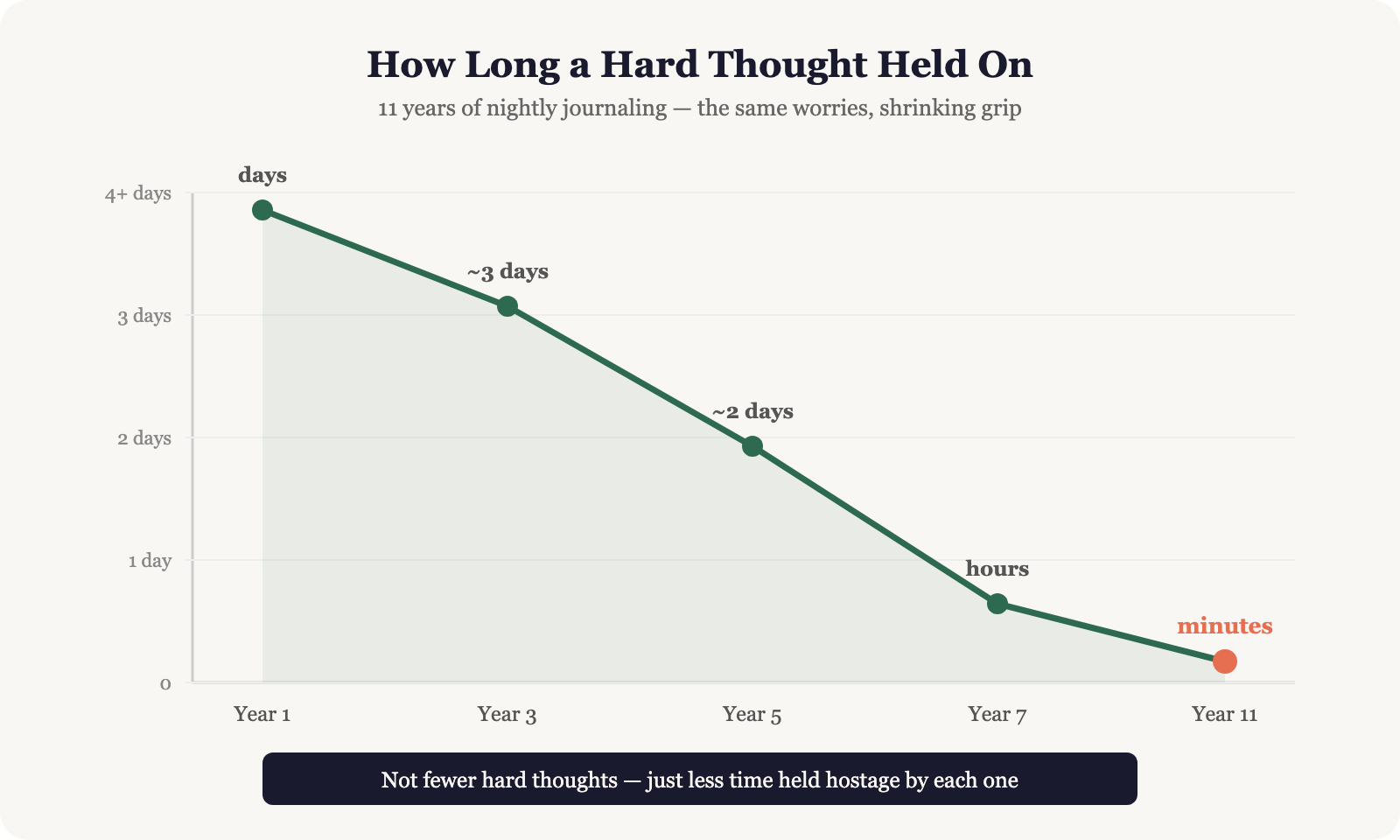
What changes isn’t that the thought disappears forever. What changes is how long I stay in it, and how much it costs me while I’m there. Ten years ago a bad thought could occupy me for days. Now it’s usually hours, sometimes just minutes. That’s the actual measure of progress — not the absence of difficult thoughts, but the shrinking grip they have on you.
Writing them down is what makes the grip visible enough to loosen. A thought spinning in your head feels infinite. The same thought on a page has an edge to it. You can see where it starts and where it ends, and somehow that’s often enough to stop feeding it. It’s not so different from how I use AI as a second brain for the practical side of life — getting a thought out of your head and onto something outside yourself is what makes it manageable, whether it’s a worry or a to-do list.
Why I’m Still Doing This at 11 Years
I’m not writing this to convince you to journal for eleven years. Most people who start a journal quit within a few weeks, and that’s fine — it’s not for everyone, and it’s not the only path to the same place.
But if you’re looking for one honest thing I can tell you from over a decade of doing this: peace was never waiting for me at some future point when things finally settled down. It was available the whole time, in the same messy, unsettled life I already had. The habit didn’t change my circumstances. It changed how much of my own mind’s noise I was willing to fight, and how much I was finally willing to just let pass.
Take life as it comes. Just don’t resist it. Eleven years of evidence, and I still haven’t found a better piece of advice than the one I accidentally gave myself on some ordinary Tuesday night.
Have you ever kept a journal, even briefly? What did it show you about yourself that you didn’t expect?
Frequently Asked Questions
Does journaling actually help with peace of mind, or is that just a feeling?
The evidence here is personal rather than clinical, but it’s consistent: 11 years of entries show the same worries recurring across years, while the time they occupy shrinks — from days to hours to minutes. That shrinking grip, tracked in writing, is the clearest sign the practice is doing something real.
How long should a journal entry be to get the benefit?
Five to ten minutes is enough. What matters is showing up again the next night, not the length of any single entry. Some nights are two lines. Consistency over years matters far more than intensity on any one night.
What should I actually write about in a journal?
What happened, what you felt about it, and one thing you’re grateful for is enough of a structure to start. The goal isn’t polished writing — it’s slowing down enough to see clearly whether you’re resisting a thought or actually responding to it.
Why do the same worries keep showing up in old journal entries?
Because letting go is a practice, not a single decision. The same fear or regret can resurface for years in slightly different language. What changes with practice isn’t that the thought disappears — it’s how long it holds you and how much it costs you each time it returns.