
A client once asked me the question every Indian investor eventually asks: SIP vs lump sum — which one actually makes you richer? He had just gotten his annual bonus and couldn’t decide whether to drip it into a mutual fund over the year or put it all in on day one.
I gave him the honest answer, which is also the unsatisfying one: it depends on what the market does next, and nobody — not me, not your relationship manager, not the fund house’s glossy brochure — knows that in advance. But the historical data is not silent on this. It has a clear lean. Most people just haven’t been shown it.
SIP vs Lump Sum: The Actual Math, Not the Slogan
Let’s run the numbers the way I ran them for my client. Say you have ₹24 lakh to put to work over 20 years, invested in something that tracks the Nifty 50, which has compounded at roughly 13% a year over the last two decades — not every year, but on average, across the ups and the crashes.
Lump sum: you invest the full ₹24 lakh on day one and let it sit for 20 years.
SIP: you invest the same ₹24 lakh as ₹10,000 a month, every month, for 20 years.
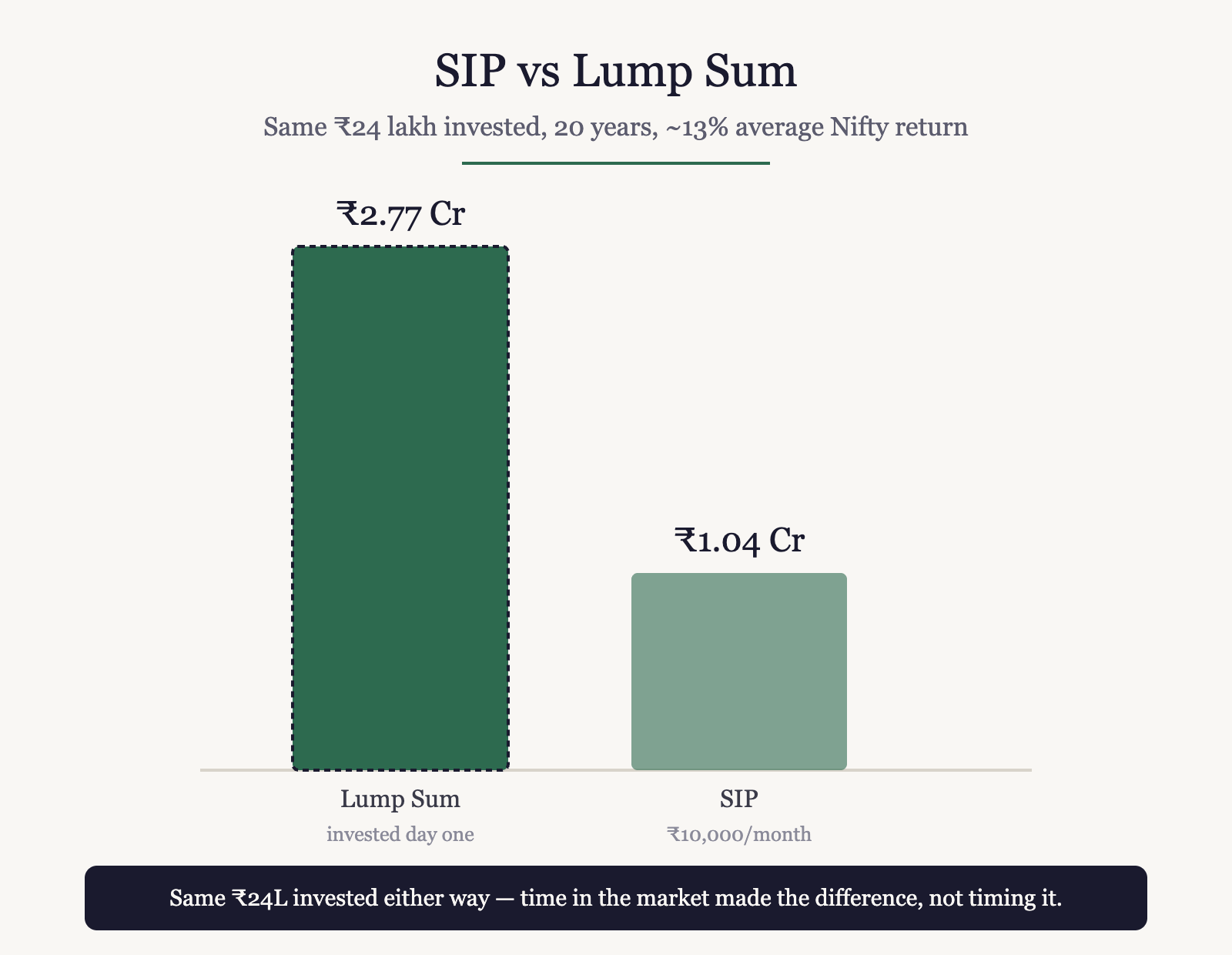
Here’s where it lands, using that same 13% average return for both:
- Lump sum: roughly ₹2.77 crore
- SIP: roughly ₹1.04 crore
That is not a rounding difference. The lump sum ends up with close to three times the money — for putting in the exact same ₹24 lakh.
Why the Gap Is That Big
The reason is almost embarrassingly simple once you see it: money invested earlier has more years to compound. Your first SIP instalment only starts earning returns from month one. Your last one, paid in month 240, barely gets any time to grow at all before the 20 years are up. The lump sum, by contrast, has every single rupee working from day one.
This is the same force I wrote about in the cost of waiting — compounding rewards time more than it rewards anything else, including how cleverly you time your entry. A SIP, by its very design, delays most of your money’s time in the market. That delay has a cost, and the cost is real.
I want to be upfront about one thing, though: that 13%-every-year number is a simplification. Real markets don’t move in a straight line — they crash, they recover, they go sideways for years. A SIP that buys more units when the market is down and fewer when it’s up (what people call rupee cost averaging) does claw back some of that gap in the real world. But across rolling 20-year windows of actual Nifty history, the lump sum has still come out ahead more often than not — just by a smaller margin than the clean math above suggests, not by a reversed one.
So Why Does Everyone Still Recommend SIP?
Here’s the part the “lump sum wins” headline always leaves out: almost nobody actually has ₹24 lakh sitting around, uninvested, waiting to be deployed on a single good day. I certainly didn’t in my thirties. Most of us earn the ₹10,000 a month before we have it — which makes the real comparison not “SIP vs lump sum” but “SIP vs letting it sit in a savings account because you don’t have a lump sum to invest anyway.” Framed that way, there’s no contest.
There’s a second reason, and it’s the one I actually lead with when I talk to friends about this. A SIP takes the decision out of your hands. You don’t have to decide, every single month, whether now is “a good time to invest” — a question that has derailed more portfolios than any market crash, because the honest answer is almost always “I don’t know,” and “I don’t know” too often becomes “I’ll wait.” I’ve written before about how automating money so it leaves before you can talk yourself out of it is the same trick that saves most people from their own savings rate quietly eroding every year.
A lump sum invested the day before a crash can sit underwater for years, and very few people have the stomach to watch that happen without pulling out at exactly the wrong moment. A SIP spreads that risk across dozens of entry points, so no single bad day can hurt you nearly as much. You give up some of the mathematical upside. You buy a lot of peace of mind in return.
So Which One Should You Actually Pick?
I’ll give you the answer I gave my client, which I still think is the right one for almost everyone reading this:
- If you’re investing from your regular income, month to month — SIP, no debate. You don’t have a lump sum to compare it against. The real alternative is money sitting idle, and idle money loses to almost anything.
- If a genuine lump sum lands in your hands — a bonus, a maturity payout, an inheritance — and you’re already comfortable with index funds as the destination, invest most of it as a lump sum. The historical odds favour it, and a bonus arriving in your bank account is already a form of market timing you didn’t control, so you’re not adding much extra risk by deploying it promptly.
- If that same lump sum would genuinely keep you up at night going in all at once, split it over 3 to 6 months, not 20 years. You capture most of the time-in-market advantage while giving your nerves room to adjust. A multi-year SIP of a lump sum is usually fear dressed up as strategy.
What I’d tell you to actually avoid is the trap I see most often: treating “SIP vs lump sum” as a moral question, where SIP is the disciplined, grown-up choice and lump sum is reckless. It isn’t. It’s a math question with a known historical lean, sitting next to a psychology question with no universal answer. Get the money invested — in either form — and you’ve already beaten the person still deciding.
Frequently Asked Questions
SIP vs lump sum: which gives better returns?
Historically, lump sum has come out ahead more often than not. Investing the same amount as a lump sum on day one, rather than spread out as a SIP, gives every rupee more years to compound — over a 20-year, 13%-average-return comparison, a lump sum of ₹24 lakh can end up close to three times larger than the same ₹24 lakh spread as a ₹10,000 monthly SIP.
Is SIP really better for most people, even if lump sum wins the math?
Yes, for a simple reason: most people investing from salary don’t have a lump sum to compare it against in the first place. The real alternative to a SIP is money sitting idle in a savings account, not a lump sum sitting ready to deploy — and idle money loses to almost anything invested consistently.
What is rupee cost averaging and does it help SIP win?
Rupee cost averaging is when a SIP automatically buys more fund units in months the market is down and fewer when it’s up, smoothing out your average entry price. It narrows the gap between SIP and lump sum in real, volatile markets, but across most rolling 20-year Nifty windows it hasn’t been enough to flip lump sum’s historical edge.
I have a bonus to invest — should I lump sum it or SIP it?
If you’re already comfortable with where it’s going (like a diversified index fund), investing most of it as a lump sum has the better historical odds. If the idea of investing it all on one day would genuinely worry you, split it over 3 to 6 months rather than spreading it over several years — that captures most of the time-in-market benefit while easing the nerves.
Have you ever sat on a lump sum for months because you couldn’t decide how to invest it? What finally made you move?