
Every founder story I read growing up followed the same shape: an idea, a garage, a leap of faith, years of ramen, and then — if you were one of the lucky few — a breakout. Nobody ever told me there was a second path. I found it by accident, years after I’d already taken the hard one.
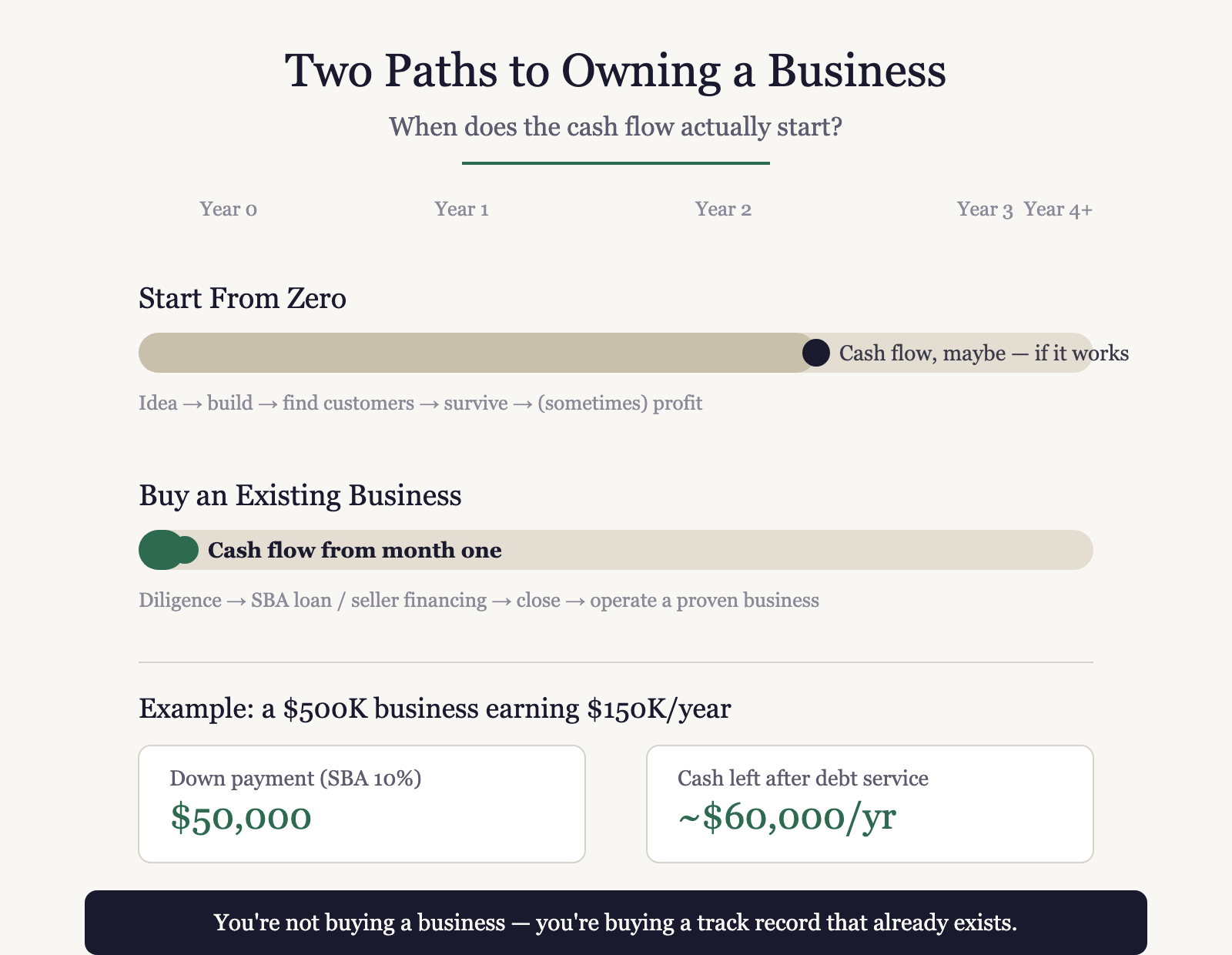
I built my company from nothing, the way the stories say you should. It worked out, eventually. But along the way I watched dozens of other founders burn five years and their savings on an idea the market simply did not want, while three miles away a laundromat owner who could not tell you what a TAM was quietly cleared $180,000 a year and went home at six.
That contrast has stuck with me for two decades. Buying a small business instead of starting one from scratch is not a lesser path. For most people, it is the smarter one.
Why Buying a Small Business Beats Starting One From Zero
Starting from zero means solving two hard problems at once: does anyone want this, and can I actually run a company. You are guessing at both, usually with your own money, usually for years before you know the answer.
Buying an existing, profitable business answers the first question before you sign anything. It already has customers. It already has revenue. It already has a system, however messy, that has been tested against reality for years, not months.
What you are buying, in plain terms, is proof. A garage-startup founder is betting on a hypothesis. A buyer of an existing business is betting on a track record that already exists in the bank statements.
This is not a new idea — it has a name in finance circles, “buy then build,” and private equity has run this playbook for decades. What changed is that ordinary people can now run it too, at a scale that fits one person’s savings instead of a fund’s.
What Makes a Business “Boring” (and Why That’s the Point)
The businesses worth buying are almost never exciting. That is the whole selling point.
Think HVAC repair, commercial laundry, pest control, plumbing, a regional accounting firm, a landscaping company, a self-storage facility. Nobody writes a TechCrunch article about any of them. They also never go through a hype cycle, never get disrupted by the next platform shift, and never need you to raise a Series A to survive a bad quarter.
A boring business tends to share four traits: it solves a problem that will exist in ten years exactly as it exists today, it has recurring or repeat customers rather than one-off buyers, it does not depend on one dramatic personality to keep functioning, and it already turns a profit without a growth story propping it up.
Compare that to most startups, where the entire value rests on a story about the future. Boring businesses do not need a story. The cash flow already speaks for itself.
I have advised a few younger founders on this exact fork in the road. The ones who picked “boring” were, almost without exception, cash-flow positive within the first year. The ones who picked “exciting” were still fundraising.
The Real Math: SBA Loans and Seller Financing
Here is the part that surprises people most: you do not need to have the full purchase price in cash.
In the US, an SBA 7(a) loan can finance the purchase of an existing small business, typically covering up to 90% of the price, with the buyer putting down as little as 10%. On a $500,000 laundromat generating $150,000 a year in seller’s discretionary earnings, that could mean buying it with $50,000 down.
Many sellers will also carry a note themselves — seller financing — for part of the price, especially when they are retiring and want a smooth handoff more than a single lump sum. It is common to combine an SBA loan, seller financing, and a modest amount of the buyer’s own cash into one structure.
Run the numbers before you fall in love with any listing. If a business generates $150,000 a year and the debt service on the loan used to buy it comes to $90,000, you are left with $60,000 before you have paid yourself anything for actually running the place. That gap is your real margin of safety, and it needs to survive a bad year, not just an average one.
The math only works when the business was already healthy before you showed up. A loan cannot fix a business that was losing customers. It can only help you buy time you did not have to save for.
Where to Actually Find a Business to Buy
The businesses worth buying rarely advertise themselves as being for sale to the public. Three places consistently produce real listings.
Business brokers who specialize in “main street” deals — typically businesses selling for under $2 million — list on marketplaces like BizBuySell, which is the largest public directory of this kind of listing in the US.
Industry associations and trade groups often know who is quietly planning to retire long before a listing goes public. A conversation at a regional HVAC or landscaping association meeting can surface a deal that never reaches a website.
Direct outreach to owners who look like they might be nearing retirement, in an industry you understand, is the least comfortable option and often the best one. A short, honest letter asking whether they have ever considered selling has led to real deals for people I know personally — because most owners have thought about it and nobody has ever asked.
The Due Diligence Nobody Skips Twice
I have never met anyone who regretted spending too much time on due diligence. I have met several who regretted spending too little.
Get three years of tax returns, not just the seller’s own profit-and-loss statement — sellers have every incentive to make the P&L look better than the number they reported to the IRS. If the two disagree by a wide margin, that gap is the first question you ask, not the last.
Understand exactly why the owner is selling. Retirement and burnout are honest reasons. A new competitor that just opened two blocks away, or a key contract expiring next quarter, are the reasons a seller hopes you never ask about directly.
Check customer concentration. If one client is 40% of revenue, you are not really buying a business — you are buying a bet that one relationship survives a change of ownership, and relationships are exactly the thing that changes hardest.
And spend real time with the employees, if the seller allows it. A business that runs entirely on the owner’s personal relationships and knowledge is much harder to run on day one than one with a manager who already knows where everything is.
The Trade-Off Nobody Advertises
I will not pretend buying a boring business is free of downside, because it isn’t.
You inherit the business’s problems along with its cash flow — the difficult employee, the aging equipment, the lease that renews on bad terms. You do not get founder mythology, IPO optionality, or the chance the business becomes worth a hundred times what you paid for it. Boring businesses stay boring. That is the deal you are making, not a flaw in it.
What you get instead is closer to what I eventually built through savings rate discipline rather than through a single lucky swing: real cash flow starting in month one, a business you can actually understand end to end, and an exit that a wider pool of buyers will actually want, because “profitable HVAC company” is a much easier sale than “promising app with declining users.”
It is also a far more honest relationship with passive income than most of what gets marketed under that name. This is not passive. You are running a company. But it produces income from month one instead of years two through five, which changes the entire risk profile of the decision.
Is Buying a Small Business Right for You?
This path fits a specific kind of person: someone who wants to build wealth through ownership and operating skill, not through a single big idea, and who would rather run something proven than pitch something unproven.
It does not fit someone chasing a unicorn outcome, or someone unwilling to do the unglamorous daily work of actually running a company — because buying the business does not remove that work, it just moves you past the years of proving the idea works at all.
I did it the hard way the first time, because nobody told me there was another way. If I were starting today, I would at least look seriously at what is already working three miles from where I live, before I spent five years trying to invent something new.
Frequently Asked Questions
Is it better to buy a business or start one from scratch?
For most people, buying is the smarter path. Starting from zero means guessing whether anyone wants the idea and whether you can run a company, usually for years before you know. Buying an existing, profitable business answers the first question before you sign anything — it already has customers, revenue and a tested system.
How much down payment do I need to buy a small business?
Often far less than the full price. An SBA 7(a) loan can finance up to 90% of the purchase, so a $500,000 business could be bought with roughly $50,000 down. Many sellers also carry part of the price themselves as seller financing, especially when they are retiring.
What makes a small business a good acquisition target?
Four traits: it solves a problem that will still exist in ten years, it has recurring or repeat customers rather than one-off buyers, it does not depend on one person’s personality to function, and it is already profitable without a growth story propping it up. Unglamorous industries like HVAC, laundromats and pest control fit this well.
Where do you find small businesses for sale?
Three reliable sources: business brokers who list “main street” deals on marketplaces like BizBuySell, industry associations and trade groups whose members often know who is quietly planning to retire, and direct outreach — a short letter asking an owner whether they have ever considered selling.
What due diligence should I do before buying a business?
Get three years of tax returns, not just the seller’s profit-and-loss statement, and question any gap between them. Understand the real reason for the sale, check how concentrated revenue is in one or two customers, and spend time with employees to see how much depends on the owner personally.
If you’ve ever looked at a business you drive past every day and wondered what its books actually look like — what stopped you from finding out? I’d love to hear it in the comments.