
Let me be honest with you. When I crossed 50, I started paying more attention to health — my own and my family’s. And somewhere along the way, I began noticing something remarkable: how AI is changing healthcare in ways that quietly touch all of us, even if we don’t realise it yet.
This isn’t scary science fiction. This is genuinely good news.
How AI in Medicine Is Helping Doctors Be Better Doctors
The first thing to understand is this: AI is not replacing doctors. It is helping them do their jobs better, faster, and with fewer mistakes.
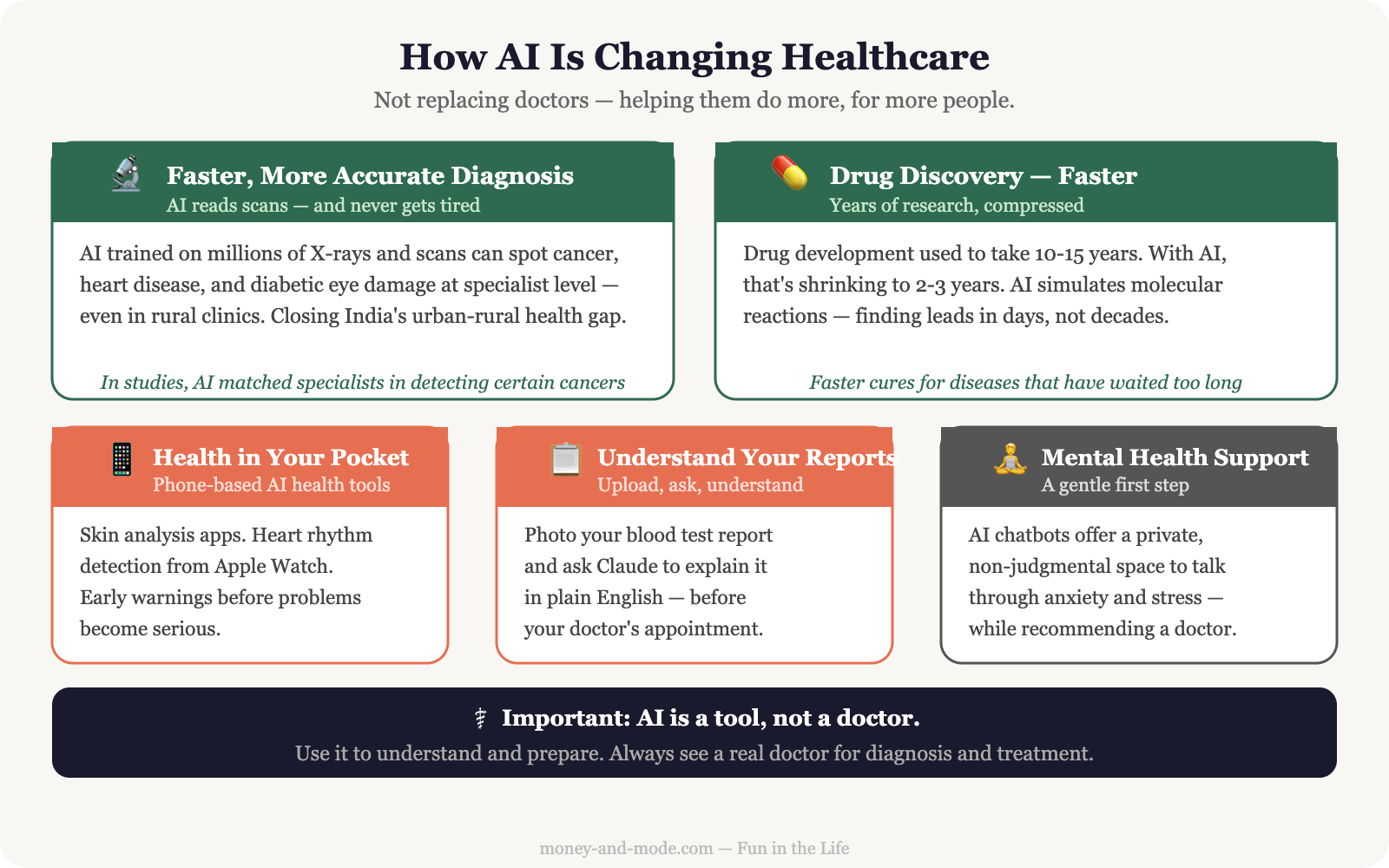
Think about an X-ray or a scan. A radiologist might look at hundreds of scans in a single day. By the end of the day, fatigue sets in. Small things can be missed. AI doesn’t get tired. Trained on millions of images, it can spot patterns that even experienced eyes might overlook.
In some studies, AI has matched or even outperformed specialists in detecting certain cancers, diabetic eye disease, and heart conditions from scans. The doctor still makes the final call. But now they have a very sharp second opinion, available instantly.
This matters enormously in India. A doctor in a small town in Rajasthan or Odisha may not have easy access to a specialist. But with AI-assisted diagnostic tools, that same small-town doctor can get the kind of diagnostic intelligence that a specialist in a Mumbai hospital has. AI is quietly helping to close that gap.
Drug Discovery, Your Phone, and the AI Health Revolution
Developing a new medicine used to take 10 to 15 years and cost billions of dollars. AI is compressing that timeline dramatically — down to 2 to 3 years in some cases. AI can analyse millions of molecular combinations and identify which drug candidates are most likely to work. During COVID-19, AI tools helped researchers identify vaccine candidates in record time.
Your smartphone is becoming a health tool. There are now apps that can analyse a photo of a skin spot and flag whether it looks concerning. Some smartwatches can detect irregular heart rhythms. Apps let you log symptoms over time and notice patterns your doctor might find useful.
Understanding Your Own Medical Reports
This is the one that changed things for me personally.
A few months ago, a family member received some blood test results with numbers and abbreviations that meant nothing to us. Instead of waiting days for a follow-up appointment, I uploaded the report to Claude and asked it to explain everything in plain English.
Within a minute, I had a clear breakdown — what each marker meant, what the normal range was, why certain values might be elevated, and what questions to ask the doctor. It felt like having a knowledgeable friend available at midnight who wouldn’t mind walking me through it.
I want to be clear: AI did not diagnose anything. It explained. The doctor still made all medical decisions. But going into that appointment informed, with the right questions ready — that made the conversation so much better.
You can do the same with any medical report, prescription, or health-related document. Upload it to Claude or ChatGPT, ask your question in plain words, and get a clear explanation. This is one of the most practical AI health benefits available to anyone, right now, for free.
Mental Health: A Gentle First Step
Mental health is still stigmatised in many parts of India. AI chatbots are not therapists — let me say that clearly. If someone is in crisis, they need a real professional. But for someone who is anxious, overwhelmed, or just needs to talk through their feelings at 2 AM, AI can be a gentle first step.
What This Means for Your Family
If you’ve read my earlier piece on how AI is changing everyday life, you know that AI has quietly entered nearly every corner of our lives. Healthcare is no different.
The changes I’ve described here — smarter diagnostics, faster drug development, phone-based health tools, easy report explanations, mental health support — these aren’t coming in the future. They’re happening now.
The rule remains the same as always: consult a real doctor for any diagnosis or treatment. AI is a tool, not a physician. But a good tool in the right hands makes everything better.
And if you’re curious about how AI can save you time in your daily life beyond healthcare, take a look at this guide on how to use AI to save 2 hours every day.
Frequently Asked Questions
Is AI replacing doctors?
No. It is helping them do their jobs better, faster and with fewer mistakes. A radiologist reading hundreds of scans gets tired; AI does not. In some studies AI has matched or outperformed specialists at detecting certain cancers, diabetic eye disease and heart conditions from scans. The doctor still makes the final call.
Can I use AI to understand my medical reports?
Yes, and it is one of the most practical uses available free today. Upload a blood test, prescription or report to Claude or ChatGPT and ask for a plain-English explanation — what each marker means, what the normal range is, why a value might be elevated, and what to ask your doctor.
Is it safe to rely on AI for health advice?
No — and that is the wrong use for it. AI explains; it does not diagnose. Consult a real doctor for any diagnosis or treatment. Its real value is walking into the appointment already informed, with the right questions ready. That alone makes the conversation far better.
How is AI changing healthcare beyond diagnosis?
Drug discovery timelines are compressing from 10–15 years toward 2–3 in some cases. Phones and smartwatches now flag concerning skin spots and irregular heart rhythms. And for someone anxious or overwhelmed at 2 AM, AI can be a gentle first step — though chatbots are not therapists, and a crisis needs a real professional.
I’d love to hear from you. Have you ever used AI to understand a medical report, research a condition, or manage your health? What was your experience? Share in the comments below.