
Every parent I know wants the same thing: for their children to learn well, to grow confident, and to not spend half the night struggling alone with homework. AI for kids education might be the most practical gift we can give our children right now — if we use it wisely.
I say this as a father of two sons. My older son Mihir is now running a YC-funded startup in San Francisco. My younger son Arnav is still finding his path. Watching both of them grow up in the tech era taught me something important: the children who thrive are not the ones who avoid new tools. They are the ones who learn to use them well.
Let me show you how to use AI to help your children learn — not just complete their homework, but actually understand things better.
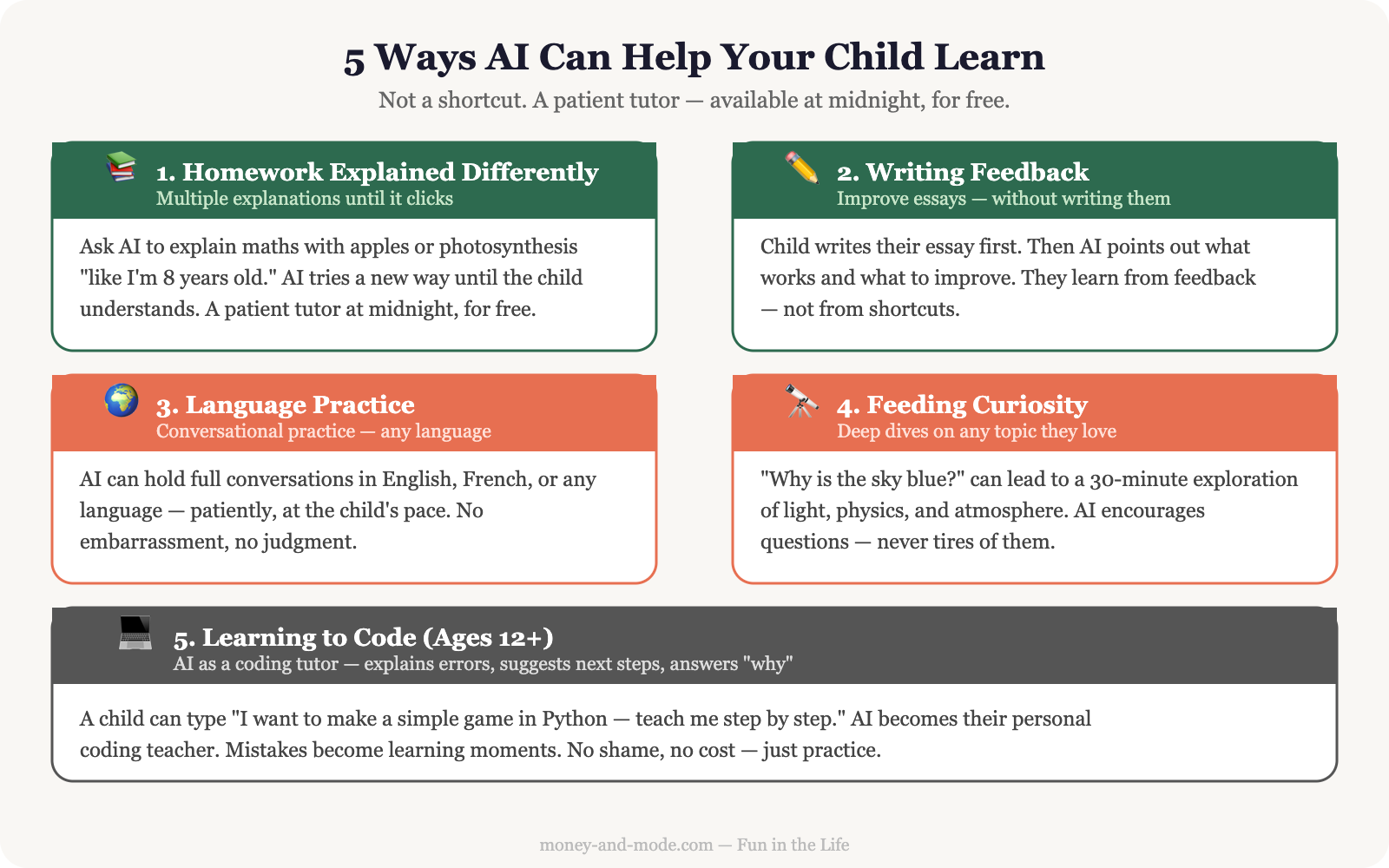
5 Ways AI Tools for Students Can Make a Real Difference
1. Homework Help — Explained Five Different Ways
Here is the thing about school textbooks. They explain something once, in one way, using formal language that often confuses more than it clarifies. A child who doesn’t understand quadratic equations after one explanation is told to re-read the same paragraph.
AI can explain the same concept five different ways until it clicks. Ask ChatGPT or Claude to explain long division using apples and baskets. Ask it to explain photosynthesis like the child is eight years old. Ask it again if the first explanation doesn’t land.
I have seen this myself — a concept that took days to sink in from a textbook can become clear in ten minutes with the right explanation. That is not magic. That is a patient tutor available at midnight for free.
2. Writing Feedback Without Writing It For Them
Many parents worry about AI writing essays for their children. That is a real concern, and I will address it shortly. But here is a smarter use: ask AI to review the essay your child already wrote.
Have your child write their essay first. Then paste it into Claude or ChatGPT with the instruction: “Review this essay and tell me what can be improved. Do not rewrite it — just point out what is weak and why.”
The AI will highlight unclear sentences, suggest where the argument is thin, and point to grammar errors. Your child reads the feedback and makes the changes themselves. This is how writing improves — through reflection, not replacement.
3. Language Practice — Conversations Without Embarrassment
For many Indian families, English remains a practical goal. Children are often shy about practising because they fear making mistakes in front of peers or teachers. AI removes that fear entirely. Your child can type a sentence, get gentle correction, and try again — with no one judging.
4. Going Deeper Than the Textbook
School syllabuses are necessarily limited. A child curious about black holes, ancient Rome, the human brain, or why the stock market falls gets a few paragraphs in a textbook and then moves on. AI lets them go as deep as their curiosity takes them. Curiosity, when fed, becomes a habit. That habit becomes a strength.
5. Learning to Code — A Patient Teacher for Older Kids
For teenagers, this one is particularly powerful. If you have read my article on how AI is changing everyday life, you already know that software and AI are reshaping every industry. AI tools like Claude can act as a coding tutor — explaining errors patiently, as many times as needed. This is how Mihir’s generation learned — by doing and asking and doing again.
The Most Important Part: Boundaries and Wisdom
I want to address the worry directly. Will AI make my child lazy? It can — if you let it. The rule is simple: use AI as a tutor, not a shortcut. A tutor explains. A tutor asks questions back. A tutor makes the student work for the understanding.
The rule in our house would be simple: AI explains the concept, the child solves the problem. AI reviews the essay, the child makes the edits. Understanding first, answer second.
As I wrote in how to use AI to save 2 hours every day — AI amplifies your capability when you bring your own thinking. For children, this lesson is even more important to establish early.
Think of It as a Private Tutor — Available 24 Hours, Free of Cost
In India, private tuition is a significant expense for middle-class families. A good maths tutor, a spoken English class, a science coach — these costs add up quickly. Many families simply cannot afford them.
AI does not replace the warmth of a good human teacher. But for the concept that wasn’t clear, for the essay draft that needs a second pair of eyes, for the question that arrives at 10 PM — AI is genuinely available, genuinely patient, and genuinely free.
Children who will thrive in the next twenty years are not the ones who avoided AI — they are the ones who learned to use it thoughtfully. You can read more about why AI is not coming for curious, adaptive people.
Start simple. Sit with your child the first few times. Guide the habit early, and you will have given them something that compounds for life.
Frequently Asked Questions
How can AI actually help my child learn?
Five ways. It explains a concept several different ways until it clicks. It gives feedback on an essay your child already wrote. It lets them practise language without embarrassment. It goes deeper than the textbook on any curiosity. And for older kids, it tutors them patiently through code.
Will AI make my child lazy?
It can — if you let it. The rule is simple: use AI as a tutor, not a shortcut. AI explains the concept, the child solves the problem. AI reviews the essay, the child makes the edits. Understanding first, answer second.
How do I use AI for homework without it doing the homework?
Have your child write or attempt the work first. Then paste it in with the instruction: “Review this and tell me what can be improved. Do not rewrite it — just point out what is weak and why.” Your child reads the feedback and makes the changes themselves. That is how writing improves.
Can AI replace a private tutor?
It does not replace the warmth of a good human teacher. But for the concept that did not land, the essay draft needing a second pair of eyes, or the question that arrives at 10 PM, AI is genuinely available, genuinely patient and genuinely free — which matters where tuition is a real expense.
Do your children already use AI for their studies? Have you set any rules around it? I would love to hear what is working in your family — drop a comment below.