
A month ago I decided to run a small experiment on myself. Every Sunday night, instead of planning my own week the way I’ve done for 25 years, I’d hand the job to an AI weekly planner — tell it what mattered, what was stuck from the week before, and let it build the plan. I wanted to know how much of “using AI to plan your week” was actually useful and how much was just a nicer-looking to-do list.
Four Sundays later, I have an honest answer: most of what AI planned for me quietly fell apart by Wednesday. But two things survived, and they’ve outlasted the experiment itself. That gap between what sounded smart on Sunday and what actually held up by Friday is the real lesson here.
How the Experiment Actually Worked
Every Sunday, I gave the AI the same three inputs: what didn’t get done last week, what absolutely has to move this week at Cymetrix, and what I want more of in my life generally — more walking, more unhurried time with family, less phone in the evening.
It would come back with a day-by-day plan: blocks for deep work, a slot for the walk, a reminder to leave client email for a fixed window instead of all day. On paper, every single week looked better than how I actually run my days.
Then Monday would arrive with its own ideas.
Week 1: The Plan Didn’t Survive the First Fire Drill
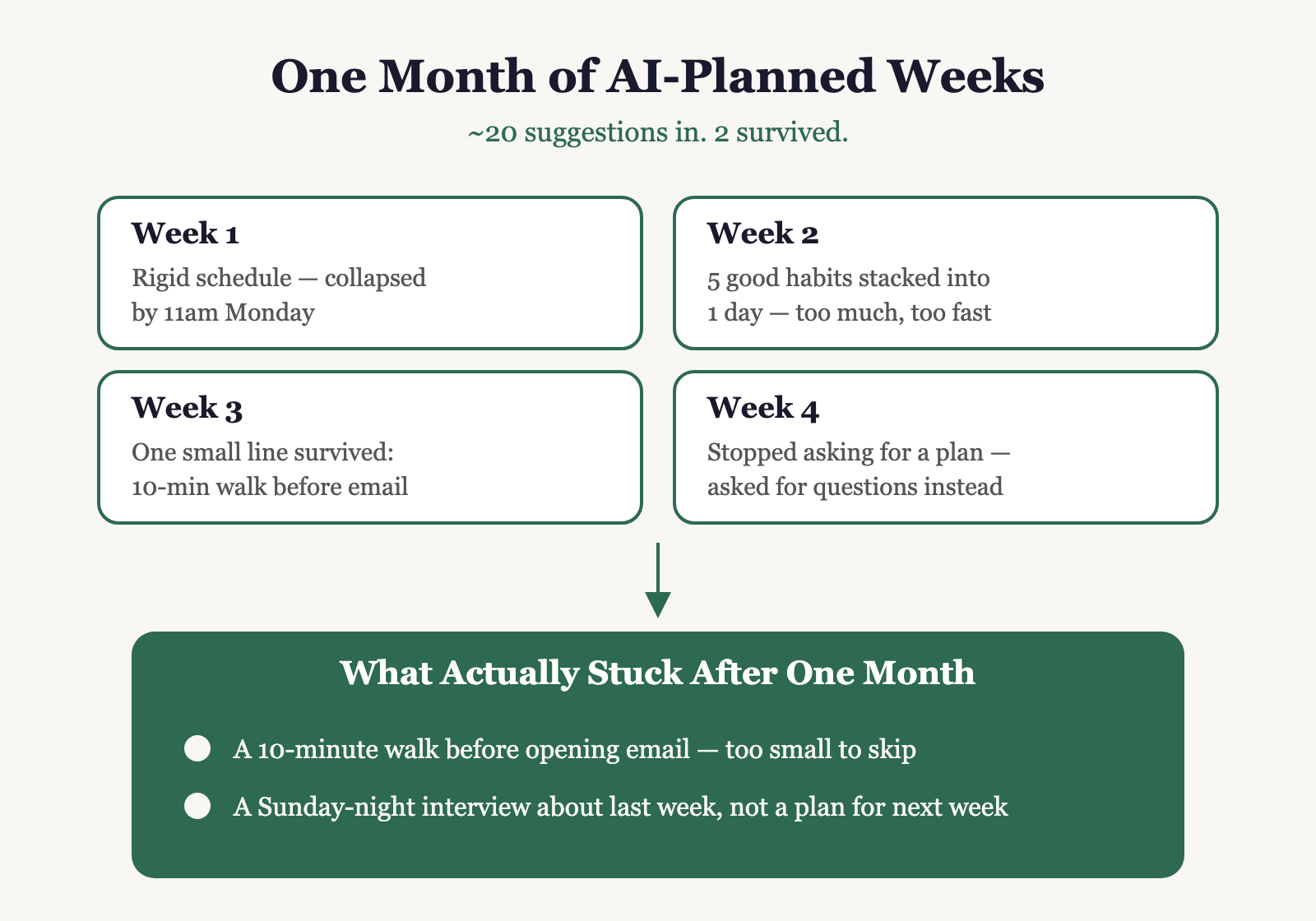
A client had an urgent escalation Monday morning. The whole beautifully blocked week collapsed by 11 am, and I never went back to look at the plan again that week. This is the first thing I’d tell anyone trying this: a rigid AI-generated schedule breaks the same way a rigid human-made one does, the moment real work shows up uninvited.
The fix wasn’t a better plan. It was asking the AI for something looser the next week — not a timetable, but a short list of “if today goes sideways, protect these two things” items. That one change mattered more than anything else in the whole month.
Week 2: Too Many Good Ideas, Not Enough Days
By week two I’d gotten more specific with my prompts, and the AI got more ambitious with its suggestions — a morning journaling slot, a dedicated reading hour, a no-meeting block, a weekly review ritual, three different exercise windows. Each idea was genuinely good on its own. Together they needed a 30-hour day.
This is where I noticed something about how AI plans differently from how I plan. I naturally cut things when a week starts to feel crowded, because I’ve lived through enough crowded weeks to feel the cost coming. AI has no felt sense of a crowded week — it will happily stack five good habits into one Tuesday because nothing in the plan itself ever gets tired.
The useful move was asking it a different question: not “build me a good week” but “pick the two things that matter most if I can only keep two.” That’s a very different exercise, and it’s the one that actually produces a plan a person can live inside.
Week 3: The One Thing That Actually Changed My Day
Somewhere in week three, almost by accident, the plan included a single line: “10-minute walk before opening email.” Not a workout. Not a goal. Just that one small thing, first, before the day’s noise started.
I kept it going past the week it was assigned. A month later, it’s still there most mornings. It didn’t need willpower the way the bigger plans did, because it was small enough to survive a bad day. This matches something I’ve believed for a long time and written about before in what 11 years of journaling taught me about peace: consistency beats intensity, almost every time, in almost everything.
Week 4: I Stopped Asking It to Plan the Week and Started Asking It to Ask Me Questions
By the last week, I’d changed the whole approach. Instead of asking AI to build my schedule, I asked it to interview me on Sunday night — what actually went well last week, what I resented doing, what I kept avoiding. The plan that came out of that conversation was thinner and far more honest than any of the earlier ones, because it was built from what was actually true about my week, not from a generic template of what a “productive week” should look like.
That’s the real shift this experiment produced. AI turned out to be a mediocre scheduler and a genuinely useful question-asker.
What Actually Stuck After One Month
Out of roughly 20 suggestions across four weeks, two survived:
- The short morning walk before opening email — small enough to never feel like a burden, consistent enough to become automatic.
- The Sunday-night interview instead of a Sunday-night schedule — five honest questions about last week, rather than an optimistic plan for the next one.
Everything else — the elaborate time blocks, the five-habit mornings, the color-coded calendar — quietly disappeared, the same way most New Year’s resolutions do, for the same reason. They were plans about an idealized week, not about my actual one.
What I’d Tell Anyone Trying an AI Weekly Planner
If you want to try using AI for your own weekly planning, skip straight to where I ended up:
- Ask it for one or two protected priorities, not a full schedule.
- Let it ask you questions about last week before it suggests anything about next week.
- Treat anything it suggests as a draft that has to survive contact with a Monday, not a finished plan.
I’ve written before about 5 AI habits that save me 10 hours a week — this one sits alongside those, except its biggest lesson wasn’t about saving time at all. It was about how little of what sounds good on a Sunday night is actually worth keeping by Friday. The question-asking approach that ended up working best also owes a lot to how to talk to AI — a vague prompt gets a vague plan, every time.
Frequently Asked Questions
Is it actually useful to let AI plan your week?
Partly. Across one month of letting AI build a weekly schedule, most of the suggestions — elaborate time blocks, five new habits at once — fell apart by Wednesday. What worked was asking it for one or two protected priorities instead of a full schedule, and having it ask questions about last week rather than guess at next week.
What’s the biggest mistake people make using AI for weekly planning?
Treating its first draft as a finished plan instead of a starting point. AI has no felt sense of a crowded week, so it will happily stack five good habits into one day because nothing in the plan itself ever gets tired — a person has to be the one who cuts it down to size.
What’s one small AI planning habit worth actually keeping?
A single protected priority, not a schedule — in this experiment, a 10-minute walk before opening email. It survived a full month precisely because it was small enough to not need willpower, unlike the bigger, more ambitious plans that quietly disappeared.
Should AI build my schedule or ask me questions about my week?
Questions worked better than schedules. Asking AI to interview you about what actually went well or got avoided last week produces a far more honest plan than asking it to generate an ideal week from a generic template.
Have you tried handing any part of your planning to AI? I’d like to know what survived and what didn’t for you. Tell me in the comments below.