
For the first fifteen years of running my company, I did not own a single share of anything. Every rupee I had went back into the business — hiring, payroll, the next contract, the next bad month I needed to survive. I told myself this was investing. It was not. It was one very large, very concentrated bet with my name on it, and no fund manager alive would have called that a portfolio.
I was well past 40 before I opened a real brokerage account and started putting money into the boring, diversified stuff every article tells you to buy in your twenties. By the numbers, I was “late.” I know exactly how late, because I have run the math on it more than once, usually at 2am, usually right after reading an article aimed at 25-year-olds.
Here is what that math actually says — and why it is nowhere near as bad as it feels at midnight.
What Waiting Actually Costs You
Compound interest rewards time more than it rewards money. That is the whole secret, and it is also the whole problem, because time is the one thing you cannot buy back once it is gone.
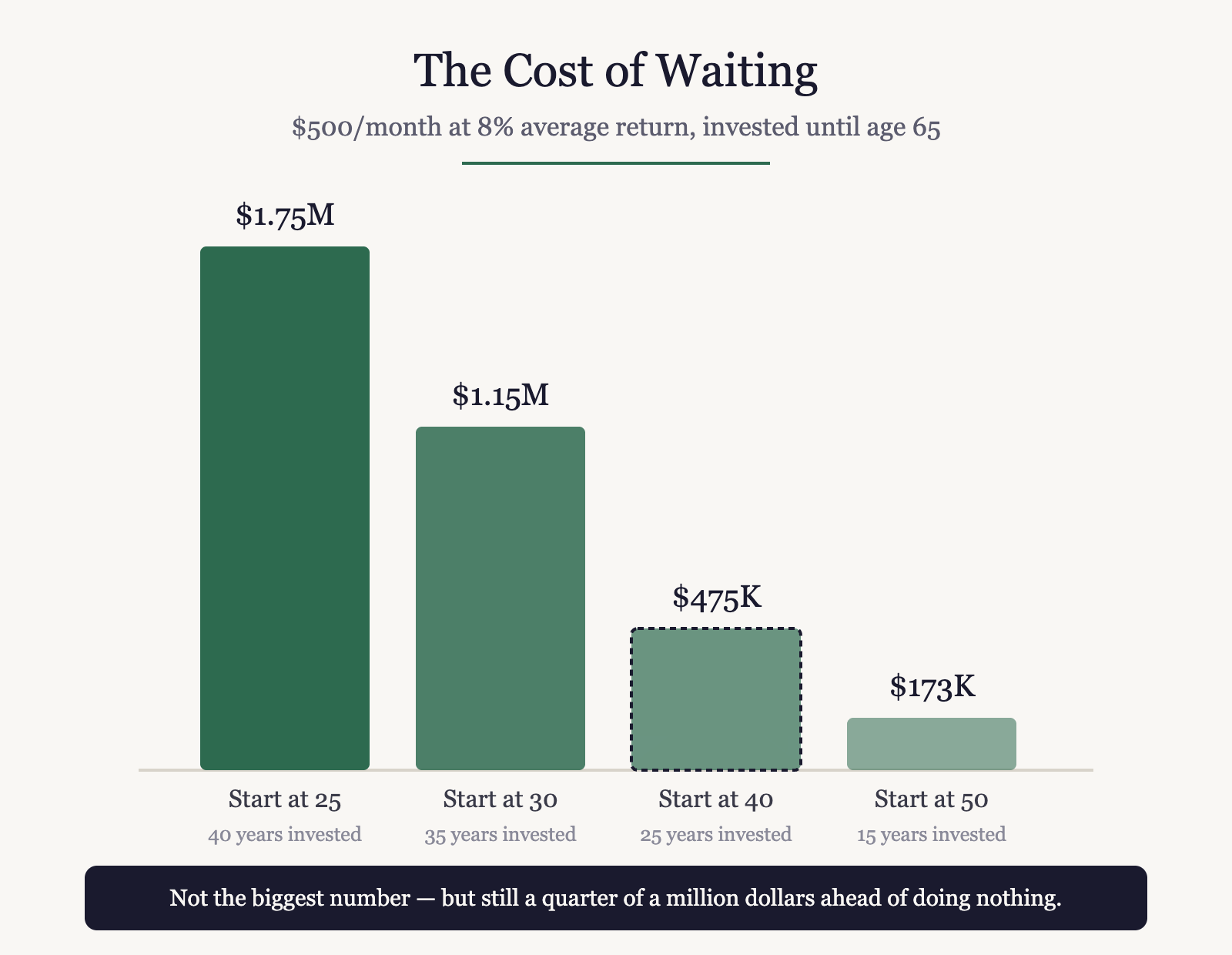
Take someone investing $500 a month at an 8% average annual return — a reasonable long-term expectation for a diversified index fund — until age 65.
- Start at 25: roughly $1.75 million by 65
- Start at 30: roughly $1.15 million
- Start at 40: roughly $475,000
- Start at 50: roughly $173,000
Look at the gap between 30 and 40. Ten years of delay does not cost you a proportional ten years of growth — it costs you nearly 60% of the final number. That is what people mean when they say compounding is a young person’s game. The last decade of a 40-year run does more work than the first two decades combined, and starting at 40 means you never get that first stretch back.
I am not going to pretend that is not a real cost. It is. If you are 40 and just starting, you will very likely retire with less than someone who started at 25 with the same monthly amount. Anyone who tells you otherwise is selling something.
Why “Too Late” Is the Wrong Conclusion
But look at that $475,000 number again. It is not zero. It is not close to zero. Invested well and left alone, it is a real foundation — and it says nothing about the other things a 40-year-old has that a 25-year-old usually does not.
Here is what nobody puts next to the compounding chart.
Your income is higher. Most people earn significantly more at 40 than at 25. The $500 a month that felt like a stretch at 25 is often easy at 40 — and easy money invested beats stretched money invested, every time, because the stretched version stops the first time life gets expensive.
Your expenses are more predictable. You know your rent, your family’s needs, your fixed costs. There is less guessing, which means there is less excuse for the money not to leave your account on the same day, every month, without a decision attached to it.
You have already survived your worst financial mistakes. The 25-year-old is still going to make them. You are not paying that tuition twice.
You have 20 to 25 working years left, not two. That is not a rounding error. Twenty-five years at 8% still turns a modest monthly amount into a real number, as the math above shows. “Too late” is a phrase for people who are out of time. A 40-year-old has decades, not days.
I wrote about the 4% rule a while back — the idea that you need roughly 25 times your annual expenses to be financially free. That target does not check your age before it applies to you. It only checks the number.
The Real Danger Isn’t Starting Late. It’s Not Starting At All
The math above assumes you actually start. Most late starters don’t, and it is rarely because they ran the numbers and decided it wasn’t worth it. It is because the numbers made them feel foolish, and feeling foolish is a terrible reason to stay at zero for another five years.
I nearly did exactly that. I remember doing this exact calculation for the first time — seeing the 25-year-old’s number next to mine — and closing the laptop for a week. Not because I didn’t understand the math. Because I did, and it stung.
What got me moving again was a smaller, less dramatic thought: the version of me at 50 will either thank the version of me at 40 for starting today, or resent him for waiting one more year to feel ready. There was no version of the story where waiting made the number bigger.
So I opened the account. I automated the transfer so it left before I could talk myself out of it — the same trick I wrote about in lifestyle inflation, where money you never see is money you never miss. And I stopped checking the balance every week, because a portfolio checked weekly feels like it never moves, and a portfolio left alone for a year usually surprises you.
What Actually Moves the Number, If You’re Starting Late
If 40 is your starting line, three things matter far more than they would at 25, because you have less time to let compounding alone do the work.
- Raise the monthly number, not just the return. You cannot out-invest a low savings rate with clever stock picking, but you can absolutely out-save a late start. Going from $500 to $800 a month closes a meaningful chunk of that gap, and at 40 you are often more able to find that extra $300 than you were at 25.
- Use your peak earning years on purpose. Your 40s and 50s are usually your highest-income decade. Every raise that doesn’t get absorbed into a bigger house or a bigger car is a raise that goes straight at the gap. I’ve written before about how lifestyle inflation quietly eats exactly this money before you notice it’s gone.
- Keep it boring. This is not the decade to chase a hot stock to make up for lost time. The math above already assumes a diversified, unglamorous index fund return. Reaching for more, faster, is how late starters turn a recoverable gap into a real disaster.
None of this requires a genius move. It requires the account to be open, the transfer to be automatic, and five more years to not go by empty like the last five did.
The Only Comparison That Actually Matters
The 25-year-old-versus-40-year-old comparison is interesting, but it is also a trap, because you are not racing that person. You never were. The only comparison that changes your actual life is the one between the 40-year-old who starts this month and the 45-year-old who is still reading articles about whether it’s too late.
I am not going to retire with what I would have if I’d started at 25. That door closed and I am at peace with it — most days, anyway. But I am going to retire with vastly more than I would have if I’d kept waiting for the “right” year to feel ready, which, if I am honest, would have been every year, forever.
Start with whatever you can automate this week. Not the number that feels impressive. The number that will actually leave your account without a fight. Forty is not the finish line arriving early. It’s just where you are — and where you are is always the only place you can actually start from.
Frequently Asked Questions
Is 40 too late to start investing?
No. A 40-year-old investing $500 a month at an 8% average return can still build roughly $475,000 by 65 — not as much as starting at 25, but a real foundation, not nothing. You have 20 to 25 working years left, which is decades, not days. The real risk is not starting late; it is staying at zero because the number feels small next to someone who started younger.
How much does waiting 10 years to invest actually cost?
At $500 a month and an 8% return, starting at 30 instead of 40 grows the final total from about $475,000 to about $1.15 million — nearly 60% more. Compounding rewards time more than it rewards the amount invested, so the last decade of a long run does more work than the first two decades combined.
What should someone starting late focus on?
Three things matter more than at 25: raising the monthly amount rather than chasing a higher return, directing raises from your peak earning years straight into investments instead of a bigger lifestyle, and staying in boring, diversified index funds rather than reaching for a risky bet to make up lost time.
Does a higher income at 40 make up for starting late?
It helps more than people expect. Income is usually highest in your 40s and 50s, expenses are more predictable than in your 20s, and you have already made — and survived — most of the financial mistakes a 25-year-old still has ahead of them. None of that undoes the math, but it makes closing part of the gap realistic.
If you’re starting later than you planned, what’s the one thing that finally got you moving — or what’s still holding you back? I’d genuinely like to know.