
Here’s a fact that should bother you more than it probably does.
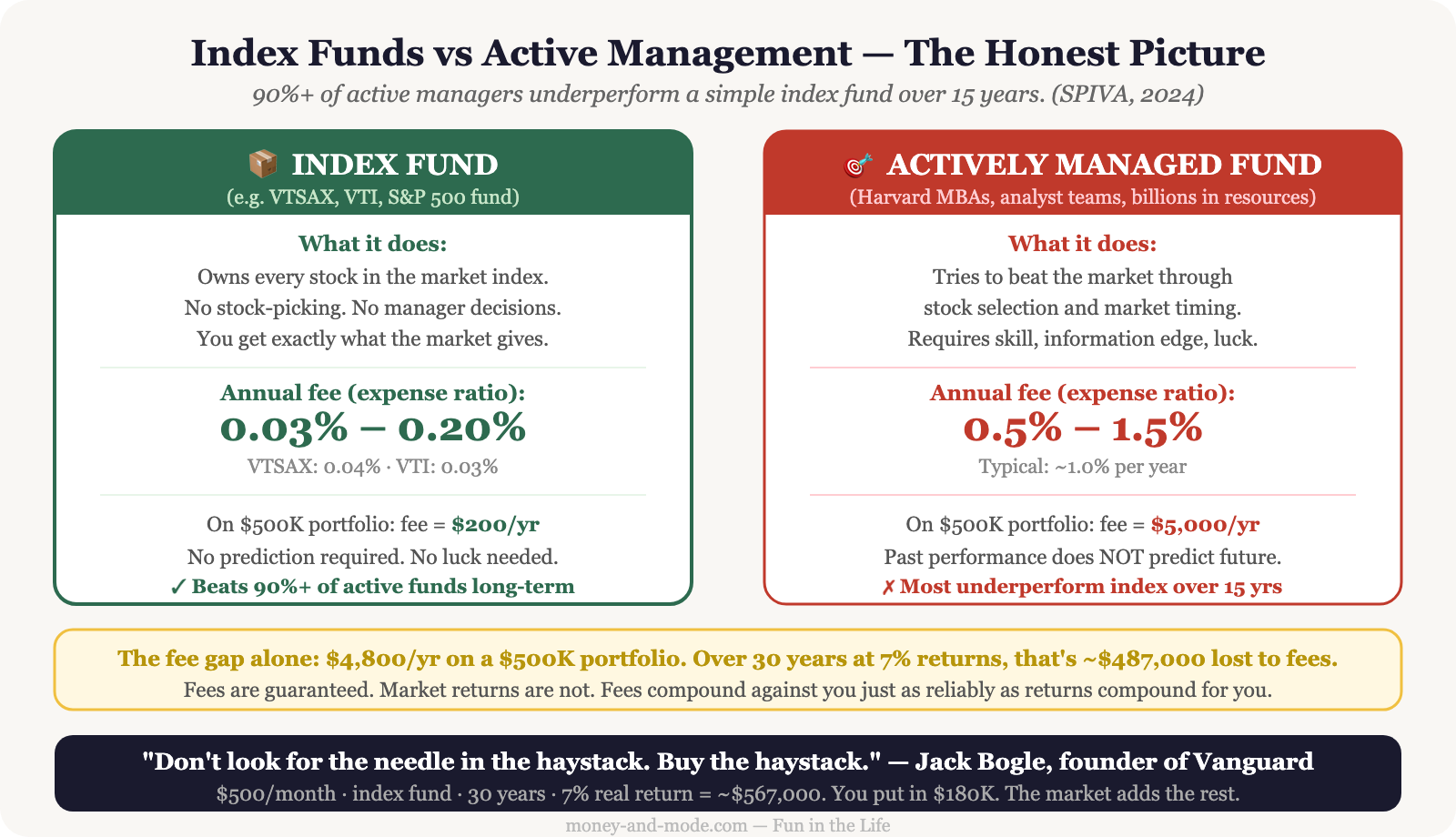
Over the past 15 years, more than 90% of actively managed US large-cap funds — funds run by teams of professional analysts, with Harvard MBAs at the helm and billions in resources — underperformed a simple S&P 500 index fund. Not in a bad year. On average, over a decade and a half.
(This data comes from the S&P SPIVA scorecard, which has tracked this consistently for over 20 years.)
These are not amateurs. These are the sharpest minds in finance, with access to more information than any individual investor, working full-time to find better returns. And most of them lose to a fund that requires no thinking whatsoever.
That should tell you something important about how to invest your money.
What Is an Index Fund, Exactly?
Let me explain this simply, because it deserves to be understood clearly.
An index fund is a fund that holds every stock in a given market index — like the S&P 500 — in proportion to each company’s size. That’s all it does. No stock-picking. No fund manager deciding which companies will outperform. Just: own a slice of everything.
The S&P 500 is an index of the 500 largest publicly traded companies in the United States — Apple, Microsoft, Amazon, Berkshire Hathaway, and 496 others. When you buy an S&P 500 index fund, you instantly own a tiny piece of all 500 of them.
If the overall US stock market goes up, your fund goes up. If it goes down, your fund goes down. You get exactly what the market gives — nothing more, nothing less.
That might sound modest. But remember: most professional investors, trying hard to do better than the market, end up doing worse. Getting exactly what the market gives turns out to be an excellent deal.
Why Passive Beats Active: The Three Reasons
Reason 1: Fees
An actively managed mutual fund typically charges 0.5% to 1.5% of your portfolio per year. That’s called the expense ratio — it’s the fee the fund takes to pay its managers, analysts, and overhead.
An index fund charges 0.03% to 0.20%. Vanguard’s VTSAX, one of the most popular index funds in the world, charges 0.04%.
That might sound like a small difference. It is not.
On a $500,000 portfolio, a 1% fee is $5,000 per year. An index fund charging 0.04% costs $200 per year. That’s $4,800 of additional return you keep, every single year, just by choosing the simpler option. Over 30 years, with compound growth, the fee difference alone accounts for hundreds of thousands of dollars.
Fees are guaranteed. Market returns are not. This means fees are the one thing you can definitely control — and they compound against you just as reliably as returns compound for you.
Reason 2: Manager Skill Is Rare and Unpredictable
Some active fund managers do beat the market — for a few years. Some have done it for longer. But here’s the problem: you cannot know in advance which manager will outperform over the next 10 or 20 years.
Past performance, as every financial disclosure correctly states, does not predict future results. The fund that had the best return last year is no more likely to have the best return next year than any other fund. Research consistently confirms this. Yet people pour money into last year’s winners, chasing a track record that doesn’t persist.
Reason 3: The Math Is Irrefutable
This is the insight that convinced me, and it comes from basic mathematics.
The total return of the stock market goes to whoever holds the stock market. All investors, in aggregate, hold the entire market and therefore earn the market return — before fees. But active managers charge fees. So active investors, in aggregate, must underperform by exactly their fee level.
This is not a theory or an opinion. It is arithmetic. In aggregate, people trying to beat the market must underperform it by the amount they pay to try. Some will beat it. For every winner there is a loser. The fees are the guaranteed subtraction.
The index fund investor opts out of that competition entirely.
The Bogle Insight
Jack Bogle founded Vanguard in 1975 and created the first index fund available to ordinary investors. He spent decades arguing for a simple idea that the investment industry had every financial incentive to ignore.
Don’t look for the needle in the haystack. Buy the haystack.
The entire haystack — all the companies, all the sectors, all the growth — is available to you at minimal cost through an index fund. You don’t need to find the winners. You own all of them. The losers drag the return down slightly, but the winners — and there are always some spectacular winners — lift it. That’s what market returns are.
Bogle was not popular with Wall Street. Wall Street makes money from active management, complex products, and the impression that investing requires expertise to navigate. The index fund undermines all of that.
He was also right.
What I Actually Own (And Why)
After I exited my first company and had serious money to invest for the first time, I sat down with a financial advisor who recommended a portfolio of actively managed funds with expense ratios ranging from 0.7% to 1.2%. She had charts. She had performance histories. She had a compelling story about each fund’s approach.
I spent three months researching the academic literature instead of taking her advice. I read Bogle’s books. I looked at the SPIVA data. I ran the fee comparison numbers myself.
Then I put the money into two funds: VTSAX (the Vanguard Total Stock Market Index Fund, which covers the entire US market, not just the S&P 500’s top 500) and VXUS (Vanguard’s Total International Stock Index, covering the rest of the world). I set up automatic contributions and stopped thinking about it.
That was years ago. Boring was the right answer.
What to Buy and Where
If you’re starting out, here are the funds worth knowing about. They’re not the only good options — but they’re simple, cheap, and well-established:
For US stocks: VTSAX (Vanguard Total Stock Market Index Fund, Admiral Shares) — the entire US stock market, not just the top 500. Expense ratio: 0.04%. Minimum: $3,000. If you have less, use its ETF equivalent, VTI, which has no minimum.
For international stocks: VXUS (Vanguard Total International Stock ETF) — everything outside the US. Expense ratio: 0.05%.
For bonds: BND (Vanguard Total Bond Market ETF) — a mix of US government and corporate bonds. Lower returns than stocks, but lower volatility. Useful as you approach retirement and need to reduce risk.
For maximum simplicity: A target-date retirement fund (example: Vanguard Target Retirement 2050) does everything automatically. It holds US stocks, international stocks, and bonds in an age-appropriate allocation, and gradually shifts more conservative as your target date approaches. One fund. Zero decisions. Minimal fees. For many people, this is the optimal choice.
Where to open an account: Fidelity, Vanguard, or Schwab all offer zero or near-zero expense ratio index funds. If you have a 401(k) at work, check whether index funds are available in the fund lineup — most plans now include them.
The Most Important Thing
I’ve said it before in this series, but it’s worth saying again here at the end.
Consistency over time beats everything else.
$500 per month invested in a total market index fund, held for 30 years, at the US market’s historical real return of approximately 7% per year, produces roughly $567,000 in today’s dollars. You contributed $180,000. The market added the rest — $387,000 — through compound returns you did nothing to earn except show up and not stop.
The market does the work. Your job is simply to not stop.
Closing Thoughts: The Full Picture
This is the eighth and final article in the Financial Freedom series. If you’ve read all eight, you now have the framework.
You understand why financial independence matters and what it actually requires. You understand the 4% rule and how to calculate your FIRE number. You’ve thought about the trade-off between retiring early and retiring well. You’ve seen why passive income is mostly earned upfront. You understand the psychology that keeps smart people stuck. And now you know the simplest, most evidence-backed investment approach available to ordinary investors.
The framework is complete. The question was never information. It was never knowing enough, or waiting for the right moment, or feeling ready.
The question was always decision. And then action.
Frequently Asked Questions
What is an index fund in simple terms?
An index fund is a fund that holds every stock in a market index — like the S&P 500 — in proportion to each company’s size. There is no stock-picking and no manager deciding which companies will win. You simply own a slice of everything, so you get exactly what the market gives.
Why do index funds beat most professional fund managers?
Three reasons. Fees: active funds charge 0.5–1.5% a year against an index fund’s 0.03–0.20%. Manager skill is rare and impossible to identify in advance. And the arithmetic is fixed — all investors together earn the market return before fees, so active investors as a group must underperform by exactly what they pay to try.
How much do fund fees actually cost me?
More than most people imagine. On a $500,000 portfolio, a 1% fee is $5,000 every year, while an index fund charging 0.04% costs $200. That is $4,800 a year you keep. Over 30 years of compounding, the fee difference alone runs into hundreds of thousands of dollars. Fees are guaranteed; returns are not.
Which index funds should a beginner buy?
For US stocks, VTSAX, or VTI if you cannot meet the $3,000 minimum. For international, VXUS. For bonds, BND. If you want maximum simplicity, a single target-date retirement fund holds all three in an age-appropriate mix and shifts conservative on its own. Open the account at Fidelity, Vanguard or Schwab.
If you could start investing in index funds with just one move this week — opening an account, setting up an auto-transfer, or adjusting your 401(k) allocation — which one would it be?