
It was a Tuesday morning. I was sitting with a coffee, no particular agenda, when a thought arrived quietly: I don’t have to do anything today unless I want to.
That thought had never been available to me before. Not at 22, when I was building my first company with no salary certainty. Not at 27, when the company was growing but the pressure was constant. Not even at 30, when I knew an acquisition was coming but hadn’t happened yet.
At 31, a SaaS company I had built from scratch in the United States was acquired. The wire transfer arrived. And somewhere in the days after, a hum that had been running in the background of my life — the hum of financial anxiety — went quiet for the first time I could remember.
That is what financial freedom actually felt like. Not fireworks. A quiet.
The Journey — and What Actually Happens After
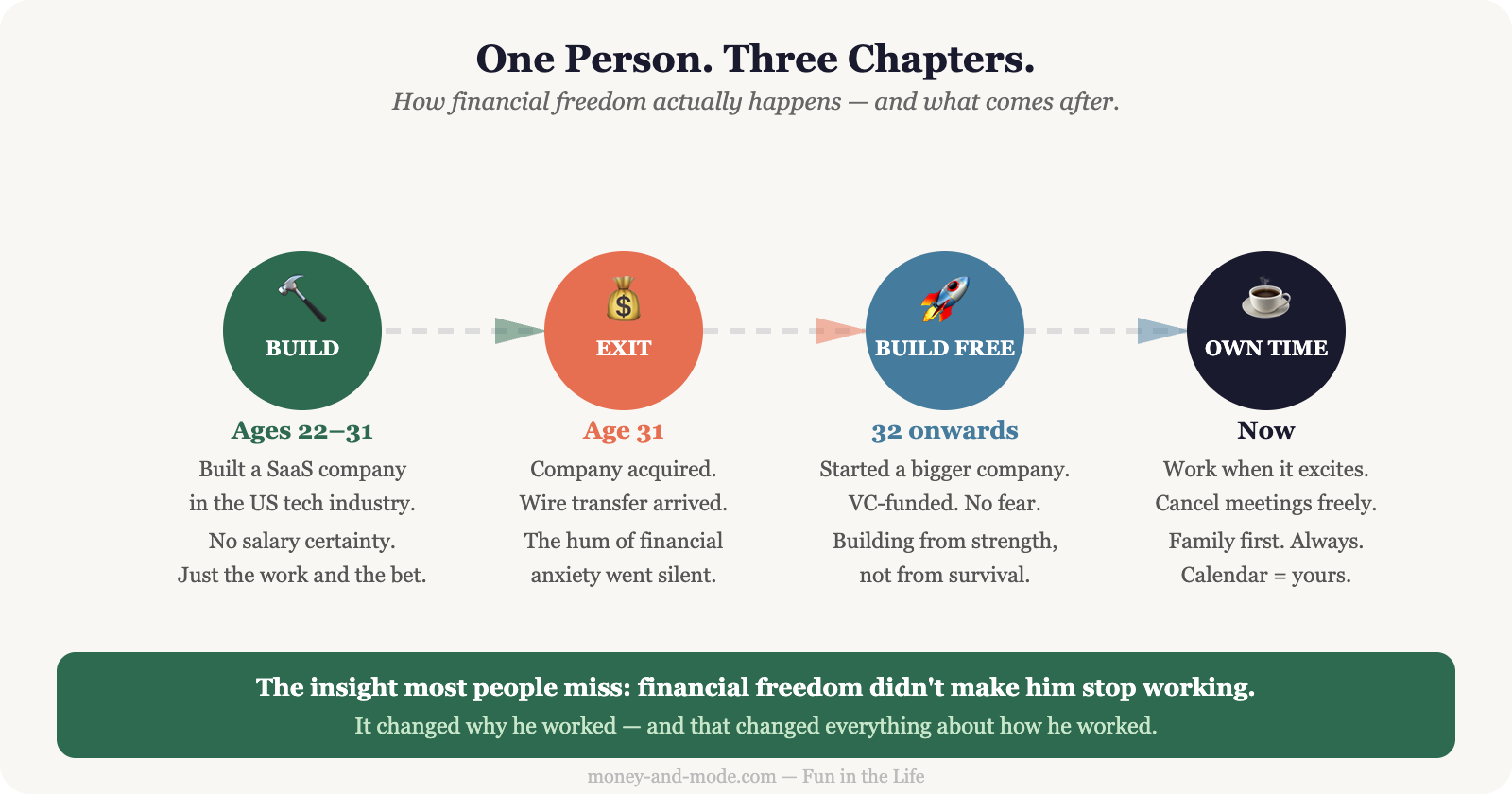
Most stories about financial freedom end at the exit. What people rarely tell you is what happens after — and why it turned out to be the most interesting part.
After the exit, I didn’t retire. I started a bigger company — VC-funded this time. But something fundamental had changed. I wasn’t building from fear anymore. I was building from strength. The difference between those two states is enormous.
When you build from fear — from the constant pressure of needing this to work, needing the revenue, needing the runway — every decision is subtly distorted. You take the meeting you shouldn’t take. You keep the client you should fire. Fear is a bad business partner.
When you build from strength — when your family’s security isn’t riding on any single outcome — you make different decisions. Clearer ones. You have the hard conversation on the first day instead of the sixth month.
What Financial Freedom Actually Changed
After the second company, I moved back to India. And there began the chapter I hadn’t planned for — and which turned out to be the most valuable thing I’d built.
I worked in bursts. When something genuinely interested me, I gave it everything. When it didn’t — or when I simply didn’t feel like working — I didn’t. Some mornings I would look at my calendar full of scheduled calls and cancel all of them. No elaborate explanation. No guilt.
Because we are not slaves to our calendars.
Think about what that would mean in your own life. How many meetings are you in right now that you did not choose? How much of your day is genuinely, freely yours? For most people in employment, the honest answer is: very little.
Two Paths to the Same Place
My path — building a company, selling it — is one path. It is not the only path. The other path is the savings and investment path: save a meaningful percentage of your income, invest it consistently in low-cost index funds, and let compounding do its work over a decade or two. Arrive at financial freedom without ever building or selling a company.
This path is slower. But it is more reliable, more accessible, and for many people — more suited to who they actually are.
The point is not which path you take. The point is that you start building toward financial freedom deliberately, rather than hoping it will somehow arrive on its own.
The next article in this series covers the single number that determines your financial future — your savings rate — and why it matters more than your income, your investment picks, or anything else.
Frequently Asked Questions
What does financial freedom actually feel like?
Not fireworks — a quiet. The hum of financial anxiety that had been running in the background for years simply went silent. The clearest sign was a thought that had never been available before: I don’t have to do anything today unless I want to.
Do you stop working once you are financially free?
Not necessarily. I did not retire — I started a bigger, VC-funded company. What changed was that I was building from strength instead of fear. When you build from fear, every decision is subtly distorted. You take the meeting you should not take. You keep the client you should fire.
Do you need to sell a company to become financially free?
No. The other path is savings and investment: save a meaningful percentage of your income, invest it consistently in low-cost index funds, and let compounding work over a decade or two. It is slower, but more reliable, more accessible, and for many people better suited to who they actually are.
What is the most important first step toward financial freedom?
Starting deliberately, rather than hoping it will somehow arrive on its own. Which path you take matters far less than the decision to build toward it — and the single number that determines your timeline is your savings rate.
What does financial freedom mean to you — not the money, but the life? What would you do differently on a Tuesday morning if you were free? Tell me in the comments.