
I run a technology company. I’ve been in the software business for 25 years. And I’ll tell you something that might surprise you: even I spent several months genuinely worried about where AI was headed.
Not for my company. For everyone.
I’ve watched software engineers joke — half-seriously — about replacing themselves with AI tools. I’ve seen companies lay off hundreds of people and cite AI as the reason. I’ve read the headlines about “white-collar bloodbaths” and “permanent unemployment.”
And then I did what I always do when something is noisy and confusing: I sat with it. I thought carefully. And I came to a view that I think is actually useful — one that goes beyond both the panic and the false reassurance.
Here it is.
The Honest Truth: Some Jobs Are Genuinely at Risk
Let’s not pretend otherwise.
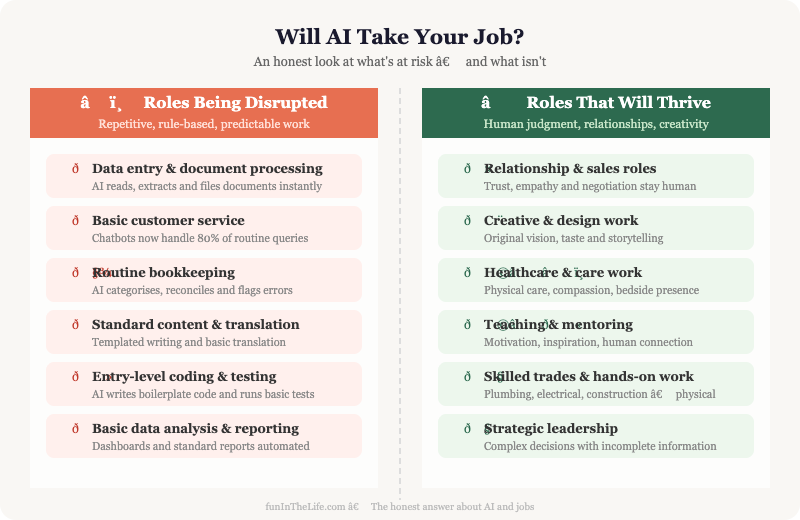
If your job involves doing the same thing repeatedly — processing the same type of document, answering the same type of question, generating the same type of report — AI can now do a version of that job faster and cheaper than a human. That’s real. It’s happening now, not in the future.
Jobs that face genuine disruption:
- Data entry and document processing
- Basic customer service and call centre work
- Routine accounting and bookkeeping
- Standard legal document review
- Entry-level content writing and translation
- Basic coding and software testing
If your work is mostly mechanical — applying a fixed set of rules to inputs that arrive in a predictable pattern — you should take this seriously.
But the Panic Is Also Wrong
Here’s what the headlines don’t tell you.
Every major technology wave in history — the printing press, electricity, the computer, the internet — was predicted to destroy jobs. And in every case, the same thing happened: old jobs disappeared, new jobs appeared, and the total amount of human work didn’t collapse.
The internet killed travel agents. It created social media managers, UX designers, and digital marketers — jobs that didn’t exist before.
AI will kill some jobs. It will create others. And right now, we’re in the middle of that messy transition — which is why it feels so alarming.
The tasks where AI performs best are components of jobs, not whole jobs. An investment banker doesn’t just analyse data — they also read the room in a meeting, build trust with a nervous CEO, make a judgement call when the numbers conflict. AI can do the data part. It can’t do the human part.
The Jobs That AI Cannot Touch
I want to be specific here, because vague reassurance doesn’t help anyone.
Jobs requiring physical presence and human touch: Caregiving, nursing, physiotherapy, teaching young children, plumbing, electrical work, cooking in a real kitchen. AI cannot hold someone’s hand. It cannot sense when a 7-year-old is frightened.
Jobs requiring complex human judgment in unpredictable situations: A surgeon making a decision mid-operation. A police officer calming a volatile situation. A manager sensing the real reason her team is underperforming.
Jobs requiring genuine relationships: Sales that depends on years of trust. Leadership that people actually follow. Therapy. Mentoring. Anything where the human being is the product.
Jobs requiring creativity with purpose: Great design, great storytelling, great music, great cooking — AI can assist and generate, but the vision, the taste, the why still comes from humans who have lived something.
The Real Question to Ask Yourself
Stop asking: “Will AI take my job?”
Start asking: “Which parts of my job could AI do better than me — and how do I shift my focus to the parts it can’t?”
Every job has both mechanical parts and human parts. AI is coming for the mechanical parts. Your job, over the next few years, is to figure out which parts of your work are irreplaceably human — and get better at those.
A lawyer who uses AI to review contracts in 10 minutes instead of 10 hours isn’t replaced. She now has 9 hours to do the high-value work: strategy, counsel, client relationships. The lawyer who refuses to use AI and still takes 10 hours to review contracts? That lawyer is in trouble — not because AI replaced her, but because she refused to adapt.
The threat isn’t AI. The threat is remaining static while the world moves.
What You Can Do Right Now
1. Start using AI today. Not to understand it academically. To actually use it. The people who are building AI literacy right now will have a real advantage in two years. It doesn’t take long to learn — a few weeks of daily use is enough to become comfortable.
2. Identify the human parts of your work. What do you do that requires your experience, your relationships, your judgment, your empathy? That’s your territory. Strengthen it.
3. Don’t wait for your industry to change — change first. The worst position to be in is waiting until your employer announces layoffs to start thinking about this. Start now, from a position of strength.
4. Stay curious, not panicked. Anxiety narrows your thinking. Curiosity expands it. The people who navigate this transition best will be the ones who stay open and keep learning.
A Personal Note
I’ve been in business long enough to have watched several waves of “this will change everything.” The internet. Mobile phones. Cloud computing. Each time, the change was real — and the people who panicked did worse than the people who adapted.
This is the biggest wave yet. I won’t pretend otherwise. But I’ve also learned something from decades of experience and a lot of hard reflection:
The deepest human qualities — wisdom, care, relationship, creativity, courage — don’t become less valuable when tools get smarter. They become more valuable. Because they’re rarer.
The question is not whether you’ll be replaced. The question is whether you’ll grow.
Frequently Asked Questions
Which jobs are genuinely at risk from AI?
Work that is mostly mechanical — applying a fixed set of rules to inputs arriving in a predictable pattern. That includes data entry and document processing, basic customer service and call centre work, routine accounting and bookkeeping, standard legal document review, entry-level content writing and translation, and basic coding and testing.
Which jobs can AI not touch?
Four kinds. Work needing physical presence and human touch, like caregiving, nursing, teaching young children or plumbing. Work needing complex judgment in unpredictable situations. Work built on genuine relationships and years of trust. And creativity with purpose, where the vision comes from someone who has actually lived something.
Is the panic about AI destroying jobs justified?
Only partly. Every major technology wave — the printing press, electricity, the computer, the internet — was predicted to destroy work. Each time, old jobs disappeared and new ones appeared. AI performs best on components of jobs, not whole jobs. We are in the messy middle of that transition, which is why it feels alarming.
What should I actually do about AI and my career?
Stop asking “will AI take my job?” and start asking which parts of your job AI could do better — then shift toward the parts it cannot. Start using AI now, identify the irreplaceably human parts of your work, change before your industry forces you to, and stay curious rather than panicked.
What’s your biggest concern about AI and your work? Leave a comment below — I read every one and try to respond personally.